Groggy Waking and Falls in Older Adults
A 2026 study of 392 adults aged 60 and over found that groggy waking stayed linked to two or more falls in a year after adjustment, and daytime sleepiness did not.
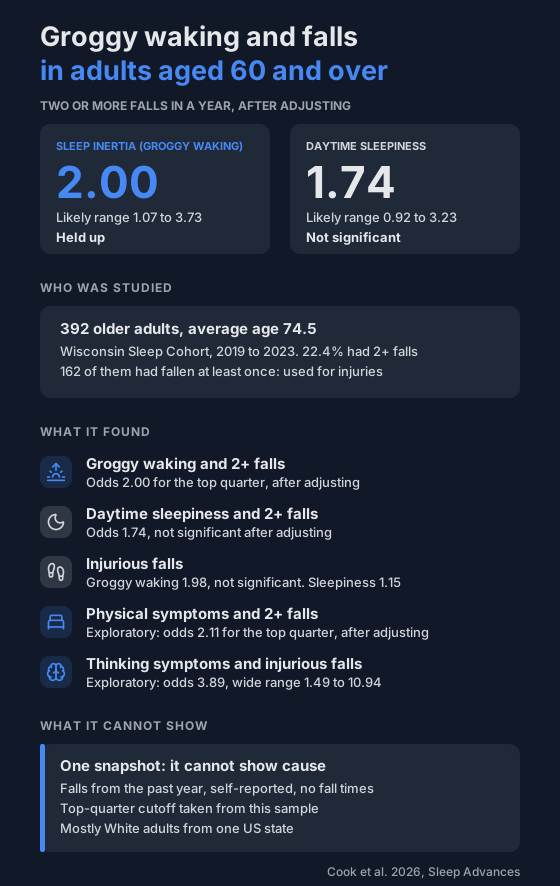
Earlier research on tiredness and falls has mostly looked at daytime sleepiness. A 2026 study asked about a different kind of tiredness: how groggy and slow you feel after waking up, called sleep inertia.
It compared the two against falls in older adults. Grogginess stayed linked to repeat falls after the authors adjusted for other factors, and daytime sleepiness did not.
Who was in the study?
- Adults aged 60 and over from the Wisconsin Sleep Cohort, a long-running US study of sleep. Data came from 2019 to 2023.
- The cohort first recruited state employees in the late 1980s and over-sampled people at higher risk of sleep apnea.
- 392 were included in the repeat falls analysis. Their average age was 74.5 and 55.1% were men.
- 96.2% were White, and their average BMI was 31.1.
- 33.2% reported a history of sleep apnea.
- No shift workers.
How did they measure it?
- Groggy waking. The Sleep Inertia Questionnaire, a 23-item questionnaire about a typical morning in the past week. There's no established cutoff for elevated grogginess, so the authors used this sample's top quarter of scores (above 37).
- Daytime sleepiness. The Epworth Sleepiness Scale, a widely used 8-item scale, scored 0 to 24. A score above 10 counted as excessive.
- Falls. Each person reported how many times they fell in the past year, and whether a fall caused an injury such as a bruise, cut, sprain or broken bone.
The injury analysis only included the 162 people who had fallen at least once. The two scores were weakly to moderately related (r = 0.30).
What did it find about repeat falls?
22.4% of the 392 had fallen two or more times in the past year. Odds ratios compare how likely something is in one group against another. Above 1 means more likely.
- Groggy waking. The top quarter of scores had 2.00 times the odds of two or more falls (likely range 1.07 to 3.73). That was after adjusting for age, sex, BMI, education, sleep duration, sleep apnea history, morning or evening preference, mood, anxiety, balance and memory concerns.
- Daytime sleepiness. Excessive sleepiness had 1.74 times the odds (likely range 0.92 to 3.23). That was not statistically significant after the same adjustment.
Before adjustment both were linked to repeat falls. With only age, sex, BMI and education adjusted, both still were. Only the grogginess link survived the full adjustment. The authors found the same when they scored each questionnaire as a continuous number, though the grogginess result was borderline (odds 1.04 per point, likely range 1.00 to 1.07).
What about falls that caused an injury?
Here the picture is less clear.
- Groggy waking was linked to injurious falls before adjustment (odds 2.42) and with only demographics adjusted (2.10).
- After full adjustment it was no longer statistically significant (1.98, likely range 0.82 to 4.91).
- Daytime sleepiness was not linked to injurious falls in any analysis (1.15 after full adjustment).
The authors note the grogginess odds barely changed across the models. They suggest the 162-person sample may simply have been too small once more factors were added. That is their explanation, not something the study tested.
They also had no firm reason for the sleepiness result. They offered a guess that sleepy people might be more careful or less active, and said more research is needed.
Which kind of grogginess mattered?
The questionnaire has four parts, and the authors looked at each one as an exploratory check.
- Physical symptoms (such as balance, coordination, heaviness) were linked to repeat falls after full adjustment. Top quarter odds 2.11 (likely range 1.16 to 3.84).
- Thinking symptoms (such as concentration and attention) were linked to injurious falls after full adjustment. Top quarter odds 3.89 (likely range 1.49 to 10.94).
- The emotional and response-to-grogginess parts showed no significant link.
Those were exploratory, and the injury group was small, so the 3.89 is a rough signal. The links didn't differ significantly by age or sex.
What doesn't it tell you?
- Cause. It's a cross-sectional study, one snapshot. Grogginess might raise fall risk, or both might come from something else, such as poor health or a sleep or mood problem.
- Timing. The data had no fall times, so it can't show falls happened soon after waking.
- Different time windows. The questionnaires covered a typical week or habitual sleepiness, while falls covered the past year.
- Self-report. Grogginess, sleepiness and falls were all self-reported at one visit, with no objective tests of grogginess.
- The cutoff. The 37-point cutoff was set from this sample's top quarter, so it may not apply elsewhere.
- Who took part. Mostly White adults from one US state.
- Fall counts. People picked a range (such as 3 to 4), so counts were split into fewer than two or two or more.
What can you do with this?
If you wake up groggy, slow or unsteady, mention it to your doctor, especially if you've had falls. It's worth knowing the study didn't test whether changing anything about mornings affects falls.
Overnight data can show what your night looked like. A recording shows your oxygen dips and pulse through the night, which you can take to that appointment. For tiredness during the day, see what goes with sleepiness in sleep apnea, and for the older-adult picture see sleep apnea in older adults.
Not a medical device. Does not diagnose, treat or prevent any condition. Discuss results and changes with a clinician.
References
- Cook JD, Barnet JH, Love JJ, Ravelo LA, Hayrynen AJ, Rasmuson A, Hagen EW, Peppard PE, Plante DT. Sleep inertia, daytime sleepiness, and falls in older adults of the Wisconsin Sleep Cohort. Sleep Advances. 2026;7(4):zpag106. doi:10.1093/sleepadvances/zpag106