Blue Light Glasses and Parkinson's Sleep
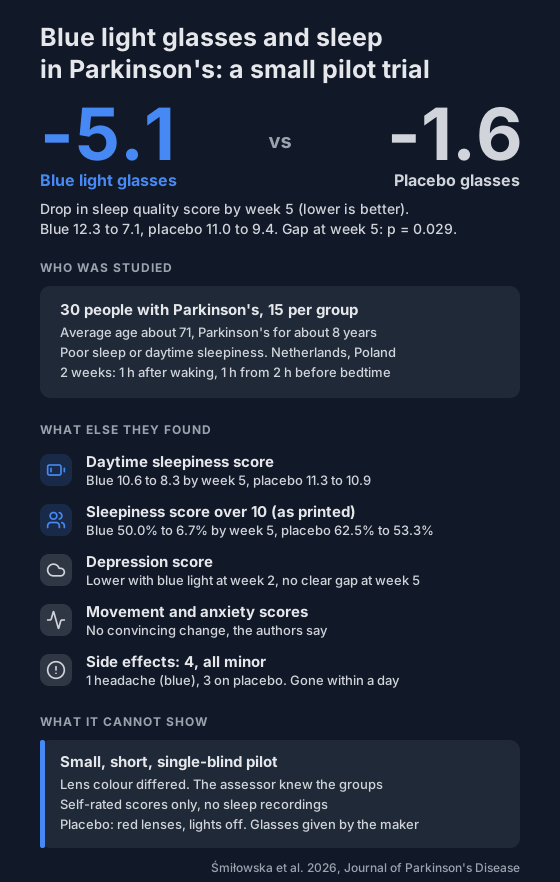
A 2026 pilot trial gave 30 people with Parkinson's blue light glasses or placebo glasses for 2 weeks. Sleep quality scores dropped 5.1 points with blue light and 1.6 with placebo by week 5.
Poor sleep and daytime sleepiness are common in Parkinson's disease. Light therapy with a bright light box has been tried before, with mixed results, and sitting in front of a box every day isn't easy.
A small trial published in 2026 tried glasses with blue LEDs built into the frame instead. Sleep quality scores went down further with the blue light glasses than with placebo glasses.
Who was in the study?
- 30 people with Parkinson's from clinics in the Netherlands and Poland, recruited between 2018 and 2023.
- Their average age was about 71, and they'd had Parkinson's for about 8 years.
- All had poor sleep quality or daytime sleepiness on standard checklists.
- People with known sleep apnea, eye disease, marked thinking and memory problems or sleep medication were left out.
What did they do?
- 15 people got glasses with blue LEDs switched on.
- 15 got identical glasses with red lenses and the LEDs off, as a placebo.
- Everyone wore them for 1 hour after waking and 1 hour starting 2 hours before bedtime, every day for 2 weeks.
- Sleep quality, daytime sleepiness, mood and movement were scored at the start, at 2 weeks and at 5 weeks.
The evening hour may sound odd, since evening blue light usually gets the blame for poor sleep. The authors based the twice-daily timing on earlier light box studies.
What did they find?
Lower sleep quality scores mean better sleep.
- Blue light glasses: 12.3 at the start, 7.9 at 2 weeks, 7.1 at 5 weeks.
- Placebo glasses: 11.0 at the start, 9.6 at 2 weeks, 9.4 at 5 weeks.
Both groups' scores went down. The blue light group's went down more, and the gap at 5 weeks was statistically significant (p = 0.029). At 2 weeks it wasn't quite (p = 0.065).
Daytime sleepiness scores also went down more with blue light:
- Blue light glasses: 10.6 at the start, 6.7 at 2 weeks, 8.3 at 5 weeks.
- Placebo glasses: 11.3, 10.1 and 10.9.
The paper reports that the share with a sleepiness score over 10 fell from 50.0% to 6.7% in the blue light group, against 62.5% to 53.3% on placebo (p = 0.005). Those percentages don't all work out as whole people in groups of 15, so take them as approximate.
Sleep diaries kept during the 2 weeks showed bigger gains in total sleep time, time to fall asleep and rated sleep quality in the blue light group than on placebo.
Did anything else change?
- Mood. Depression scores were lower with blue light at 2 weeks, but the gap was no longer significant at 5 weeks.
- Movement and anxiety. The authors saw no convincing change.
- Side effects. 4 in total, all minor: 1 headache with blue light, and a headache, dizziness and itchy eyes on placebo. Each cleared within a day.
What can't it show?
The authors list most of these themselves.
- Small and short. It's a pilot of 30 people over 5 weeks, meant to size a bigger trial.
- Single-blind. People weren't told what the lens colours meant, but they could see them. Nobody checked whether they guessed.
- Same assessor. One neurologist, who knew the groups, gave out the glasses and did every assessment.
- Self-rated sleep only. There were no sleep recordings or wrist trackers, so it can't show what happened to sleep itself.
- A month-long checklist. The sleep quality checklist asks about the past month, which fits poorly with changes over 2 to 5 weeks.
- Glasses from the maker. The study had no funding, and the company supplied the glasses free, though the authors say it had no role in the study.
What can you do with this?
If you have Parkinson's and sleep badly, tell your neurologist. One small pilot can't show whether the glasses help, and the authors call for larger, longer trials.
For how sleep tends to change with Parkinson's, see Parkinson's sleep changes over five years. For light in everyday life, read about daylight, evening light and sleep and a daytime light lamp trial in older adults.
Not a medical device. Does not diagnose, treat or prevent any condition. Discuss results and changes with a clinician.
References
- Śmiłowska K, de Vries NM, Bloem BR, van Wamelen DJ. Blue light therapy delivered through light glasses improves sleep quality and daytime sleepiness in Parkinson's disease: A randomized trial. Journal of Parkinson's Disease. 2026;16(6):1201-1210. doi:10.1177/1877718X261468544