Resistance Training and Oxygen: A Trial
A 2026 trial gave 60 adults aged 60 to 75 either 12 weeks of supervised resistance training or no exercise program. Breathing muscle strength rose more with training. The change in SpO2 over a 1-minute sit-to-stand test showed no statistically significant difference.
Muscle strength falls with age, and that includes the muscles you breathe with. The authors of this study say the effects of resistance training on breathing aren't fully understood.
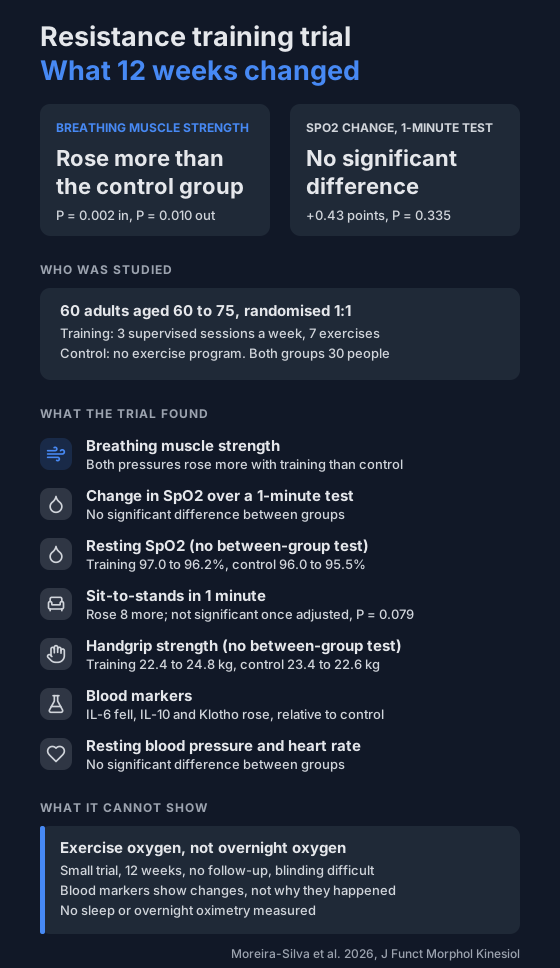
This Brazilian randomised trial, published in October 2026, measured breathing muscle strength and SpO2. After 12 weeks of supervised resistance training, breathing muscle strength rose more than in a group with no exercise program. The SpO2 change over a 1-minute exercise test showed no statistically significant difference between the groups.
This is oxygen during exercise, not overnight oxygen. The trial did not measure sleep.
Who was in the trial?
- 60 community-dwelling adults aged 60 to 75, recruited through social media and a university program for older adults.
- Random split into 30 who trained and 30 with no exercise program.
- None reported regular structured exercise in the previous 6 months.
- Average age 67.7 in the training group and 69.5 in the control group.
- 21 women and 9 men trained, and 20 women and 10 men were controls.
What did the training involve?
- 3 supervised sessions a week for 12 weeks, about 60 minutes each.
- 7 exercises: lat pulldown, machine chest press, lateral shoulder raise, biceps curl, triceps pushdown, leg extension and leg curl.
- 4 sets of 8 to 15 repetitions, starting at about 65% of the most the person could lift once.
- Loads went up by 2% to 10% when the repetitions were completed in two sessions in a row.
What happened to breathing muscle strength?
This was the main measure the trial was sized for. It was tested with a mouth-pressure device, in cmH2O, using the best of three attempts.
- The training group's maximum breathing-in pressure rose more than the control group's (P = 0.002).
- The same held for breathing out (P = 0.010).
- The paper shows the average pressures in charts and does not give them in the text.
The authors note that these exercises don't target the diaphragm directly. They suggest that stronger muscles overall and better nerve activation may explain it, and they did not test that.
What happened to SpO2?
SpO2 was measured by pulse oximeter before and after a 1-minute sit-to-stand test.
- The change in SpO2 differed by +0.43 percentage points between the groups (95% CI -0.45 to 1.30, P = 0.335).
- That is no statistically significant difference.
- The trial was sized for breathing muscle strength, and the authors say its size may have limited its ability to pick up smaller differences.
- The abstract describes training as lessening the drop in oxygen during exercise, but the results section reports no significant difference.
- Resting SpO2 was 97.0% before and 96.2% after in the training group, and 96.0% before and 95.5% after in the control group.
- The paper's table marks the training group's fall as significant within that group (P = 0.006), but the confidence interval printed beside it (-1.33 to 0.24) crosses zero.
- The paper doesn't give a between-group test for resting SpO2.
What about the other results?
- Sit-to-stand test. The training group's 1-minute count rose by 8.0 repetitions more than the control group's in the planned analysis (95% CI 2.2 to 13.9, P = 0.008). The training group started lower, and after adjusting for that the difference was 4.7 repetitions (95% CI -0.6 to 10.0, P = 0.079), not statistically significant.
- Handgrip. The training group went from 22.4 to 24.8 kg and the control group from 23.4 to 22.6 kg. The paper gives within-group tests only (training P = 0.001, control P = 0.170), with no between-group test.
- Blood markers. Relative to the control group, IL-6 (an inflammation marker) fell, and IL-10 (an anti-inflammatory signal) and Klotho (a protein the authors link to aging) rose. TNF-α, another inflammation marker, showed no statistically significant difference between groups (P = 0.057).
- No statistically significant difference between groups. Blood cell counts, hemoglobin, resting blood pressure, resting heart rate, body weight, BMI, body fat, waist size and muscle mass index.
What can't it tell you?
- Overnight oxygen. No sleep study or overnight oximetry was done.
- What's behind the blood marker changes. They are blood levels at two time points, and the authors say they can't establish the mechanism.
- Long-term effects. The trial lasted 12 weeks with no follow-up.
- Who it applies to. It was small, run at one Brazilian university, and the authors call for larger and more varied groups.
- Blinding. The authors note it is hard to blind people or supervisors in an exercise trial.
- Body composition. It was estimated with an impedance scale and body measurements rather than a scan.
- Missing data. The paper reports no dropouts, but its statistics imply fewer than 60 people in some analyses, such as about 54 for the sit-to-stand test.
- Conflicts. The authors declare none. Grants came from Brazilian research funders, and some team members held fellowships paid by companies. The paper says the funders and fellowship provider Attivos Magistrais/Pholias had no role in the study.
What can you do with this?
The study shows what happened in one supervised program in 60 people. It doesn't show what would happen to your SpO2.
If you do a strength program, a fingertip oximeter can show your own SpO2 and pulse before and after a session. Compare like with like: same test, same finger, same resting time beforehand.
For a related trial in people with sleep apnea, see strength training and sleep apnea. For breathing muscle strength and overnight oxygen, see hypoxic burden and breathing muscle strength.
Not a medical device. Does not diagnose, treat or prevent any condition. Discuss results and changes with a clinician.
References
- Moreira-Silva NN, Moura-Maia MS, Silva-Reis A, Silva-Cardoso KR, Silva-Sousa E, Carrijo-Nascimento M, Paixão-Santos G, Veiga-Celestino R, Paula-Vieira RHR, Chiappa GR, Bachi ALL, Albertini R, Papakonstantinou E, Stolz D, et al. Resistance Training Improves Respiratory Muscle Strength and Immune Response in Older Adults: A Randomized Clinical Trial. Journal of Functional Morphology and Kinesiology. 2026;11(4):434. doi:10.3390/jfmk11040434