Altitude Camp Sleep and SpO2 in Swimmers
Seven world-class swimmers spent 21 days at 2,320 m. Self-rated sleep difficulty went up in week 1 and eased after, morning SpO2 rose from 93.6% to 95.7% and resting heart rate fell from 62 to 56 bpm.
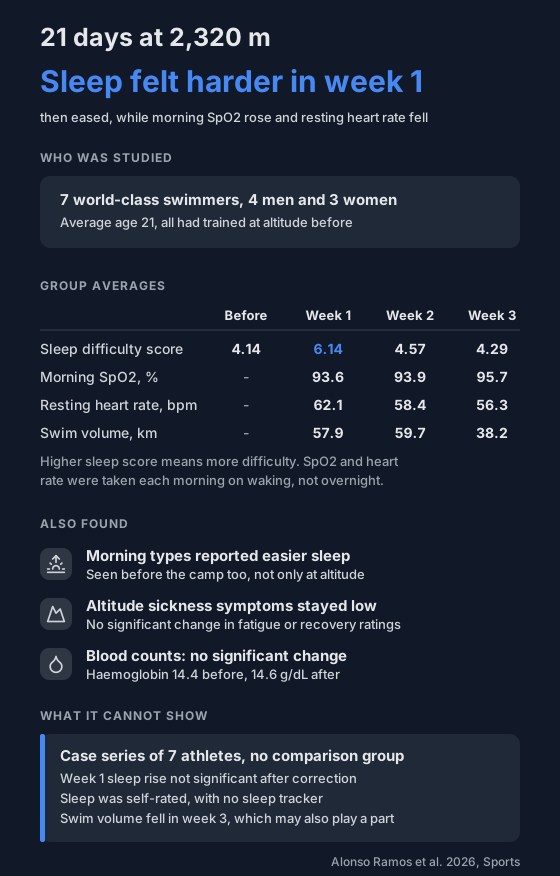
Elite swimmers go to altitude camps every year, and sleeping badly in the first few nights is a common complaint. A study published in October 2026 followed seven world-class swimmers through a 21-day camp at 2,320 m in the Sierra Nevada, Spain.
Self-rated sleep difficulty went up in week 1 and then eased back. Morning SpO2 went up and resting heart rate went down by week 3.
It's a very small case series with no comparison group, and the authors call it exploratory.
Who was studied?
- 7 swimmers from one Spanish club, 4 men and 3 women, average age 21.
- All were at world-class level and had been to at least one altitude camp in the previous two seasons.
- They kept their usual training and medical care. The researchers didn't change anything.
What was measured?
- Sleep difficulty: a short athlete sleep checklist, filled in for the week before the camp, at the end of each week at altitude, and in the week back at sea level. Higher scores mean more difficulty.
- SpO2 and resting heart rate: every morning on waking, lying down, with a fingertip oximeter and a chest strap. These were spot readings, not overnight recordings.
- How they felt: altitude sickness symptoms, fatigue, recovery and hydration, every morning.
- Training load: swim distance and how hard each session felt.
- Blood counts: haemoglobin, haematocrit and iron, 3 days before and the day after the camp.
- Chronotype: whether each swimmer was more of a morning or an evening type.
What happened to sleep?
- Before the camp the average sleep difficulty score was 4.14.
- In week 1 at altitude it went up to 6.14.
- It came back to 4.57 in week 2 and 4.29 in week 3.
The change across all time points was statistically significant. But none of the individual week 1 comparisons stayed significant once the authors corrected for running several tests. So read the week 1 rise as a pattern, not a proven effect.
For what happens to breathing in the first nights up high, see oxygen dips in the first nights at altitude.
What happened to SpO2 and heart rate?
Weekly averages of the morning readings:
- SpO2: 93.6% in week 1, 93.9% in week 2, 95.7% in week 3.
- Resting heart rate: 62.1, 58.4 and 56.3 beats per minute.
Week 3 SpO2 was significantly higher than weeks 1 and 2. Week 3 heart rate was significantly lower than week 1, but not week 2. The authors say every swimmer followed the same general pattern.
Weekly swim volume also dropped, from about 60 km in week 2 to 38 km in week 3. Training and altitude weren't varied separately and there was no sea-level group, so the authors can't say how much of the change was the altitude and how much was the lighter training.
For more on how these numbers shift over weeks up high, see heart rate and SpO2 at altitude.
Did morning or evening types sleep differently?
- Swimmers who leaned towards mornings reported less sleep difficulty, before the camp and in week 1.
- The link was strong in size, but didn't pass the authors' correction for multiple tests.
- In weeks 2 and 3 and after the camp it was weaker.
Because it showed up before the camp too, the authors think it's more about the person than the altitude. One idea they offer: staff woke everyone at a fixed time, so evening types who went to bed later got less sleep. They didn't record the swimmers' usual sleep and wake times, so that's a guess.
What else did they find?
- Altitude sickness symptoms stayed low throughout.
- Fatigue, recovery and hydration scores showed no statistically significant change.
- Blood counts showed no statistically significant change. Haemoglobin was 14.4 g/dL before and 14.6 after.
The authors say the blood result doesn't mean nothing changed. They didn't measure haemoglobin mass or other more sensitive markers of blood changes at altitude.
What can't it show?
- Seven people. The authors call the results exploratory and hypothesis-generating.
- No comparison group. Nobody stayed at sea level on the same training plan.
- Self-rated sleep. No tracker or sleep lab, so no sleep time, efficiency or wake-ups, and answers are open to reporting bias.
- Recalled baseline. The "before" sleep score was filled in on arrival, from memory of the week before, which may already have been affected by the coming camp.
- Men and women pooled. Too few to test for differences between them.
- Morning spot readings only. No one recorded overnight oxygen.
- Elite athletes used to altitude. A first-time visitor might respond quite differently.
What can you do with this?
If you're heading to altitude, in this group self-rated sleep was hardest in week 1 and eased by week 2.
You can watch your own numbers change over a trip. These swimmers took one reading each morning on waking, lying down, the same way every day. An overnight recording adds what the study didn't measure: how your oxygen behaves while you sleep. Blood oxygen at altitude covers what to expect and how to track it.
If you feel unwell at altitude, see a doctor.
Not a medical device. Does not diagnose, treat or prevent any condition. Discuss results and changes with a clinician.
References
- Alonso Ramos JF, Del Castillo JA, López-Hernández A, González-Ravé JM. Sleep, Chronotype and Physiological Acclimatisation During a 21-Day Altitude Training Camp in World-Class Swimmers. Sports. 2026;14(10):449. doi:10.3390/sports14100449