Snoring and Jaw Muscle Pain: A 2026 Study
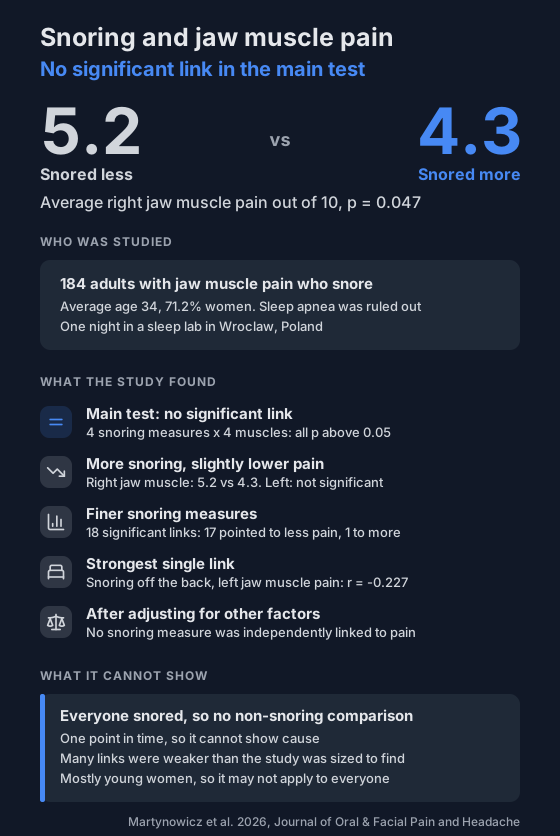
A 2026 sleep lab study of 184 adults who snore, have jaw muscle pain and don't have sleep apnea found no statistically significant link between the main snoring measures and pain. Where a link showed up, more snoring went with slightly lower pain.
Sleep apnea has been linked to jaw pain in earlier research. So you might expect plain snoring, without sleep apnea, to go with sorer jaw muscles too.
A study published in 2026 measured it in a sleep lab and didn't find that. The main snoring measures had no statistically significant link with jaw muscle pain. Where a link did show up, more snoring went with slightly lower pain, not higher.
Who was in the study?
- 184 adults from a jaw pain clinic at Wroclaw Medical University in Poland, recruited between 2017 and 2022.
- Their average age was 34, and 71.2% were women.
- All of them had muscle-type jaw pain (the paper calls it myogenous temporomandibular disorder), signs of teeth grinding, and reported snoring.
- People with sleep apnea, or more than 5 breathing events per hour on the sleep study, were left out.
- People on painkillers were left out too.
So this is a study of snorers only. There was no group of people who don't snore. It is a cross-sectional study, and the paper says this is an extra analysis of data first collected for a different study.
What was measured?
- Snoring. One night in a sleep lab with a microphone and a nasal pressure sensor. The four main measures were a snore index, a snore train percentage (a snore train is a run of back-to-back snores), the number of snore trains per hour, and the average sound level.
- Pain. Within 30 days before the sleep night, a dentist pressed on four chewing muscles and each person rated the pain from 0 to 10. The muscles were the masseter, at the angle of the jaw, and the temporalis, at the temple, on each side.
What did it find?
The main test found nothing.
- None of the four main snoring measures had a statistically significant link with pain in any of the four muscles.
- Every one of those correlations pointed the same way, towards less pain with more snoring, but all were weak (between -0.014 and -0.160).
Splitting the group in half found a small gap on the right side.
- The half with a lower snore index rated right masseter pain at 5.2 out of 10 on average.
- The half with a higher snore index rated it at 4.3 (p = 0.047).
- The paper's measure of masseter pain on both sides was also lower in the higher half (0.913 against 0.783, p = 0.014).
- There was no statistically significant difference for the left masseter or for either temporalis muscle.
- Splitting by snore train percentage gave a similar result: 5.2 against 4.2 for the right masseter (p = 0.025) and 5.6 against 4.7 for the right temporalis (p = 0.032).
- Splitting by snore trains per hour gave 5.2 against 4.3 for the right masseter. The paper's text gives p = 0.050 for this, and its table marks it as not significant.
- Splitting in half by average sound level showed no statistically significant difference in any muscle.
- Splitting into quarters gave seven statistically significant gaps, counted from the paper's table. All were in the right masseter, the right temporalis or the both-sides masseter measure, and all had lower pain in a group that snored more.
After adjusting for other factors, nothing stood out.
- A model of right masseter pain, run on 123 of the participants, included BMI and the four snoring measures. None was independently linked to pain.
- The paper says teeth grinding was in that model as well, but its results table doesn't list it.
Did sleep position or sleep stage matter?
The authors also broke snoring down by body position, sleep stage and loudness.
- 18 of those finer correlations were statistically significant.
- All but one pointed to less pain with more snoring.
- The strongest was between the snore index when not lying on the back and left masseter pain (r = -0.227, p = 0.005).
- Snoring during REM sleep when not on the back was linked to pain at three of the four muscle sites.
All of these are weak links. The authors say the reason for the pattern is unknown.
For how position shows up in your own recordings, see back vs side sleeping.
What doesn't it tell you?
The authors list these limits:
- Cause. Everything was measured at one point in time, so it can't show that snoring changes pain or the other way round.
- Weak links. The study was sized to pick up correlations of 0.205 or stronger, and many of the ones it reports are weaker than that.
- One night. There was no practice night in the lab, and a first night there can change how people sleep.
- Who it applies to. The group was mostly young, healthy women. Men and women weren't analysed separately.
- Pain detail. How long people had been in pain, and how often, wasn't recorded.
Three more things we noticed:
- The paper's conclusion says snorers had lower pain than non-snorers. Everyone in the study snored, so the data only compare people who snored more with people who snored less.
- The authors ran a large number of comparisons. With that many, some will come out statistically significant by chance.
- The paper's summary says the links were mainly on the left side, and its discussion says the right. The tables show both: the left masseter had the most significant correlations (8 of the 18), and the group comparisons were significant on the right.
The study was funded by Wroclaw Medical University. The authors declare no conflict of interest. One author sits on the journal's editorial board, and the paper says he had no part in its peer review.
What can you do with this?
These are our suggestions, not the study's findings.
- If your jaw muscles hurt, see a dentist or doctor. This study didn't find that more snoring went with more jaw muscle pain.
- Snoring on its own isn't sleep apnea. For the signs that set them apart, read snoring vs sleep apnea.
- Do you grind your teeth too? See teeth grinding and overnight oxygen.
- An overnight oximeter doesn't record snoring or jaw pain. It records your oxygen and pulse, and you can share that with your doctor.
Not a medical device. Does not diagnose, treat or prevent any condition. Discuss results and changes with a clinician.
References
- Martynowicz H, Bort M, Nowacki D, Frosztega W, Przegralek J, Nowak J, Madziarska K, Wieckiewicz M. Association of simple snoring and myogenous temporomandibular disorders based on polysomnographic examination. Journal of Oral & Facial Pain and Headache. 2026;40(2):1-13. doi:10.22514/jofph.2026.017