Teeth Grinding and Overnight Oxygen: A Study
A small 2026 sleep lab study compared 45 adults who grind their teeth in their sleep with 45 who don't. Average and lowest overnight oxygen were almost identical, and the highest reading was 0.33 points lower in the grinding group.
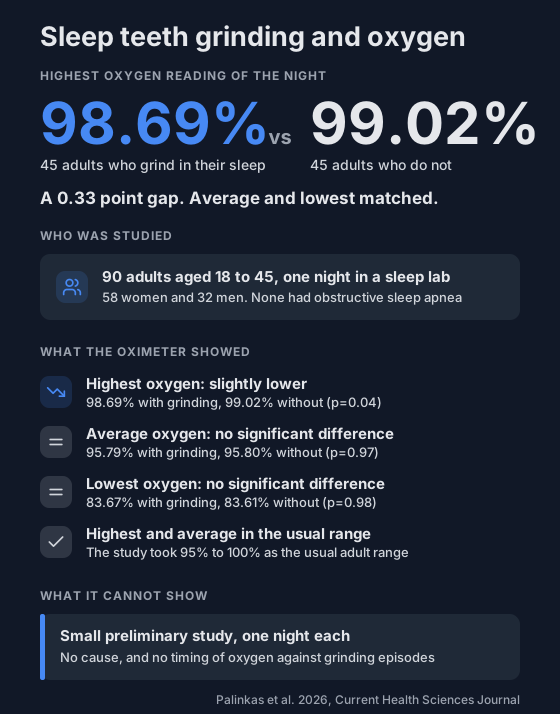
Does grinding your teeth in your sleep show up in your overnight oxygen? A small study published in 2026 looked at that.
Average and lowest oxygen were almost identical with or without grinding. Only the highest reading of the night differed, by 0.33 points.
Who was in the study?
- 90 adults aged 18 to 45, picked from 580 people at a dental school in Brazil.
- 45 had sleep bruxism, the name for grinding or clenching your teeth while asleep. 45 did not.
- Each group had 29 women and 16 men, matched for age, weight and height.
- Nobody had obstructive sleep apnea, a jaw joint disorder or a neurological movement disorder.
What was measured?
Everyone spent one night in a sleep lab. Sensors on the jaw muscles counted grinding episodes, and fewer than 2 an hour counted as no bruxism.
A pulse oximeter recorded SpO2 all night. The researchers compared three numbers: the lowest, the average and the highest reading.
What did it find?
| Reading | Grinding group | Comparison group | p-value |
|---|---|---|---|
| Highest | 98.69% | 99.02% | 0.04 |
| Average | 95.79% | 95.80% | 0.97 |
| Lowest | 83.67% | 83.61% | 0.98 |
- Only the highest reading showed a statistically significant difference.
- The authors call the gap small and say to read it with caution.
- The study took 95% to 100% as the usual adult range. Both groups' average and highest readings sat inside it.
- The lowest readings varied a lot from person to person in both groups.
The authors suggest brief arousals during grinding could change breathing, but didn't test that. They also note an earlier study that found no link between grinding and oxygen dips.
What doesn't it tell you?
- Cause. It's a cross-sectional study, a one-night snapshot. It shows what went together, not what caused what.
- Timing. Nobody checked whether oxygen changed at the moment of a grinding episode.
- Everyone. It was 90 adults under 46 from one centre. The authors call it preliminary and ask for larger studies.
- Dips. It didn't count oxygen dips per hour or time spent at low oxygen.
What can you do with this?
In this study, average and lowest overnight oxygen were almost identical with or without grinding. It didn't count dips, so it can't tell you whether grinding explains dips in your own recordings.
To check your own numbers, see how to read your O2Ring report.
If you also snore loudly or wake up gasping, take the sleep apnea risk check and talk to a doctor. Jaw pain or worn teeth are a question for your dentist.
Not a medical device. Does not diagnose, treat or prevent any condition. Discuss results and changes with a clinician.
References
- Palinkas M, Siéssere S, Regalo SCH. Observational Assessment of the Effect of Sleep Bruxism on Oxyhaemoglobin Saturation: A Preliminary Study. Current Health Sciences Journal. 2026;52(2):271-276. doi:10.12865/CHSJ.52.02.271. PubMed 42763683