Smoking, Vaping and Sleep on Wrist Trackers
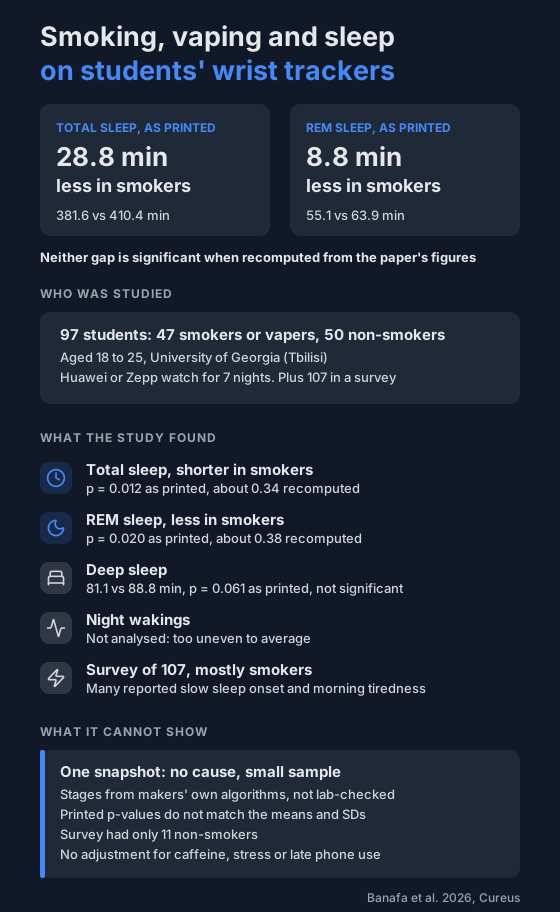
A 2026 study of 97 students reported that smokers and vapers logged about 29 minutes less sleep and 9 minutes less REM a night on consumer smartwatches, but its printed p-values cannot be reproduced from its own figures.
Smoking and vaping are often linked to poorer sleep. Most evidence comes from sleep labs or questionnaires.
A 2026 study from Georgia (the country) asked a simpler question: do smokers and vapers look different on the sleep readouts of a consumer smartwatch? On paper, they did. But the paper's numbers don't add up cleanly, so read it as a weak signal.
For a different study on smoking and REM sleep, see smoking and REM sleep.
Who was studied?
- 97 full-time university students aged 18 to 25 at the University of Georgia in Tbilisi.
- 47 current cigarette or e-cigarette users and 50 non-smokers, who had not smoked for at least a year.
- People using sleep-affecting medicines or illicit drugs, drinking alcohol, working night shifts or reporting a sleep disorder were left out.
- Each wore a Huawei or Zepp smartwatch on the non-dominant wrist for 7 nights.
- Recruitment was by convenience sampling: emails, posters and class announcements.
Separately, 107 students from about 20 universities filled in an online survey. They were different people, and 96 of them were smokers or vapers and only 11 were not.
What did the watches show?
Averages per night, smokers against non-smokers, as printed in the paper:
- Total sleep: 381.6 against 410.4 minutes, a 28.8-minute gap (p = 0.012).
- REM sleep: 55.1 against 63.9 minutes, an 8.8-minute gap (p = 0.020).
- Deep sleep: 81.1 against 88.8 minutes, a 7.7-minute gap that was not statistically significant (p = 0.061).
- Night wakings: not compared. The authors say they were too uneven to average.
The study doesn't report whether cigarettes or vapes made a difference, or how much people smoked.
What did the survey say?
- 68% of the 107 said they smoked within 2 hours of bedtime, and 34% within 30 minutes.
- 66% reported taking longer to fall asleep, 61% restless or light sleep, and 48% waking in the night.
- 71% reported morning fatigue.
These are self-reports from a group that was almost all smokers, with no comparison group of any size.
Do the numbers hold together?
Not fully, and this matters for how much weight to give it.
- The p-values don't match the averages. Using the printed means, standard deviations and group sizes, a standard t-test gives p of about 0.34 for total sleep, 0.38 for REM and 0.48 for deep sleep, not the printed 0.012, 0.020 and 0.061. The printed confidence intervals are also much narrower than those figures allow.
- The spread is very wide. The standard deviations for total sleep are 134 and 163 minutes on averages near 400. That is hard to square with weekly averages from seven nights.
- The abstract's deep sleep line is garbled. It reads "81.10 vs. 60.79 minutes vs. 88.78 vs. 45.89 minutes", which mixes the averages with the standard deviations from the table.
- Night wakings are inconsistent. The abstract lists them as measured, the results say they weren't analysed, and the discussion says there was no significant difference.
- Survey counts don't fit. 96 people reported smoking, yet the cigarette, e-cigarette and both groups add up to 107, and so do the daily, weekly and occasional groups.
- Age range. The survey ranged from 18 to 28, though 18 to 25 was an inclusion rule.
We can't tell which figures are wrong. The direction fits earlier research on smoking and sleep, but the exact gaps and their significance can't be relied on.
The abstract and conclusion also go further than the design allows. They say smoking "may cause" poorer sleep and call the results "objective proof", while the limitations section says a cross-sectional study can't show cause.
What can't it show?
- Cause. It's a cross-sectional comparison. The authors say it can't show whether smoking changed sleep, or whether other factors did.
- Stage accuracy. The watches use manufacturers' own algorithms, and the paper gives no check of them against a sleep lab. A 2026 review of smartwatch testing found over 90% agreement with a sleep lab on asleep or awake, but 50-86% on sleep stages. See how valid smartwatch numbers are.
- Mixed devices. Two brands were used and the paper doesn't say how many students wore each.
- Other factors. Age, sex, caffeine, activity, stress and phone or device use before bed were listed as possible confounders but not adjusted for. The only test was a simple comparison of two groups.
- Volunteers. A convenience sample of young students at one university.
- The survey. It wasn't piloted or validated, and it had almost no non-smokers.
What can you do with this?
If you wear a tracker, read its sleep-stage numbers as rough, and watch your own trend over weeks, not a single night. A tracker's REM and deep sleep figures are estimates.
A finger oximeter records overnight oxygen and pulse rate rather than estimating sleep stages. You can open a recording in the session viewer.
If sleep, tiredness or smoking worry you, discuss them with your doctor.
Not a medical device. Does not diagnose, treat or prevent any condition. Discuss results and changes with a clinician.
References
- Banafa AF, Ayub A, Banafa AF, Jaber M, Ansari SM, Khalid A, Mozafari P, Kadri TA, Anchan YP, Qasem W, Gogichadze M. Effects of smoking on the sleep-wakefulness cycle: actigraphic research among university students. Cureus. 2026;18(8):e115079. doi:10.7759/cureus.115079