Smoking and REM Sleep: A 2026 Study
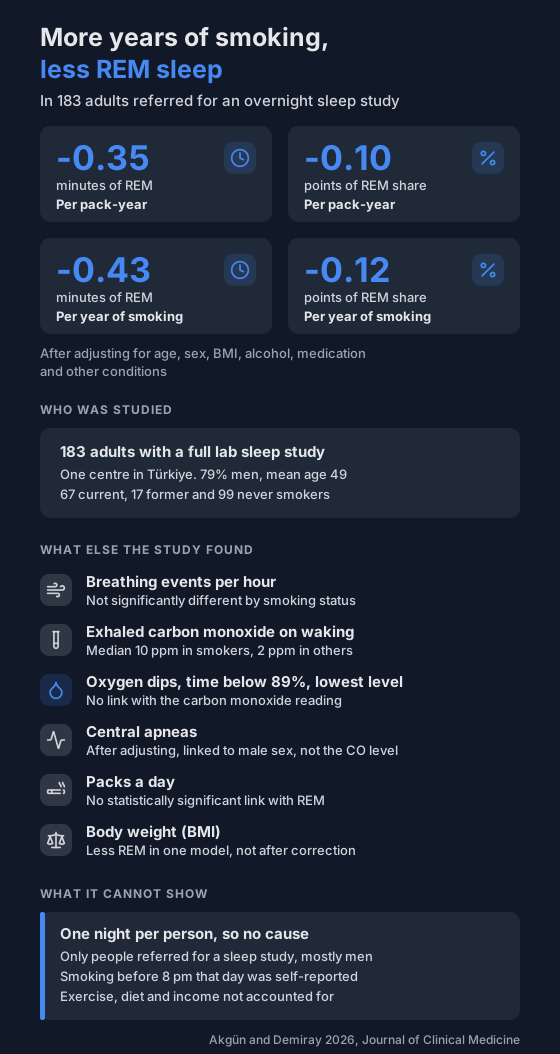
In 183 adults referred for a sleep study, more pack-years and more years of smoking went with less REM sleep. Smoking was not linked with breathing events per hour.
Smoking is often listed as a risk factor for sleep apnea. Many studies on it rely on what people say they smoke.
A study from Türkiye, published in July 2026, added an objective measure: exhaled carbon monoxide, taken on waking after a lab sleep study. Smoking history didn't line up with breathing events. It did line up with less REM sleep, the dreaming stage.
Who was studied?
- 183 adults referred to one sleep unit with suspected sleep apnea, between October 2025 and February 2026.
- Mean age 49, and 79% were men.
- 67 smoked, 17 had quit and 99 had never smoked.
- People with asthma, COPD, bronchiectasis or lung cancer, and anyone already on CPAP, were left out.
- Everyone had a full overnight sleep study in the lab, with brain waves, breathing and oxygen recorded.
- Within 10 minutes of waking, they blew into a carbon monoxide meter.
Smoking was banned from 8 pm, when they arrived, and video cameras checked it overnight. In smokers, the median morning reading was 10 ppm. In never and former smokers it was 2 ppm.
What did it find about REM sleep?
The authors looked at smoking in two ways: carbon monoxide that morning, and smoking history over the years.
- The morning carbon monoxide reading showed no link with REM sleep.
- Packs a day showed no statistically significant link either.
- Pack-years (packs a day times years smoked): each extra pack-year went with 0.35 minutes less REM, and a REM share of total sleep 0.10 percentage points lower.
- Years of smoking: each extra year went with 0.43 minutes less REM, and a REM share 0.12 points lower.
Those last two held after adjusting for age, sex, BMI, alcohol, sleeping pills or antidepressants, high blood pressure, diabetes and heart disease. They also held after a stricter test for running several comparisons at once.
The paper doesn't report how much REM people got on average, so it's hard to say how big these changes are on a typical night. The unadjusted links were weak, with correlations of about -0.16 to -0.18.
What about breathing and oxygen?
- Breathing events per hour weren't significantly different between current, former and never smokers.
- The carbon monoxide reading wasn't linked with breathing events per hour, in or out of REM sleep.
- It wasn't linked with oxygen either: the oxygen desaturation index, time below 89% or the lowest oxygen level.
- Current smokers had fewer central apneas, the pauses where the brain doesn't send the signal to breathe, and higher carbon monoxide readings went with fewer of them. After adjusting, the carbon monoxide link went away and being male was the only factor tied to central apneas.
- Higher BMI went with less REM in one model, but it didn't pass the stricter test.
What can't it show?
- Cause. It's a cross-section: one night per person. It shows what went together, not what caused what. The authors say so.
- Everyone. Everyone was referred with suspected sleep apnea, and only 6.55% had no sleep apnea on the study. Most were men, from one centre.
- Daytime smoking. The ban from 8 pm was checked. Smoking earlier that day was self-reported, and the authors say many smokers likely didn't stick to it.
- Lifestyle. Exercise, diet and income weren't accounted for.
The authors reported no conflicts of interest.
What can you do with this?
A pulse oximeter doesn't measure sleep stages, so it can't show your REM sleep. It records oxygen and pulse. In this study, the oxygen measures weren't linked with the morning carbon monoxide reading.
If you smoke and track your nights, note it alongside other things like alcohol, and compare averages over several nights. Separately from this study, carbon monoxide can make a fingertip oximeter read higher than it should; see a 98% reading with carbon monoxide poisoning.
If you're wondering whether your sleep is worth looking into, the sleep apnea risk check takes about a minute. If you want help cutting down or quitting, talk to your doctor.
Not a medical device. Does not diagnose, treat or prevent any condition. Discuss results and changes with a clinician.
References
- Akgün KB, Demiray DY. Association of Cumulative Smoking Exposure with REM Sleep Alterations in Obstructive Sleep Apnea: A Cross-Sectional Study Supported by Exhaled Carbon Monoxide Measurement. Journal of Clinical Medicine. 2026;15(13):5301. doi:10.3390/jcm15135301