Carbon Monoxide and a 98% Oximeter Reading
A 2026 case report describes two people with carbon monoxide poisoning whose pulse oximeters read 98%. Blood tests showed carbon monoxide on 33% and 24.1% of their hemoglobin.
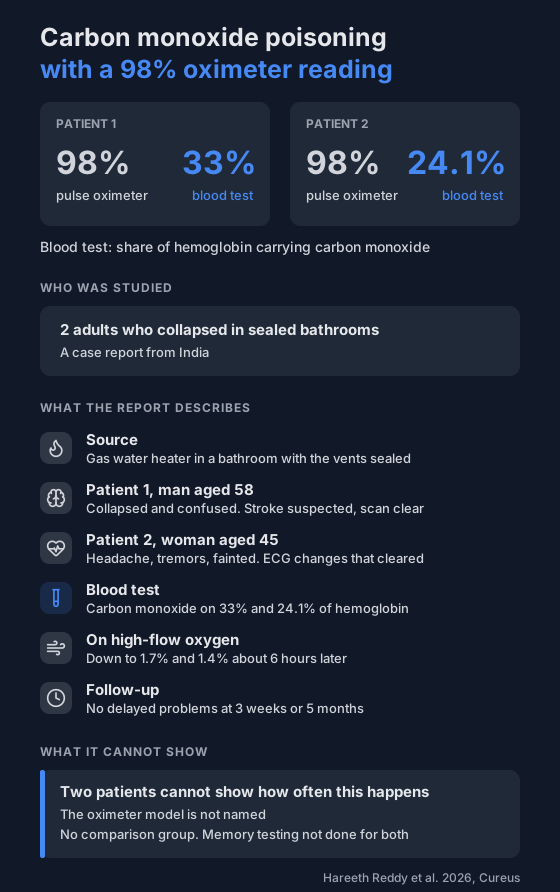
A reading of 98% on a pulse oximeter looks like good news. A case report published in May 2026 describes two people who had that reading while poisoned by carbon monoxide.
It's two patients, so it proves very little on its own. It does show a known blind spot in how oximeters work.
Who were the patients?
Both collapsed in a bathroom with a gas water heater. The report says the vents had been sealed.
- Patient 1: a 58-year-old man who'd had a stroke five months earlier. He arrived awake but disoriented, so doctors first suspected another stroke. A brain scan showed no new one.
- Patient 2: a 45-year-old woman with no health problems. She had a headache, tremors and weakness, then fainted. Her heart tracing showed subtle changes that later cleared.
What did the tests show?
- Pulse oximeter: 98% on room air, in both patients.
- Blood test: carbon monoxide was attached to 33% of the man's hemoglobin and 24.1% of the woman's.
Both were given high-flow oxygen. About six hours later the blood figures were 1.7% and 1.4%. Both went home the next day. Neither had hyperbaric oxygen, partly because the hospital had limited access to it. No delayed problems were reported at three weeks or five months.
Why did the oximeter read 98%?
The authors say standard pulse oximeters can't tell hemoglobin carrying carbon monoxide from hemoglobin carrying oxygen. They say that's why the number can stay high while less oxygen reaches the body. The report didn't measure that directly. The blood test that separates the two is called CO-oximetry.
For how the reading is made, see what SpO2 is and how accurate pulse oximeters are.
What can't this report show?
- Two patients can't show how often this happens.
- The report doesn't name the oximeter, so you can't compare it with yours.
- There was no comparison group.
- The authors say heart blood tests and formal memory testing weren't available for both patients.
- The details were collected from records after the event.
What can you take from it?
- A pulse oximeter measures oxygen saturation. It isn't a carbon monoxide alarm.
- A high reading doesn't rule out carbon monoxide.
- The report's two patients had headache, tremors, weakness, confusion or collapse in a closed room with a gas appliance. If that happens to you, get to fresh air and call emergency services.
Not a medical device. Does not diagnose, treat or prevent any condition. Discuss results and changes with a clinician.
References
- Hareeth Reddy RG, Mrganayani V, Somasundar C, Teja B SS, N F. Gas Geyser-Related Carbon Monoxide Poisoning Presenting as Stroke Mimic and Syncope in Closed-Space Exposure: A Report of Two Cases. Cureus. 2026;18(5):e108695. doi:10.7759/cureus.108695