Sleep Deprivation and How You Walk
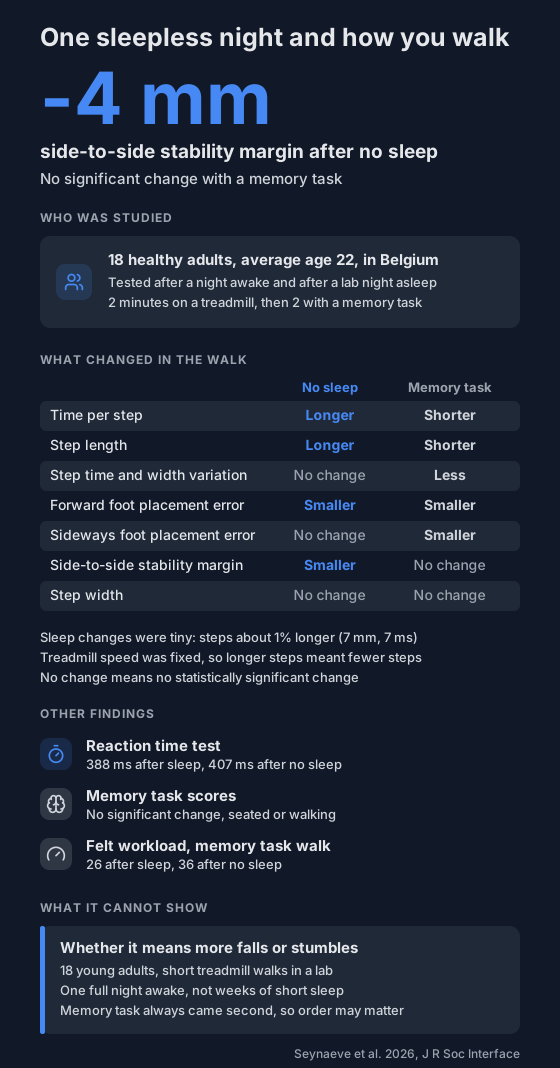
A 2026 lab study of 18 young adults found that after a night without sleep they took slightly longer steps and had a 4 mm smaller side-to-side stability margin, a pattern unlike walking with a memory task.
You know a night without sleep slows your thinking. It also seems to change the way you walk.
A study published in October 2026 kept young adults awake all night, then put them on a treadmill. The researchers wanted to know if a tired walk is just a distracted walk. Not fully: most of the changes looked different from walking while doing a memory task.
Who was in the study?
- 18 healthy adults at KU Leuven in Belgium, 9 women and 9 men. 4 more were left out for sleeping under 7 hours on the control night.
- Average age 22.
- All slept well at the start, with no known sleep conditions, and none smoked.
It was a randomised crossover study: each person came in twice, a week apart, in random order:
- Control night. Asleep in the lab from 23:00 to 07:00, wired up to measure sleep. They slept 7.7 hours on average.
- Sleepless night. Awake all night under supervision, in a dim room.
How was walking measured?
The next morning they did two 2-minute walks on a treadmill set to their usual walking speed:
- Just walking.
- Walking while doing a memory task: pressing a button when a number matched the one shown two before.
Cameras tracked markers on the feet and hips, over about 222 steps per walk. The researchers measured step length, step timing and width, how closely each foot landed where the body's motion predicted, and a side-to-side stability margin. That margin is how far the body's moving centre stays inside the outer edge of the standing foot.
What changed after the sleepless night?
Compared with the control night, all the changes were small:
- Longer steps. Step length went from 0.620 m to 0.627 m in the plain walk, about 1% longer.
- Slower stepping. Each step took 0.549 s instead of 0.542 s.
- The treadmill speed was fixed, so walking speed didn't change: longer steps meant fewer steps per minute.
- Smaller stability margin. It dropped by about 4 mm on average.
- Forward foot placement matched the body's motion slightly more closely.
- No significant change in step width, sideways foot placement or how much steps varied.
People also reacted slower on an attention test: 407 ms against 388 ms. They rated the memory task walk as harder work, 36 against 26 on a workload scale, mainly more effort and frustration. Their memory task scores didn't change significantly.
Was it the same as walking while distracted?
Not really. One change was shared: forward foot placement matched the body's motion more closely in both. Otherwise the memory task changed walking in its own way:
- Shorter, quicker steps.
- Less variation in step timing, step width and the stability margin.
- Sideways and forward foot placement matched the body's motion more closely.
- No significant change in the average stability margin.
The authors say walking without sleep can't be fully explained as having less brain capacity to spare. They suggest lower alertness may weaken the small corrections that keep you steady side to side. A tired body might also walk in a more passive, energy-saving way. These are ideas, not things the study tested.
Combining the night awake with the memory task showed no statistically significant extra effect.
What can't it show?
- Falls. It didn't test stumbles, trips or anyone being pushed off balance.
- Size. 18 people is small, and the authors say it may miss smaller effects.
- Who. Healthy people in their early 20s. Older adults might show larger changes.
- Real life. Short treadmill walks at a set speed in a lab, not walking on a street. The authors think a set speed may hide some effects.
- Task. The memory task may have been too easy to show an effect of the sleepless night.
- Order. The memory task walk always came second, so some of its effects could come from settling in.
- Kind of sleep loss. One full night awake, not weeks of short sleep, which is more common.
The study was funded by KU Leuven and Research Foundation Flanders, and the authors declared no competing interests.
What can you do with this?
In this study, a night without sleep changed walking in small ways that distraction alone didn't explain. If you track your sleep, you can note how steady you feel on days after a short night and look for a pattern. The sleep experiment planner can help you set that up.
A separate study in older adults linked broken sleep with less steady walking, while overnight oxygen numbers showed no link. For thinking speed after poor sleep, see broken sleep and next-day thinking.
Not a medical device. Does not diagnose, treat or prevent any condition. Discuss results and changes with a clinician.
References
- Seynaeve M, Render AC, Fino PC, de Beukelaar T. Effects of one night of sleep deprivation on single- and dual-task gait. Journal of the Royal Society Interface. 2026;23(243):20260047. doi:10.1098/rsif.2026.0047