Sleep Patterns in Dizziness: A 2026 Study
A 2026 study of 90 people found that three types of dizziness all came with worse self-rated sleep, but each had its own measured pattern. The positional vertigo group had the most breathing events and oxygen dips per hour.
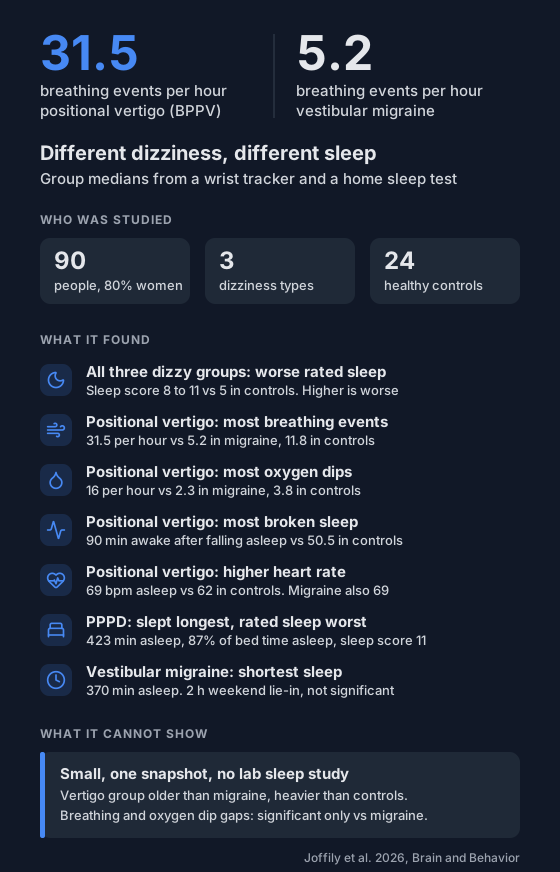
Dizziness and poor sleep often turn up together. Most studies lump all dizziness into one group. A 2026 study from Brazil looked at three common types separately, and found each came with a different sleep pattern.
Who was in the study?
90 adults in Rio de Janeiro, the patients from a hospital dizziness clinic:
- 21 with benign paroxysmal positional vertigo (BPPV): short spins of vertigo set off by moving the head.
- 23 with persistent postural-perceptual dizziness (PPPD): dizziness or unsteadiness most days for months.
- 22 with vestibular migraine: migraine that comes with dizziness or vertigo.
- 24 healthy controls from hospital staff and patients' families.
About 80% were women. Each person wore an activity tracker on the wrist for 14 days, then a WatchPAT home sleep test for one night. They also filled in questionnaires on sleep quality, anxiety, low mood and how much the dizziness affected them.
The BPPV group was recorded after their positional vertigo had been cleared with a head repositioning manoeuvre, not during an episode.
What did everyone have in common?
All three dizzy groups rated their sleep worse than the controls. On the sleep quality questionnaire, where higher means worse sleep, the medians were:
- Controls: 5
- BPPV: 8
- Vestibular migraine: 9
- PPPD: 11
All three groups also scored higher for anxiety than the controls.
What stood out in the BPPV group?
- Breathing events: a median of 31.5 per hour, against 5.2 in the vestibular migraine group and 11.8 in the controls.
- Oxygen dips: 16 per hour, against 2.3 in the migraine group and 3.8 in the controls.
- Broken sleep: 90 minutes awake after first falling asleep, against 50.5 in the controls, and 11 awakenings a night against 7.8.
- Heart rate while asleep: 69 beats per minute, against 62 in the controls. The migraine group also had a median of 69.
- Movement at night: the most of any group in the quietest 5 hours, though only significantly more than the PPPD group.
The gaps in breathing events and oxygen dips were only statistically significant against the migraine group, not the controls or the PPPD group. They held after adjusting for age and BMI.
The authors suggest sleep apnea may be the main thing breaking up sleep in this group. They note they had no lab sleep study to confirm it.
For what an oxygen dip count measures, see the oxygen desaturation index.
And the other two groups?
PPPD had what the authors call a sleep paradox:
- The longest time in bed (526 minutes) and the most sleep (423 minutes).
- Asleep for 87% of their time in bed, the highest of any group.
- The worst self-rated sleep, the highest anxiety and the least daytime activity.
- Almost no difference between weekday and weekend get-up times.
Vestibular migraine had the shortest sleep, at 370 minutes. They got up a median of 120 minutes later at weekends, but that difference between groups wasn't statistically significant. The authors read it as a possible sign of weekday sleep debt.
For a larger study on migraine and sleep, see migraine, insomnia and sleep apnea.
What can't it show?
- Cause. It's a cross-sectional study, a single snapshot, so it shows what went together, not what caused what.
- Size. 21 to 24 people per group, so small differences could be missed.
- Group differences. The BPPV group was older than the migraine group and heavier than the controls.
- Measurement. One night of a home sleep test, scored automatically, with no lab sleep study.
- Daily routine. Shift work and whether people were early birds or night owls weren't recorded.
- Controls. The healthy controls had a median of 11.8 breathing events per hour, more than the migraine group.
The authors suggest checking for sleep apnea in BPPV, cognitive behavioural therapy in PPPD and regular sleep times in vestibular migraine. They say these are hypotheses to test in future trials, not evidence-based advice.
The WatchPAT used here has its own quirks, covered in WatchPAT with insomnia.
What can you do with this?
If you have dizziness and sleep badly, mention both to your doctor. If you snore loudly or someone has seen you stop breathing in your sleep, the sleep apnea risk check can help you decide whether to raise it.
An overnight oximeter records your oxygen dips and pulse, and you can share that with your doctor.
Not a medical device. Does not diagnose, treat or prevent any condition. Discuss results and changes with a clinician.
References
- Joffily L, de Lima MASD, Araújo JF, Kaski D. Sleep in Different Types of Dizziness. Brain and Behavior. 2026;16(10):e71863. doi:10.1002/brb3.71863