Olympic Swimmers' Sleep on an Oura Ring
Eight Olympic swimmers wore an Oura ring through three meets in 2024. Sleep efficiency fell at the Olympics, but sleep scores showed no significant link to race times.
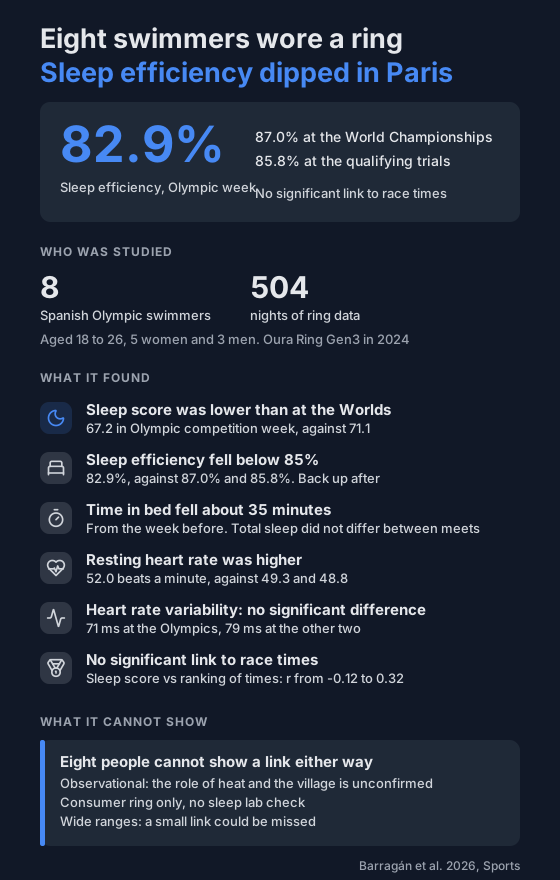
You'd expect the biggest meet of a swimmer's life to cost them some sleep. A 2026 observational study followed eight Olympic swimmers on an Oura ring to see. Sleep efficiency and the sleep score dipped at the Olympics, and the sleep score showed no statistically significant link to race times.
Who was studied?
- 8 Spanish swimmers aged 18 to 26, 5 women and 3 men.
- That was 8 of the 18 federated Olympic swimmers in Spain at the time.
- Pool and open-water swimmers, all at the top international level.
- Each wore an Oura Ring Gen3 from February to August 2024.
- Three meets: the World Championships in Doha (February), the qualifying trials (June) and the Paris Olympics (July and August).
- For each meet, seven nights before, a seven-night competition window and seven nights after.
- That's 504 nights, with no gaps.
Each swimmer was compared with their own results, not with the other seven. The researchers only observed, with no control over training or competition.
What happened at the Olympics?
The numbers below are for the seven-night competition window, which also took in travel.
- Sleep efficiency (share of time in bed spent asleep): 82.9% at the Olympics, against 87.0% at the World Championships and 85.8% at the trials. It was the only meet below 85%, a common reference line in wearable research. It rose again afterwards.
- Sleep score (the ring's 0 to 100 rating): 67.2 at the Olympics against 71.1 at the World Championships. At the Olympics it also fell from the week before. The paper doesn't give the trials figure.
- Time in bed: at the Olympics, about 35 minutes shorter than the week before. The wider test across all three phases wasn't significant, and time in bed didn't differ significantly between meets.
- Total sleep time: no statistically significant difference between meets. It averaged 413 minutes at the World Championships, 402 at the trials and 407 at the Olympics.
- Resting heart rate: 52.0 beats a minute at the Olympics, against 49.3 at the World Championships and 48.8 at the trials. There was no statistically significant difference between meets in the weeks before and after.
- Heart rate variability: 71 ms at the Olympics and about 79 at the other two. That wasn't a statistically significant difference.
So the ring's numbers moved at the Olympics, but the authors call the changes modest. They say sleep duration and quality stayed at or near recommended levels across the whole study.
Did sleep line up with race times?
Not to a statistically significant degree, in a study this small. Each swimmer's three race times were ranked fastest to slowest, because the events differed. Five swimmers had their best time at the trials, and four had a middle result at the Olympics. The rankings didn't differ significantly between meets.
The sleep scores didn't line up with the rankings either. For the sleep score before, during and after each meet, the Pearson correlations ran from -0.12 to 0.32, none statistically significant. The abstract says no sleep or heart measure was linked to performance, but the paper only shows the numbers for the sleep score.
Average times slowed by 2.0% between the trials and the Olympics. Changes ran from 0.5% faster to 8.2% slower, and the two open-water swimmers slowed the most, by 7.4% and 8.2%.
What can eight people show?
Very little, and the authors say so.
- No link either way. The authors point out that a non-significant result with eight people doesn't mean there's no relationship. The ranges were wide.
- No cause. The authors suggest the Olympic setting, heat above 35 °C and no air conditioning in the village may have played a part. They didn't measure stress or compare temperatures across the meets, so this is unconfirmed.
- A ring, not a sleep lab. All sleep data came from a consumer device. There were no questionnaires and no off-season baseline.
- Uneven data. One swimmer slept shorter and less efficiently than the rest and accounted for half of the unusual values.
- Different meets. Hotels at two meets and the village at the Olympics, and training between meets wasn't controlled.
- Rough correlations. They pooled 24 results from the same eight swimmers and weren't adjusted for repeated comparisons, so the authors call them descriptive only.
What can you do with this?
It's a small look at how a ring's numbers moved around a big competition. You can log your own nights the same way and compare a busy week with a quiet one.
Compare your own weeks rather than anyone else's. Heart rate variability differed far more between swimmers than within each swimmer, so the authors say changes only make sense against a person's own baseline. For how other studies line up ring data with training, see wearable sleep and training strain in athletes. For how accurate rings are at staging sleep, see smart rings and sleep stages.
Not a medical device. Does not diagnose, treat or prevent any condition. Discuss results and changes with a clinician.
References
- Barragán L, Crespo C, Ibáñez SJ, Timón R, Olcina G. The Influence of Sleep and Autonomic Recovery on Performance in World-Class Swimmers at Major Competitions: The Qualifying Trials, World Championships, and Olympic Games. Sports (Basel). 2026;14(10):426. doi:10.3390/sports14100426