Sleep Apnea and Atrial Fibrillation Risk
A 2026 review of 21 cohort studies of about 612,000 adults. Breathing events in sleep were linked to a 67% higher risk of atrial fibrillation starting and a 55% higher risk of it coming back.
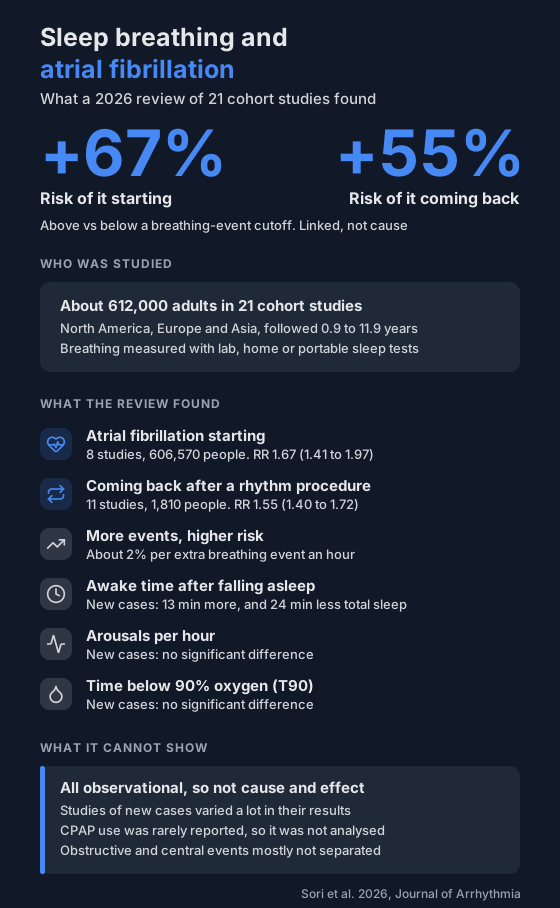
Sleep apnea and atrial fibrillation, a common irregular heart rhythm, often turn up in the same people. A review published in October 2026 brought together 21 follow-up studies to put a number on it.
It found that people with more breathing events in their sleep were more likely to develop atrial fibrillation, and more likely to have it come back after a procedure to reset the rhythm. It also looked at broken sleep, and at time below 90% oxygen.
Who was studied?
- 21 cohort studies, which follow groups of people over time. The search ran to February 2026.
- About 612,000 adults in North America, Europe and Asia. The abstract gives 611,898; the discussion gives 665,457.
- One Taiwanese study made up 579,521 of them.
- 19 studies went into the pooled numbers; 2 were only described.
- Follow-up ran from just under 1 year to almost 12 years.
- 9 studies measured breathing with a full sleep study in a lab or at home. Most of the rest used simpler portable sleep tests.
Two questions were pooled separately:
- Starting: people without atrial fibrillation, followed to see who developed it.
- Coming back: people who'd had a procedure to restore a regular rhythm, such as ablation or cardioversion, followed to see whose atrial fibrillation returned.
What did it find?
Atrial fibrillation starting (8 studies, 606,570 people):
- People above the studies' breathing-event cutoff had a risk ratio of 1.67, a 67% higher risk (95% CI 1.41 to 1.97).
- The result held with a cutoff of 5 events an hour (1.93) and of 15 (1.60).
- It held whether the study used a full sleep study (1.94) or a portable one (1.47).
- Leaving out any one study kept the figure between 1.60 and 1.77.
- Age and BMI didn't explain why the studies differed.
Atrial fibrillation coming back (11 studies, 1,810 people):
- The risk ratio was 1.55, a 55% higher risk (95% CI 1.40 to 1.72).
- Unlike the first question, the studies here agreed closely with each other.
- Overall, atrial fibrillation came back in 25% to 81% of people, depending on the study.
Does more mean higher risk?
The review found the risk rose with the number of events, then levelled off.
- Each extra breathing event an hour went with about a 2% higher risk of atrial fibrillation starting.
- A second model put the risk ratio at 1.07 at 5 events an hour and 1.71 at 30, with little further rise above that.
- People who went on to develop atrial fibrillation had about 4 more events an hour at the start than those who didn't. Those whose atrial fibrillation came back had about 4.5 more.
What about broken sleep?
Fewer studies reported it, so these are smaller comparisons between people who developed atrial fibrillation and those who didn't.
- Awake time after first falling asleep: about 13 minutes more in those who developed it.
- Total sleep: about 24 minutes less.
- Brief arousals per hour: no significant difference, for starting or for coming back.
- Time below 90% oxygen (T90): no significant difference.
The authors suggest awake time reflects longer stretches of broken sleep, while arousals are short and may matter less.
What can't it show?
- Cause. Every study was observational. The authors name medication, alcohol, other health conditions and sleep apnea no one had found as things that may still skew the result.
- Agreement. The studies of atrial fibrillation starting varied a lot in their results.
- CPAP. Too few studies reported CPAP use to analyse it, and the authors say that gap may skew the result. For one study on that, see CPAP hours and atrial fibrillation returning.
- Type of event. Most studies didn't separate obstructive from central breathing events. The authors think the result mostly reflects obstructive sleep apnea.
- Test type. Home tests divide events by recording time rather than sleep time, which can count fewer events per hour.
- Small numbers. The studies of atrial fibrillation coming back were small, 1,810 people in total.
The authors call breathing in sleep and broken sleep possible risk factors that could be changed, and say only trials of changing them can show whether that changes atrial fibrillation.
What does an overnight oximeter show here?
The review's main measure was breathing events per hour from a sleep study. A finger or ring oximeter doesn't measure that.
What it does record:
- How often your oxygen dips through the night. Dips follow many breathing events, but not all, so this count can differ from a sleep study's. See home ODI vs a lab sleep study.
- Time below 90%. In this review, T90 didn't differ between people who did and didn't develop atrial fibrillation.
- Your pulse rate, night after night.
What it doesn't record:
- Whether you're asleep or awake, so no awake time after falling asleep.
- Your heart rhythm. A pulse rate from your finger isn't an ECG.
If you have atrial fibrillation and you snore, or someone has seen you stop breathing in your sleep, that's worth raising with your doctor. The sleep apnea risk check takes about a minute. If you've been recording, here's how to share your oximeter data.
Not a medical device. Does not diagnose, treat or prevent any condition. Discuss results and changes with a clinician.
References
- Sori E, Abid H, Zartasha, Pedra W, Odewabi A, Salau IL, Jillkumar V, Hyder A, Mutar M, Sattar Y. Sleep-Disordered Breathing and Sleep Fragmentation in Relation to Atrial Fibrillation Risk: A Systematic Review and Meta-Analysis. Journal of Arrhythmia. 2026;42(5):e70499. doi:10.1002/joa3.70499