Sleep Apnea and Gum Disease: Is There a Link?
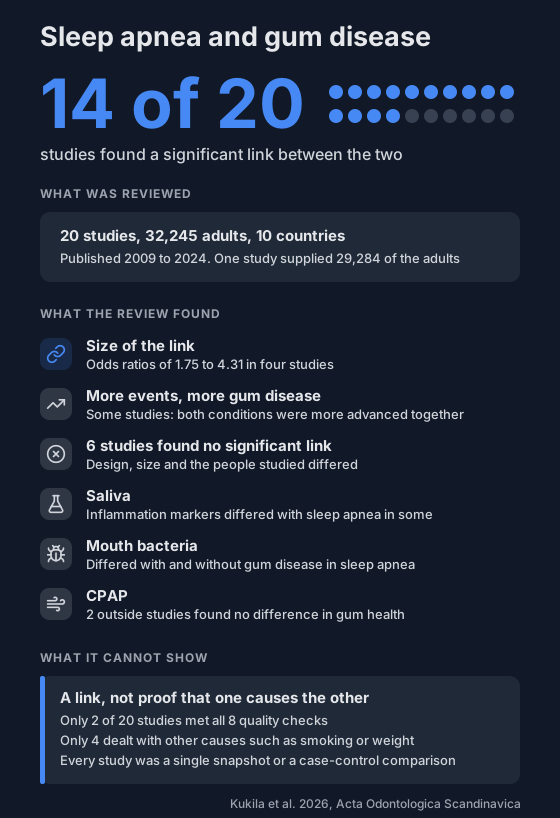
A 2026 systematic review found that 14 of 20 studies reported a significant link between obstructive sleep apnea and gum disease, but only 2 met every quality check.
Sleep apnea and gum disease share a lot of risk factors: age, weight, diabetes, smoking and alcohol. So do they turn up together more often than chance?
A systematic review published in July 2026 pulled together 20 studies on that question. 14 of them found a significant link. The catch is that only 2 of the 20 met every quality check.
What did the review look at?
- 20 studies published between 2009 and 2024, found by searching four databases up to April 2025.
- 32,245 adults in total, from 10 countries.
- One Taiwanese study supplied 29,284 of them, and the other 19 had between 50 and 687 people each.
- 12 were case-control studies and 8 were cross-sectional, meaning a single snapshot in time.
- Sleep apnea was confirmed with an overnight sleep study, and three studies also accepted a simpler overnight breathing recording.
- Gum disease here means periodontitis, the advanced form that damages the tissue and bone holding the teeth.
- Dentists measure it by pocket depth and attachment loss around each tooth.
So is there a link?
In most of the studies, yes.
- 14 of the 20 studies (70%) reported a statistically significant link between obstructive sleep apnea and periodontitis.
- Four studies gave odds ratios for it, ranging from 1.75 to 4.31.
- 6 studies found no significant link.
- The authors put the disagreement down to differences in study design, sample size, the people studied and how other risk factors were handled.
The review did not pool the results into one overall figure.
Does more sleep apnea mean more gum disease?
Some studies pointed that way.
- One study found the two tracked each other: gum disease was more advanced in people with the most breathing events per hour.
- Another found that the number of breathing events per hour explained 16.4% of the variation in attachment loss.
- One Indian study of 500 people found periodontitis more common as breathing events per hour went up.
- One study found the link in people with 5 to 15 breathing events per hour, the lowest grade.
For why event counts are only part of the picture, see sleep apnea beyond event counts.
Why might they be connected?
The review's leading explanation is inflammation.
- Repeated oxygen dips may raise inflammation across the body, including in the gums.
- The review says inflammation markers in saliva differed between people with and without sleep apnea in some studies.
- It also says one study observed no differences in saliva or blood markers.
- Four studies looked at mouth bacteria and suggested more of the species tied to gum disease in people with sleep apnea.
- Mouth breathing and oxygen dips may also affect saliva and shift the mix of bacteria.
The authors also point to a genetic analysis outside the 20 studies. It was consistent with sleep apnea raising the risk of periodontitis, and not the other way round.
Related: teeth grinding and overnight oxygen.
Does CPAP change anything for your gums?
The review found very little to go on.
- Two studies looked at gum health in CPAP users, and neither met the review's entry criteria, so they sit outside the 20.
- One found CPAP or BiPAP users had similar plaque, tartar, gum inflammation and number of teeth to matched controls.
- The other checked people 10 years on and found no differences in how periodontitis progressed between people without sleep apnea, people with sleep apnea not on CPAP and regular CPAP users.
- Short-term changes in mouth bacteria have been seen after CPAP use, but in small samples.
- CPAP may lower CRP, a blood marker of inflammation, but the authors say what that means for gums is unclear.
The authors call the CPAP evidence limited and inconclusive.
On CPAP already? See tracking your oxygen alongside CPAP.
How strong is the evidence?
Limited, going by the review's own quality scoring.
- Only 2 of the 20 studies met all 8 quality checks.
- Of those two, one found a link and one did not.
- Only 6 studies identified other risk factors like age, weight, diabetes, smoking and alcohol, and only 4 said how they dealt with them.
- In 3 studies the comparison group never had a sleep study, and 2 studies had no comparison group.
- Three studies came from the same research group and used partly overlapping data.
- Smoking was reported inconsistently, and it is a well-established risk factor for gum disease.
- Every study was case-control or cross-sectional, so none can show which condition came first.
The authors conclude that sleep apnea may contribute to periodontitis, but that cause and effect has not been established.
What can you do with this?
- If you have sleep apnea, mention it to your dentist.
- If you have gum disease and you snore or feel tired in the day, mention that to your doctor.
- Not sure whether your snoring is worth raising? Read snoring vs sleep apnea or try the sleep apnea risk check.
- An overnight oximeter can log your oxygen dips to take along. Here's how to share them.
Not a medical device. Does not diagnose, treat or prevent any condition. Discuss results and changes with a clinician.
References
- Kukila A, Manzoor M, Salminen A, Mäntylä P, Pussinen P. Obstructive sleep apnea and periodontitis: a systematic review with considerations on CPAP therapy. Acta Odontologica Scandinavica. 2026;85:453-459. doi:10.2340/aos.v85.46512