Sjögren Syndrome and Overnight Oxygen
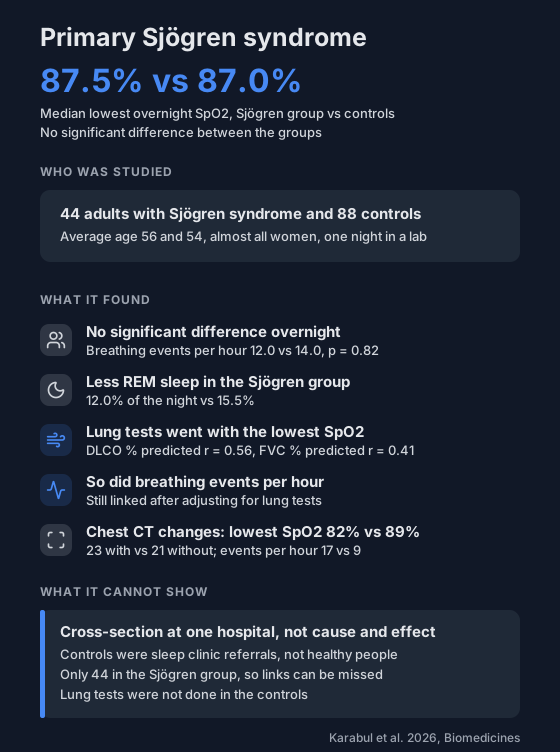
A 2026 study of 44 adults with primary Sjögren syndrome and 88 controls found no statistically significant difference in overnight oxygen between the groups. Within the Sjögren group, lower lung test results went with a lower lowest SpO2.
Sjögren syndrome is an autoimmune condition best known for dry eyes and a dry mouth. It can also involve the lungs, sometimes without symptoms. A 2026 study from Istanbul asked whether lung test results line up with how low overnight SpO2 goes in people who have it.
Overnight oxygen showed no statistically significant difference from the comparison group. Within the Sjögren group, though, lower lung test results went with a lower lowest SpO2.
Who was studied?
- 44 adults with primary Sjögren syndrome, recruited from one hospital clinic in Istanbul between April 2019 and December 2020.
- 88 controls picked afterwards from people referred to the sleep clinic over the same period, with no known lung disease and clear chest imaging.
- Average age was 56 in the Sjögren group and 54 in the controls, and average BMI was 29.0 and 28.5.
- 95.5% of the Sjögren group were women, and all of the controls were.
- Everyone had a full overnight sleep study in a lab. The Sjögren group also had lung function tests and a chest CT scan within 3 months of it.
How did the two groups compare overnight?
No statistically significant difference on most measures.
- Median lowest SpO2 was 87.5% in the Sjögren group and 87.0% in controls.
- Median breathing events per hour were 12.0 and 14.0.
- Median oxygen dips were 73.5 and 74.0 per night.
- REM sleep was lower: 12.0% of the night in the Sjögren group, 15.5% in controls.
The paper's results text calls REM sleep the only significant difference. But Table 1 also shows more people at 5 to 14.9 breathing events per hour in the Sjögren group: 27.3% against 12.5% (p = 0.035).
The controls weren't healthy volunteers. They were people referred to a sleep clinic, so many of them had their own breathing events and dips. The authors say that may have hidden differences between the groups.
What went with the lowest SpO2 in the Sjögren group?
Two lung tests were used:
- DLCO is how well your lungs pass oxygen into the blood.
- FVC is how much air you can blow out after a full breath in.
Within the Sjögren group, a higher lowest overnight SpO2 went with:
- A higher DLCO: r = 0.56 for % of predicted.
- A higher FVC: r = 0.41 for % of predicted.
Lower results on the same tests went with more oxygen events below 90%. The total count of oxygen dips had a weaker link with DLCO and none with FVC, and there was no significant link with dips below 80%, which were rare.
Did breathing events per hour matter too?
Yes. The study's own title says lung function mattered "beyond" breathing events, not instead of them.
The authors ran a regression with the lowest SpO2 as the outcome:
- Adjusted for age, BMI and breathing events per hour, DLCO still showed a significant link.
- Breathing events per hour stayed significantly linked in every model. In the model with DLCO, each extra event per hour went with a lowest SpO2 about 0.25 points lower.
- Once FVC was added, the DLCO link was no longer significant (p = 0.084), while FVC was (p = 0.017). The authors read that as the two tests overlapping, not as one beating the other.
What did the chest CT show?
23 of the 44 had structural changes in the lungs on CT, and 21 didn't.
| With CT changes | Without | |
|---|---|---|
| Median lowest SpO2 | 82.0% | 89.0% |
| Median events below 90% | 20 | 0 |
| Median breathing events per hour | 17.0 | 9.0 |
| Median DLCO, % of predicted | 66% | 91% |
The authors call this analysis exploratory. The group with CT changes also had more breathing events per hour, so the two overlap.
Against the controls, the group with CT changes had a lower lowest SpO2 (82.0% against 87.0%). The group without CT changes had a higher one (89.0% against 87.0%). How many lung segments showed changes didn't line up with the lowest SpO2.
What doesn't it tell you?
- Cause. It's a cross-sectional study, so it shows what went together, not what came first.
- A clean comparison. The controls were sleep clinic referrals, and lung function wasn't tested in them.
- Everyone with Sjögren syndrome. It was one hospital, mostly women, and the group was small, which can hide weaker links.
- Other measures. Average SpO2, time below 90% (T90) and hypoxic burden weren't available. Neither were disease activity scores, heart scans for lung blood pressure, or a DLCO corrected for blood count.
- Why REM sleep was lower. Depression and antidepressant use weren't recorded, and either can change REM sleep.
- Home use. The oxygen readings came from a lab sleep study, not a home oximeter.
What can you do with this?
In this study, the lowest overnight SpO2 in people with Sjögren syndrome went with lung test results as well as breathing events. An overnight oximeter shows the lowest SpO2 and how many dips you had. It can't tell you why they happened, so share the recording with your doctor.
For what the numbers mean, see what is SpO2 and oxygen desaturation index. A larger Swedish study found a similar pattern in the general population: lung function and overnight oxygen.
Not a medical device. Does not diagnose, treat or prevent any condition. Discuss results and changes with a clinician.
References
- Karabul E, Aksoy EM, Borekci S, Ugurlu S, Balcan B. Pulmonary Dysfunction Contributes to Nocturnal Hypoxemia Beyond Obstructive Sleep Apnea Severity in Primary Sjögren Syndrome. Biomedicines. 2026;14(10):2152. doi:10.3390/biomedicines14102152