Shift Work Sleepiness: A 2026 AASM Review
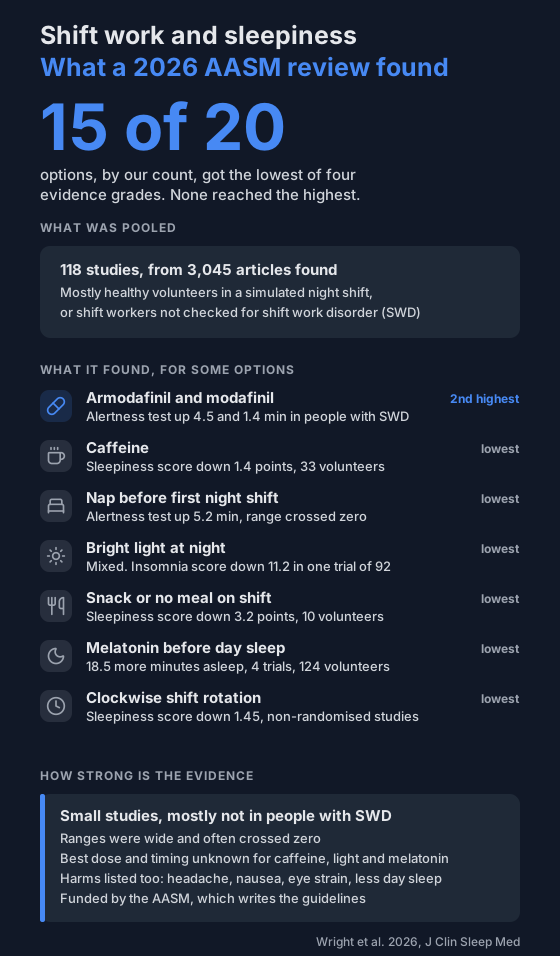
The American Academy of Sleep Medicine pooled 118 studies on shift work disorder. Armodafinil and modafinil got the second-highest grade of four. By our count, 15 of 20 options got the lowest.
Working nights or rotating shifts often means sleepiness on shift and poor sleep by day. When it goes on for 3 months or more and causes real problems, it's called shift work disorder (SWD). A 2026 review from the American Academy of Sleep Medicine (AASM) pooled the evidence on the options tested for it.
The AASM commissioned six experts to search for trials of sleepiness, accident risk, sleep quality and work performance. It's the evidence base for the AASM's guideline on SWD.
What did the review do?
- Searches ran from 2021 to August 2025 and turned up 3,045 articles.
- 118 studies had data that could be pooled or graded.
- Most were small, under 200 people.
- Few tested people with SWD.
- Most data came from healthy volunteers in a lab-simulated night shift, or shift workers who hadn't been checked for SWD.
- The expert group set "clinically meaningful" thresholds, for example 1 point on the Karolinska Sleepiness Scale or 1 minute on a sleep-latency test.
- Each option got an overall certainty grade on a four-level scale (GRADE).
How were the options graded?
We counted the review's options from its overall grades. That's 20 options, because each use counts on its own, such as melatonin at three different times.
- Highest grade: none.
- Second highest: 2 options.
- Second lowest: 3 options.
- Lowest: 15 options.
Which options got the highest grade?
Only armodafinil and modafinil were graded second highest of four. The review says they're the only FDA-approved drugs for excessive sleepiness in SWD.
Armodafinil (150 mg)
- 5 randomised trials in people with SWD, mean age 38.
- On a sleep-latency test, people took 4.5 minutes longer to fall asleep than without it (3 trials, 280 people, range 1.8 to 7.2).
- On the Karolinska scale, sleepiness was 0.99 points lower (3 trials, 612 people), just under the 1-point threshold.
- People reported fewer mistakes, near misses or accidents on the drive home: risk ratio 0.62, about 205 fewer per 1,000 (1 trial, 150 people, 12 weeks).
Modafinil
- 5 randomised trials, but only one in people with SWD.
- That trial of 200 mg in 182 people: 1.4 minutes longer on the sleep-latency test (range 0.4 to 2.4), sleepiness 1.1 points lower.
- Fewer accidents or near accidents in sleep diaries: risk ratio 0.54, about 247 fewer per 1,000 (1 trial, 204 people).
For both
- The accident figures were self-reported.
- The review says the most frequent side effects are headache, nausea and dry mouth, and it lists trouble sleeping for modafinil.
- In the armodafinil trials, one person with a history of depression had suicidal thoughts.
- The review says both drugs can lower hormone levels from hormonal contraceptives, which makes them less effective.
What about caffeine, naps, light and meals?
All of these got the lowest grade. None of the data came from people known to have SWD, only from healthy volunteers in lab-simulated night shifts or shift workers who hadn't been checked for it. The combinations in the review, such as naps plus caffeine, and light used to shift the body clock were graded lowest too.
Caffeine
- Sleepiness was 1.4 points lower on the Karolinska scale in one trial of 33 people (range 0.2 to 2.6).
- A different sleepiness scale showed little to no difference (2 trials, 68 people).
- Lapses on a reaction-time test were 3.2 fewer across 2 trials (45 people).
- Sleep was 81.7 minutes shorter on a sleep-lab recording in one trial of 34 shift workers (range 26.9 to 136.5).
- The review says caffeine disrupts daytime sleep more than night sleep, and the best dose and timing are unknown.
Naps before the first night shift
- With a 2.5-hour nap chance, an alertness test ran 5.2 minutes longer in one trial of 33 people.
- The range ran from slightly negative to 11.6, so it can't rule out no effect.
- The review warns about grogginess after waking, which is worst in the first 10 minutes.
Bright light at night
- 24 studies, with light from 361 to 10,000 lux, for anything from minutes to hours.
- On the Karolinska scale, two trials of 104 shift workers found little to no difference.
- Alertness tests ran 2.6 minutes longer (2 trials, 39 volunteers) and 5.1 minutes longer (2 trials, 76 volunteers).
- In one trial of 92 shift workers, 30 minutes of 7,000 to 10,000 lux light came with an insomnia score 11.2 points lower than dim light over 2 weeks.
- In one lab trial of 21 volunteers, people took 54 minutes longer to fall asleep afterwards.
- The review lists headaches in people with a history of migraines and temporary eye strain, and says it may not be suitable for people with bipolar disorder.
- The best intensity, timing and light colour are unknown.
A snack or no meal on shift, against a full meal
- Sleepiness was 3.2 points lower in one trial of 10 people.
- Reaction-time lapses were 3.1 fewer across 2 trials (49 people).
- The review notes that skipping meals may not suit people with diabetes.
What about sleeping during the day?
Melatonin before daytime sleep
- 10 trials, doses 0.18 to 9 mg.
- People slept 18.5 minutes longer on a sleep-lab recording (4 trials, 124 healthy volunteers, range 3.9 to 33.2).
- Sleep-onset time and reaction-time lapses showed little to no difference.
- Graded lowest, and so was melatonin before a day sleep ahead of the first night shift.
Melatonin on the first night off
- 3 trials of shift workers not checked for SWD, followed for 1 night.
- People reported 20.1 minutes more sleep in diaries (1 trial, 172 people, range 4.9 to 35.3).
- The review lists headaches, drowsiness, dizziness and nausea as possible harms of melatonin.
- Graded second lowest.
Ramelteon
- One trial of 28 volunteers, followed for 1 day.
- 43 minutes more sleep on a sleep-lab recording.
- The review lists drowsiness, dizziness and nausea as possible harms.
- Graded second lowest.
Suvorexant
- One trial of 44 shift workers over 21 days.
- About 177 more minutes of sleep on a wrist monitor.
- The review lists drowsiness, dizziness and headache among the possible harms, and says doses of 30 mg and higher aren't approved because of suicidal thoughts.
- Graded second lowest.
Triazolam
- 4 trials in healthy volunteers.
- 36 more minutes asleep (2 trials, 50 people).
- The task force judged the risks of dependence, withdrawal and falls outweighed the benefit.
- It was the only option where the task force judged harms to outweigh benefits.
- Graded lowest.
CBT for insomnia
- 1 trial and 3 before-and-after studies, mostly in people with SWD.
- The changes were smaller than the thresholds, for example 1.8 points on the Pittsburgh Sleep Quality Index against a 3-point threshold.
- Graded lowest.
And shift schedules?
Clockwise rotation, against counterclockwise
- Sleepiness was 1.45 points lower in 2 non-randomised studies of 170 shift workers.
- The review says about 1 in 5 people have a body clock shorter than 24 hours and would be expected to cope better the other way.
- Graded lowest.
8-hour against 12-hour shifts
- 5 non-randomised studies showed no clear difference.
- Graded lowest.
What doesn't it tell you?
- Most of it is indirect. Healthy volunteers in a lab aren't the same as people working real shifts.
- Ranges were wide. Many crossed zero or the review's own threshold.
- Accident outcomes. The task force counted any decrease as meaningful, and says that may overstate the real benefit.
- Long-term health. Most options were tested on short-term symptoms, not long-term risks such as heart disease or depression.
- Gaps. Almost nothing on early-morning shifts, or on split shifts.
- Limits of the options. The review says current options don't bring night-time alertness or daytime sleep up to what healthy day workers get.
- Who paid. The AASM funded it, and AASM staff are among the authors.
- Author ties. Two authors disclose ties to drug, device or nutrition companies.
What can you do with this?
The review doesn't cover oxygen or breathing, and it never mentions sleep apnea. Sleepiness has many causes, so if it affects your driving or work, tell a doctor.
Your doctor can weigh up anything in this review for your situation. If you log your oxygen during day sleeps too, you can share the recordings.
For more on shift work, see night shifts, glucose and heart rate and a self-help book trial for shift workers. For naps, see sleep inertia and falls.
Not a medical device. Does not diagnose, treat or prevent any condition. Discuss results and changes with a clinician.
References
- Wright KP Jr, Abbott SM, Ashbrook L, Drake CL, Flynn-Evans E, Framnes-DeBoer S, Kazmi U, Keeler K, McCall C, Morgan R, Shaffer-Hodgeman T, Trotti LM. Management of shift work disorder: an American Academy of Sleep Medicine systematic review, meta-analysis, and GRADE assessment. Journal of Clinical Sleep Medicine. 2026;22(1):201. doi:10.1007/s44470-026-00076-w