Body Clock Sleep Disorders and Dry Eye
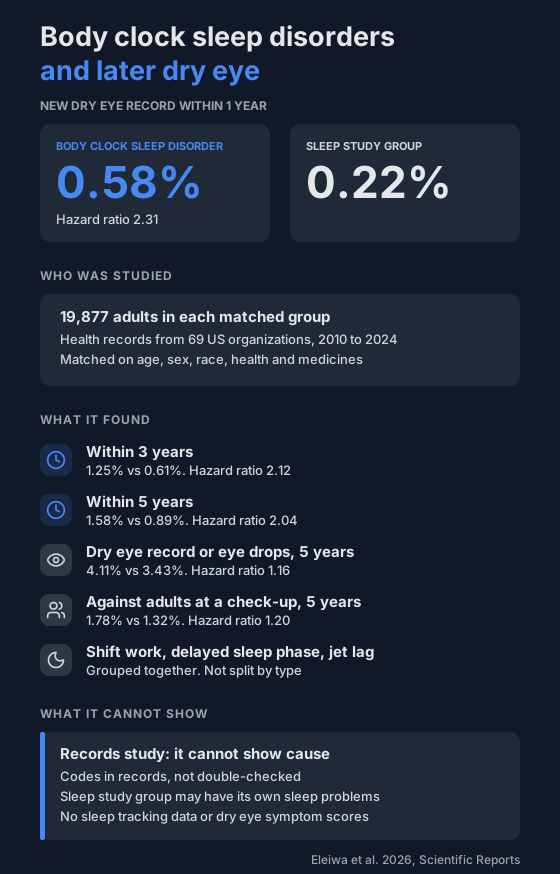
A 2026 US records study found that adults with a coded body clock sleep disorder were more likely to have dry eye recorded within 1, 3 and 5 years than matched adults who had a sleep study.
Poor sleep and dry eyes often show up together. Most studies on this looked at insomnia, short sleep or sleep apnea. A 2026 study asked about a different group: people whose body clock runs out of step with the day, such as shift workers and people with a very late sleep schedule.
What did the study look at?
Eye researchers in the US and Egypt used TriNetX, a pool of de-identified health records, drawing on 69 US health organizations.
- They compared adults with a coded body clock (circadian rhythm) sleep disorder against adults who had an overnight sleep study and no body clock or other sleep disorder code.
- Before matching there were 48,356 adults in the first group and 24,185 in the second.
- After matching on age, sex, race, ethnicity, health conditions, eye conditions, eye surgery and medicines, each group had 19,877 adults.
- The first body clock code fell between 2010 and 2024.
- Anyone with a dry eye code or dry eye eye drops before the start date was left out.
- People in the body clock group with a sleep apnea, insomnia or sleep deprivation code were also left out.
- Each follow-up point only counted people whose records ran that long, and the paper does not say how many that was.
The body clock group was mixed. After matching, the paper's Table 2 lists:
- Unspecified type: 40.9%.
- Shift work type: 29.3%.
- Delayed sleep phase: 17.9%.
- Jet lag type: 4.9%.
- Irregular sleep-wake: 3.8%.
- Advanced sleep phase: 1.8%.
Some people had more than one type, so these add up to more than 100%.
What did it find?
New dry eye records were more common in the body clock group at every point, with a higher hazard each time.
| Follow-up | Body clock group | Sleep study group | Hazard ratio (95% CI) |
|---|---|---|---|
| 1 year | 0.58% | 0.22% | 2.31 (1.85 to 2.87) |
| 3 years | 1.25% | 0.61% | 2.12 (1.82 to 2.47) |
| 5 years | 1.58% | 0.89% | 2.04 (1.78 to 2.33) |
The absolute numbers are small. Fewer than 2 in 100 people followed for 5 years in either group had a new dry eye record.
When the authors counted a dry eye record or the start of dry eye eye drops, the gap was smaller:
- 1 year: 1.61% against 1.15%, hazard ratio 1.36.
- 3 years: 3.15% against 2.65%, hazard ratio 1.19.
- 5 years: 4.11% against 3.43%, hazard ratio 1.16.
The authors think the drops, especially over-the-counter lubricants, are often used for brief eye irritation in both groups, which blurs the comparison. Starting eye drops alone did not differ significantly between the groups.
Two more checks gave the same direction:
- Against a second group of adults who had a general check-up visit, new dry eye records were still more common in the body clock group at 5 years: 1.78% against 1.32%, hazard ratio 1.20.
- Requiring two body clock codes in the records instead of one gave similar results. At 5 years it was 1.54% against 1.13%, hazard ratio 1.98.
Why was the hazard ratio lower by year 5?
The hazard ratio was highest in year 1 and lower by year 5, even though the gap in percentages grew. The authors list possible reasons:
- People get more medical attention after a body clock code, so dry eye may be recorded sooner.
- The people most likely to develop dry eye may do so early in follow-up.
- A short-term effect of the body clock disorder is possible too.
They say the data cannot tell these apart.
What can't this study show?
- Cause. It is a retrospective records study, so it shows an association, not that a body clock disorder leads to dry eye.
- Coding. Body clock disorders and dry eye were identified from codes in the records. The body clock codes were not confirmed by a specialist or a repeat visit, which can lead to misclassification.
- Types. Unspecified and shift work types made up most of the group, so the study cannot say whether one type matters more.
- The comparison group. Adults who have a sleep study may have sleep problems of their own, which the authors say could shrink the gap.
- Missing detail. The records had no sleep tracking data such as actigraphy, no dry eye symptom questionnaires, and little on device use, contact lenses, work patterns or how often people sought care.
- One snapshot. Body clock status was taken from the first code and not updated over time.
- Who it covers. The records came from US health organizations, so the results may not apply elsewhere.
The authors call the findings hypothesis-generating and say prospective studies are needed. They did not test why the link might exist.
What can you do with this?
Nothing here tells you to change anything. If your sleep timing is out of step with your day and your eyes feel dry or gritty, mention both to your doctor or eye specialist.
You can also look at your own pattern. For more on irregular sleep timing, see social jet lag and sleep regularity, and for night work, night shifts, glucose and heart rate. If you have recordings, here is how to share them with your doctor.
Not a medical device. Does not diagnose, treat or prevent any condition. Discuss results and changes with a clinician.
References
- Eleiwa TK, Chacko JA, ElSheikh RH, Dihan QA, Ayoubi M, Alzein A, Saeed HN, Al'Aref SJ, Elhusseiny AM. Association between circadian rhythm sleep disorders and dry eye disease: a retrospective cohort study. Scientific Reports. 2026;16(1):28118. doi:10.1038/s41598-026-67958-0