L-Arginine and Fatigue: An 8-Week Trial
120 tired adults took L-arginine 3 g, 6 g or placebo for 8 weeks. Only 6 g a day differed from placebo on the fatigue score. The sleep score changes were not adjusted for repeat testing, and the trial was company-funded.
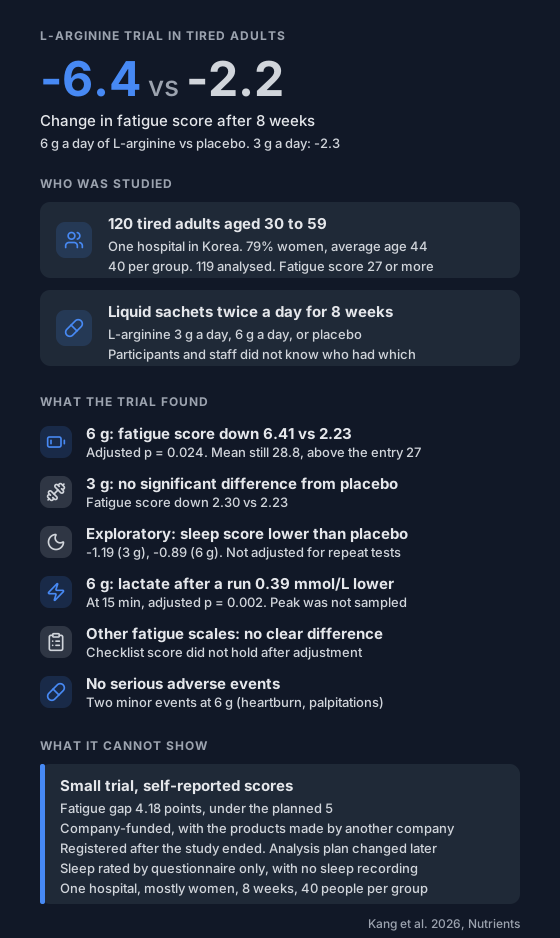
Tiredness that doesn't lift is common, and the authors say evidence for nutritional approaches to it is limited. A 2026 trial from Korea tested L-arginine, an amino acid the body uses to make nitric oxide, against placebo.
Only the higher dose, 6 g a day, differed from placebo on the main fatigue score. The sleep score changes were not adjusted for repeat testing, so the authors call them exploratory. The trial was funded by a company.
What was tested?
- A randomised, double-blind, placebo-controlled trial at one hospital in Daejeon, Korea, with recruitment from July to December 2024.
- Three groups of 40: L-arginine 3 g a day, L-arginine 6 g a day, or placebo.
- Everyone drank a 20 g liquid sachet twice a day for 8 weeks. The 3 g group had 1.5 g per sachet, the 6 g group 3 g per sachet.
- Neither participants nor staff knew who had which.
Who was studied?
- 120 adults aged 30 to 59, living in the community.
- 119 were analysed, because one person in the 6 g group had no results after the start.
- Average age 44, and about 79% were women.
- All scored 27 or more on the FSS, a 9-item fatigue questionnaire where higher means more fatigue. Average starting scores were 34 to 37. The authors note that 36 is a cut-off often used for clinically significant fatigue, so average scores sat around that line.
- Their fitness was in the middle of the Korean range.
- People with major chronic disease, uncontrolled psychiatric illness, night-shift work, a BMI of 35 or more, or abnormal kidney or liver tests were excluded.
What did it find on fatigue?
- At 6 g a day, the FSS score went down 6.41 points, against 2.23 on placebo. That is a 4.18-point difference, and it held after the authors' correction for testing two doses (adjusted p = 0.024).
- That gap was smaller than the 5 points the trial was sized to find. The authors say no minimal important change is established for this score in community groups, so its clinical relevance is uncertain.
- At 3 g a day it went down 2.30 points, with no statistically significant difference from placebo (p = 0.935).
- The 6 g group's average at week 8 was 28.8, still above the entry score of 27. The authors say this is a reduction, not an end to persistent fatigue.
- A second fatigue questionnaire (the Checklist Individual Strength) went down 7.44 points at 6 g, against 0.78 on placebo. That did not hold after correction.
- Two other fatigue measures, a multidimensional fatigue scale and a visual rating scale, showed no consistent difference.
What about sleep?
Sleep was a secondary question, rated with the Pittsburgh Sleep Quality Index, where a lower score is better sleep.
- Starting scores were 6.1 to 6.7.
- After adjusting for starting scores, the total score was 1.19 points lower than placebo at 3 g (p = 0.007) and 0.89 points lower at 6 g (p = 0.045). The ranges overlapped, so the two doses were not clearly different.
- Without that adjustment, the 6 g difference was p = 0.097.
- One component, habitual sleep efficiency, differed from placebo at 3 g only.
- Another, daytime dysfunction, was 0.30 points lower than placebo at both doses (p = 0.047 and 0.046).
- The authors call these results exploratory. The p-values were not corrected for the number of tests, and some estimates were close to no difference.
- The groups started with different daytime-dysfunction scores, and the analysis plan allowed adjusting for that. The same adjustment was added to the total score and sleep efficiency after the fact.
- Sleep was rated by questionnaire only. There was no sleep recording and no overnight oxygen measurement.
What about the exercise test?
At the start and at week 8, participants ran on a treadmill for 30 minutes at about 70% of their maximum fitness. Blood was taken before, straight after, and 15 and 30 minutes after.
- At 6 g, blood lactate 15 minutes after the run was 0.39 mmol/L lower than placebo (adjusted p = 0.002), and total lactate over the test was lower (adjusted p = 0.041).
- The 30-minute value, and the 3 g group at every time point, showed no statistically significant difference.
- The peak was not sampled, so the study can't say whether lactate cleared faster or was made less.
- Resting nitrite, a marker of nitric oxide, showed no statistically significant difference.
- The 15-minute values stayed in the typical range, and the authors say their clinical relevance is not established.
Were there side effects?
- No serious adverse events.
- Two minor events, heartburn and palpitations, both in the 6 g group (2 of 39, against 0 of 40 on placebo). The difference was not statistically significant, and the authors judged both unrelated to the product.
- The authors note 40 people per group cannot pick up uncommon events. They also note a trial of L-arginine soon after a heart attack raised safety concerns, and say that does not apply to these participants.
Who paid for it?
- ARI BnC Co., Ltd. gave financial support, and Daesang Wellife Co., Ltd. made the products and supplied and blinded them free of charge.
- The authors say neither had a role in the design, analysis, writing or decision to publish.
- They declare no commercial or financial conflicts.
- The paper thanks two people for resources from ARI BnC, and Daesang Wellife for preparing the products and logistical support.
What doesn't it tell you?
- What it would do for you. 40 people per group is small, and the authors say the sleep, exercise and dose-comparison results were underpowered.
- Anything beyond 8 weeks. There was no follow-up after the supplement stopped.
- Everyone. One hospital, mostly women, and people without major illness.
- Pre-planned analysis. Recruitment ended in December 2024, and the trial was registered on 30 July 2026, after it finished. The authors say the protocol and main fatigue score had ethics approval before anyone enrolled. The switch to the main analysis group and the correction for repeat tests were made after the fact. The authors say the main fatigue result was the same in both analysis groups.
- Objective fatigue or sleep. Both were self-reported, and the authors note recall and expectation bias.
- Why 6 g differed from placebo and 3 g didn't. The authors say the data can't explain it. The 3 g group started with a higher fatigue score and lower fitness, and they can't rule out a part for that.
What can you do with this?
This trial can't say whether L-arginine would change your fatigue or sleep. The authors say the 6 g dose needs confirmatory trials. Supplements can interact with medicines and conditions, so discuss any change with a clinician.
Fatigue has many causes, and tiredness with loud snoring or pauses in your breathing during sleep is worth raising with a doctor. Read snoring vs sleep apnea for the other signs.
The sleep apnea risk check takes about a minute. If you track sleep, an overnight oximeter records what your oxygen and pulse did, and you can share that with your doctor.
For another supplement trial, see ashwagandha, magnesium and sleep.
Not a medical device. Does not diagnose, treat or prevent any condition. Discuss results and changes with a clinician.
References
- Kang EB, Hong SB, Yoon N, Lee N, Kim B. Effects of Oral L-Arginine on Everyday Persistent Fatigue, Sleep, and Post-Exercise Lactate Recovery in Community-Dwelling Working-Age Adults: A Double-Blind, Placebo-Controlled Randomized Trial. Nutrients. 2026;18(20):3375. doi:10.3390/nu18203375