Nightmare Smartwatch Pilot: First Responders
Ten San Francisco first responders with PTSD nightmares used a prescribed smartwatch that buzzes during sleep. Self-reported nightmare nights fell from 5.2 to 3.6 a week over 60 days. No control group, and the device maker funded it and employs two of the three authors.
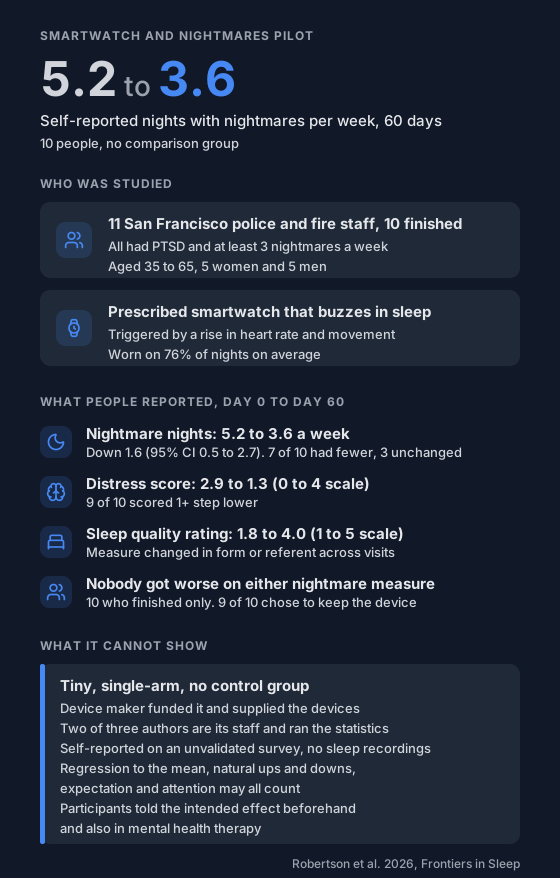
Nightmares are common in people with post-traumatic stress disorder (PTSD). A 2026 report describes what 11 San Francisco police and fire staff with PTSD said while using a prescribed smartwatch device that buzzes during sleep. It's a very small pilot with no comparison group, and the results are self-reported. The device's maker funded it, and two of the three authors work for the company.
What was studied?
- Who: 11 first responders from the San Francisco Police and Fire Departments started. Ten finished all three check-ins. One dropped out after the first survey and isn't in the results. Half were police and half were fire service.
- Age and sex: 35 to 65, 5 women and 5 men among the 10 who finished.
- Work status: 4 were on active duty. 6 were on workers' compensation leave or retired.
- Condition: all had PTSD and at least 3 nightmares a week. They were also in mental health therapy, at varying frequency. Medication details weren't collected, though none were taking prazosin.
- The device: a prescription kit with an Apple Watch and a phone app. It estimates a stress level from heart rate and movement during sleep. When it passes a personal threshold, the watch buzzes for 3 to 5 seconds, with stronger buzzes if the level stays high.
- Use: the group wore it on 76% of nights on average, between 55% and 100%.
It's a single-arm, open-label pilot. Everyone got the device, everyone knew it, and there was no comparison group. It ran as a program evaluation of routine care, so it was exempt from ethics board review, and people gave verbal consent to their data being used.
What did people report?
They answered a survey at the start, at day 30 and at day 60.
- Nightmare nights: 5.2 a week at the start, 3.8 at day 30 and 3.6 at day 60. The average drop of 1.6 nights had a 95% confidence interval of 0.5 to 2.7 (p = 0.011).
- Distress from nightmares (0 to 4): 2.9, then 1.9, then 1.3. The average drop of 1.6 points had a confidence interval of 1.0 to 2.2.
- Who changed by day 60: 7 of 10 had fewer nightmare nights, including 3 with a drop of at least half. The other 3 were unchanged. 9 of 10 scored at least one step lower on distress, and 6 at least two steps lower. Nobody got worse on either measure.
- Sleep quality (1 to 5): an average rating of 1.8 at the start, 3.2 at day 30 and 4.0 at day 60.
- Satisfaction (1 to 5): 2.2 for their current or earlier care at the start, 4.5 for the device at day 60. Those two ratings are about different things, so it isn't a before-and-after change. Nine of 10 chose to keep using it after the pilot.
Most of the drop in nightmare nights was already there by day 30. The distress score went on falling to day 60.
How much weight can this carry?
Very little. The authors place the findings "firmly in the hypothesis-generating category".
- Ten people is too few for a precise estimate, and one or two people can move the averages. The authors call the p-values exploratory.
- No control group. The authors say the change can't be put down to the device alone. Regression to the mean (extreme scores tend to drift back on their own), natural ups and downs, expectation and the attention of a monitored program may all have contributed.
- Self-reported. The survey was a custom one and isn't an independently validated scale. There were no sleep recordings.
- Sleep quality and satisfaction are simple averages. The authors say both measures changed in form or referent across visits.
- Missing details. Demographics, other health conditions and other care weren't systematically captured. The paper gives no side-effect data.
- Not a controlled result. An earlier randomized trial in 65 veterans, cited by the authors and also funded by the device maker, found that both the active and sham device groups scored better over 30 days. None of the comparisons between the two groups was statistically significant. A post hoc analysis that left out low users found a significantly better sleep quality change with the active device.
Who paid and who wrote it?
NightWare, Inc., the device's maker, funded the work. It provided the devices and took part in the analysis and reporting of the results. Two of the three authors are its employees, and those two ran the statistics. The third is a member of the First Responder Support Network in San Rafael, California, and says he received no payment. The paper calls the evaluation company-affiliated, and its discussion makes the case for the device, so weigh that part with those ties in mind.
The paper also says the participants were told the device's intended effect before they started. That can shape what people report.
What does it mean for tracking your own sleep?
- The device is triggered by heart rate and movement during sleep. With no comparison group, the pilot can't show that the buzzing is what changed anyone's reports.
- For what the sleep lab evidence says about nightmares and sleep structure, see nightmares and sleep study results.
- Nightmares linked to trauma are a topic for a doctor or a mental health professional. A recording from your own device can be shared with them.
Not a medical device. Does not diagnose, treat or prevent any condition. Discuss results and changes with a clinician.
References
- Robertson BD, Wargo EF, Fay J. Real-world reduction in nightmare frequency and distress among San Francisco first responders treated with a prescription wearable device: a 60-day open-label pilot. Frontiers in Sleep. 2026;5:1941077. doi:10.3389/frsle.2026.1941077
- Davenport ND, Werner JK. A randomized sham-controlled clinical trial of a novel wearable intervention for trauma-related nightmares in military veterans. Journal of Clinical Sleep Medicine. 2023;19(2):361-369. doi:10.5664/jcsm.10338