Hydrogen Jelly and Sleep: A Placebo Trial
In a 2026 trial, 44 adults with poor sleep took hydrogen-rich or placebo jelly for 8 weeks. Sleep scores showed no statistically clear difference between the groups. An exploratory gut bacteria finding is a hypothesis, not a result.
Hydrogen water and hydrogen supplements are sold on the idea that hydrogen mops up reactive oxygen molecules that can damage cells. Earlier studies in people with long COVID or obesity reported better self-rated sleep with it, but there's little on healthy people.
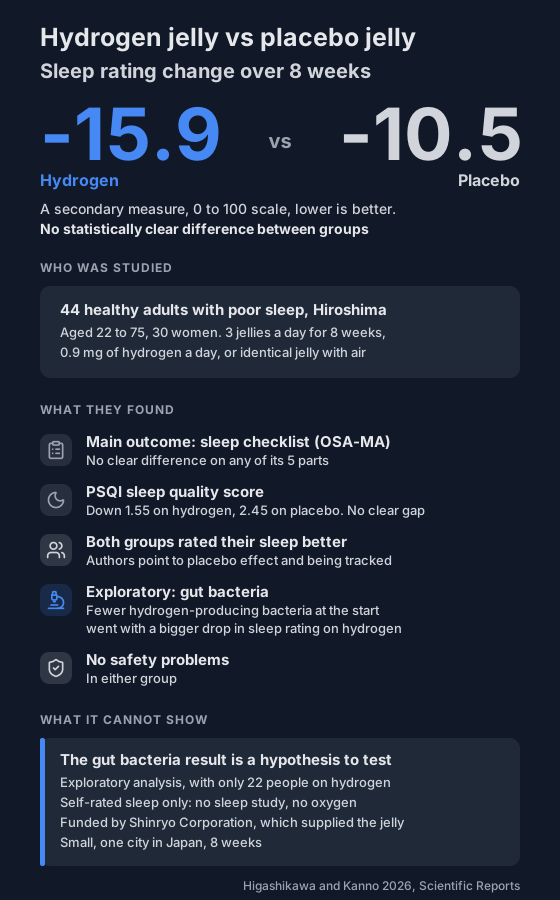
A placebo-controlled trial from Japan, published in July 2026, tested hydrogen-rich jelly on 44 adults with poor sleep. Overall, sleep scores showed no statistically clear difference between hydrogen and placebo.
Who was in the trial?
- 44 healthy adults in Hiroshima who weren't happy with their sleep, aged 22 to 75.
- 30 women and 14 men, with a typical BMI of about 22 to 23.
- People on therapy for a long-term condition, or taking antioxidant supplements, were left out.
- Half took hydrogen-rich jelly, half took a placebo jelly with air in it, identical in look and taste.
- 3 sachets a day for 8 weeks, 0.9 mg of hydrogen a day in total.
- Neither the participants nor the researchers knew who had which.
- At the end, 18 of 44 guessed their group correctly.
- Everyone finished, and both groups took about 95% of their sachets.
The hydrogen group was a bit older on average (60 vs 53), though that gap wasn't statistically clear.
What did it measure?
All the sleep measures were questionnaires, filled in every week:
- OSA-MA: the main outcome, a Japanese sleep checklist with 5 parts, like how sleepy you are on waking and how well you fall and stay asleep. Higher is better.
- Sleep rating: a 0 to 100 line, where 0 is the best sleep imaginable. Lower is better.
- PSQI: a standard sleep quality score from 0 to 21. Lower is better.
- Ratings for mental stress, physical tiredness and anxiety.
There was no sleep study, and no overnight oxygen or heart rate.
What did it find?
Both groups rated their sleep better by the end, and the gap between them wasn't statistically clear.
- OSA-MA: no clear difference on any of the 5 parts. The falling and staying asleep part rose by 5.5 points with hydrogen and 6.4 with placebo.
- Sleep rating: down 15.9 points with hydrogen and 10.5 with placebo.
- PSQI: down 1.55 with hydrogen and 2.45 with placebo.
- Mental stress rating: down 15.0 with hydrogen and 9.3 with placebo.
- Physical tiredness rating: down 14.0 with hydrogen and 17.1 with placebo.
So neither group came out ahead on every measure. The paper says the gains tended to be bigger with hydrogen, but in its own table placebo did better on the PSQI, physical tiredness and 3 of the 5 checklist parts. The authors say the change in both groups may come from the placebo effect, scores drifting back from a bad patch, and people changing habits because they're being tracked.
Blood and urine markers of oxidative stress, which hydrogen was meant to lower, showed no consistent change. No safety problems were seen in either group.
What about the gut bacteria?
This is the paper's headline, and it's exploratory.
- Some gut bacteria make hydrogen. The main one here was Bacteroides.
- The researchers analysed stool samples from the start of the trial.
- In the hydrogen group, people with fewer hydrogen-making bacteria tended to have a bigger drop in their sleep rating.
- No such link showed up in the placebo group.
- The statistical model also flagged the stress rating and the falling and staying asleep part of the main checklist.
- For the sleep rating, it held up after adjusting for age.
- It didn't show up on the PSQI, the anxiety scores, or the other 4 parts of the main checklist.
The authors' idea is that extra hydrogen stands out more in people whose gut makes little of its own. They call it a hypothesis that needs confirming in larger studies.
Read it that way. It comes from 22 people on hydrogen, several measures were tested, and the main outcome showed no statistically clear difference. It doesn't show that anyone should test their gut bacteria or take hydrogen.
What can't it show?
- That hydrogen helps sleep. The planned comparison found no statistically clear difference.
- How you'd sleep on a recording. Every sleep measure was self-rated. The authors say future studies need objective measures.
- Who it applies to. 44 people of one ethnic background in one city in Japan, for 8 weeks.
- Diet and antibiotics. Diet wasn't fully recorded and past antibiotic use wasn't ruled out, and both shape gut bacteria.
- Funding. The trial was funded by Shinryo Corporation, which supplied the jellies. The authors declared no competing interests.
What can you do with this?
Self-rated sleep often gets better in a trial whatever people take. That's why a placebo group matters, and why it's worth recording your nights rather than going on feel alone. People often misjudge their own sleep.
If you're curious how a change in routine lines up with your nights, run it as a self-experiment. Wear an overnight pulse oximeter for a run of nights before and after, not just one of each. See how many nights to record.
Poor sleep that lasts has many possible causes. If you snore loudly, someone has heard you stop breathing, or you're very tired during the day, the sleep apnea risk check can help you decide whether to talk to a doctor.
Not a medical device. Does not diagnose, treat or prevent any condition. Discuss results and changes with a clinician.
References
- Higashikawa F, Kanno K. Individual variability in hydrogen-producing microbes influences the response to hydrogen supplementation on sleep quality: a randomized, double-blind, placebo-controlled, parallel study. Scientific Reports. 2026;16(1):23337. doi:10.1038/s41598-026-52342-9