Caffeine and Sleep Length: A 2025 Study
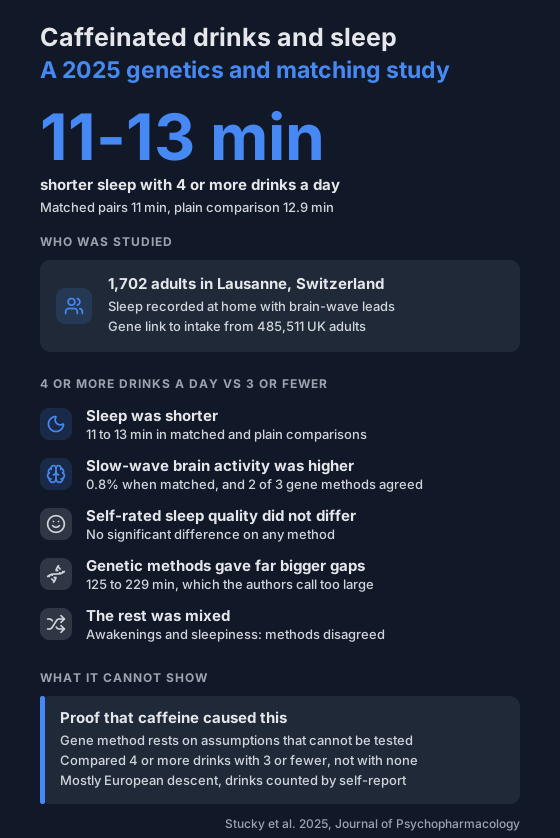
A 2025 study of 1,702 adults recorded at home found that four or more caffeinated drinks a day went with 11 to 13 fewer minutes of sleep and more slow-wave brain activity. Self-rated sleep quality showed no significant difference.
Lab studies show a dose of caffeine delays sleep and shortens it. Most of them ask people to stop caffeine first, so they say little about people who drink it every day.
A 2025 study looked at habitual drinkers instead. It compared people who have four or more caffeinated drinks a day with people who have three or fewer, using whole-night sleep recordings made at home. Its authors also used genetics to argue the link is more than coincidence.
Who was in the study?
- 1,702 adults from HypnoLaus, a population study in Lausanne, Switzerland.
- Average age was 57 in the higher-caffeine group and 59 in the lower one. About half were women.
- Each had a full night of sleep recorded at home, with brain-wave (EEG) leads and standard scoring.
- Caffeine was self-reported as drinks a day. About a quarter reported four or more.
- A second dataset, the UK Biobank (485,511 adults), was used only to find which gene variants go with drinking more.
What did they find?
Total sleep time was shorter in the four-or-more group on every method.
- Matched pairs: 11 minutes shorter (p = 0.007).
- Plain comparison, adjusted for age and sex: 12.9 minutes shorter (p < 0.001).
- Three genetic methods: 125, 140 and 229 minutes shorter. The authors call these gaps of over 2 hours unrealistically large.
The share of slow-wave (delta) brain activity in non-REM sleep was higher, which the authors read as deeper sleep. Two of the three genetic methods found it higher (8.8% and 10.3%), and matching found it 0.8% higher. The measure is itself a percentage of total brain-wave power, and the paper prints these differences as percentages. The plain comparison found no statistically significant difference in slow-wave activity. The matched differences were small: Cohen's d was -0.15 for sleep time and 0.14 for slow-wave activity.
Of the genetic results, the weighted-median estimates for sleep time and slow-wave activity were the ones the paper reports as still significant after correcting for multiple tests.
Self-rated sleep quality on the Pittsburgh questionnaire showed no statistically significant difference on any method. REM share and spindle-range brain activity showed none on any method either. Time to fall asleep showed no significant difference on any genetic method, while matching found it slightly shorter in the four-or-more group. Awakenings, a sleepiness score and morning-or-evening preference were flagged by only some methods, and matching pointed the opposite way to the flagged genetic estimates on awakenings and sleepiness. The abstract says morning-or-evening preference did not differ, while the results report one genetic method (weighted median) that flagged it.
The authors suggest the shorter sleep is partly made up for by deeper sleep. They note naps were not recorded, so fewer naps in heavy drinkers could have contributed to the extra slow-wave activity.
What does "causal evidence" rest on here?
The study uses two tricks, and neither is a trial.
Genes as a natural experiment.
- Some gene variants go with drinking more caffeinated drinks. Many sit in or near genes that handle caffeine in the liver.
- You inherit them by chance, so your job, habits and how badly you sleep can't change them.
- If people carrying the "drinks more" variants also sleep less, the drinking becomes a candidate cause.
- The authors picked 30 variants from the UK Biobank, and each of three methods used its own subset, with different assumptions about faulty variants.
- They also ran a control. Caffeine can't change your age, and no causal method found an effect on age, while the plain comparison did, because older people drink less.
Matching.
- Each higher-caffeine person was paired with a similar lower-caffeine person. 609 pairs remained for sleep time.
- Pairs were matched on factors including health, activity, alcohol, smoking, BMI, age, sex, education and job.
- That only balances what was measured.
The authors say the two approaches have different weak spots, so agreement between them counts for more than either alone.
What can't it show?
- Proof of cause. The genetic method only works if the variants affect sleep through caffeine and nothing else. That can't be tested. The authors judged each variant from published literature, and note many affect liver function. A built-in check (the MR-Egger intercept) showed no sign of this.
- A precise size. The genetic signals were weak, so the genetic estimates were very uncertain. The 11 to 13 minute figure comes from the methods without that problem.
- Matching's blind spots. It can't rule out unmeasured differences or the reverse, where short sleepers drink more.
- Any caffeine vs none. The split was four or more against three or fewer, so the comparison group includes people who have a few drinks a day.
- Your own sleep. A group average doesn't say what happens to one person.
- Exact intake. Drinks were self-reported and counted equally, whatever their caffeine content.
- Everyone. Most participants were of European descent.
- The whole sleep picture. Some brain-wave features weren't analysed, and the effects were small.
- Nights over time. Sleep was recorded on a single night per person.
The paper's participant counts differ in places. The abstract and figures give 1,702 HypnoLaus participants, the methods mention 1,755 with recordings, and the groups in the demographics table add up to 1,726.
The work was paid for by University of Zurich institutional funds, and the authors declared no conflicts of interest.
What can you do with this?
It's one study, and it doesn't tell you what to drink.
An overnight oximeter doesn't record brain waves, so it can't show sleep depth or sleep time. It does record pulse and oxygen all night. If you're curious about your own pattern, note your drinks for each night and compare nights with three or fewer to nights with four or more. How many nights to record covers how many nights make a fair comparison.
For another caffeine study, see caffeine naps for drivers with sleep apnea. For a similar self-experiment with a different evening habit, see alcohol and overnight oxygen.
Not a medical device. Does not diagnose, treat or prevent any condition. Discuss results and changes with a clinician.
References
- Stucky B, Henckel L, Maathuis MH, Haba-Rubio J, Marques-Vidal P, Siclari F, Heinzer R, Landolt HP. Community-based causal evidence that high habitual caffeine consumption alters distinct polysomnography-derived sleep variables. Journal of Psychopharmacology. 2025;39(12):1437-1448. doi:10.1177/02698811251368364