Nap HRV and Mood in Younger and Older Adults
A 2026 lab study of 111 healthy adults found older adults had lower heart rate variability awake and during a nap, and that HRV during the nap went with how positive people felt afterwards.
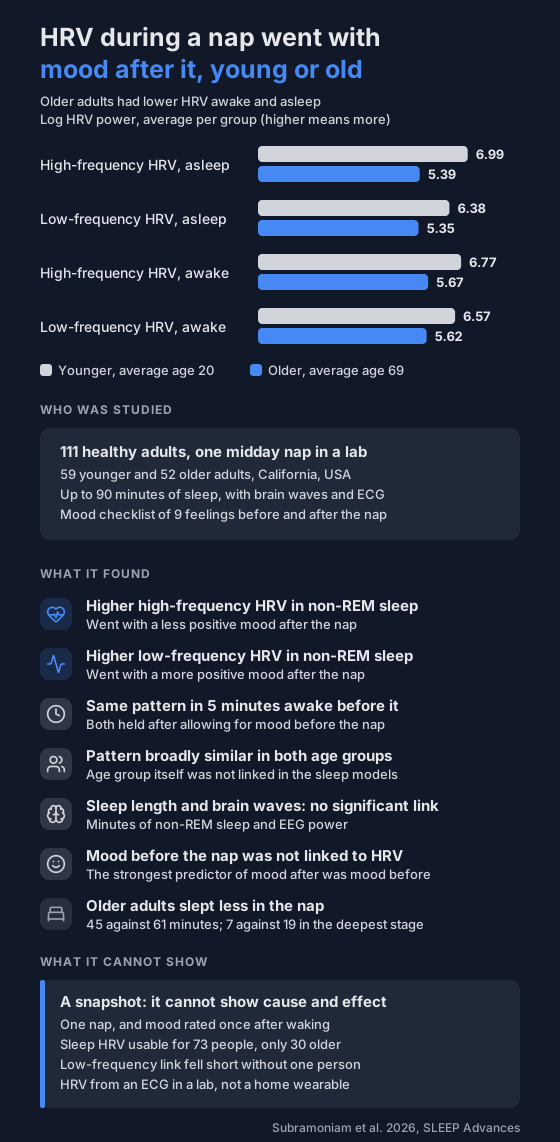
Older adults tend to report more positive moods than younger adults. Heart rate variability (HRV) also tends to fall with age, and higher HRV is often read as a good sign.
A study published in July 2026 put the two together during a daytime nap. It looked at whether HRV during the nap went with how people felt when they woke up.
Who was in the study?
- 111 healthy adults recruited from the community, in a study approved by the University of California, Riverside.
- 59 younger adults, average age 20, and 52 older adults, average age 69.
- None had a history of sleep, heart, neurological or psychiatric conditions, and all reported sleeping 6 to 9 hours a night.
- No caffeine or alcohol for 24 hours before the visit.
What did they measure?
- The nap. A 2-hour chance to sleep in the lab, woken early if they reached 90 minutes of sleep. Brain waves were recorded to score sleep stages.
- HRV. From an ECG, for 5 minutes lying awake before the nap and in clean 3-minute stretches of non-REM sleep.
- Mood. A checklist of 9 feelings, rated 1 to 7, before and after the nap.
The HRV measures were high-frequency and low-frequency power. High-frequency power is usually read as the "rest and digest" side of the nervous system. What low-frequency power reflects is less clear, and the authors note that what drives HRV is still debated.
Mood was turned into a positivity score: positive feelings minus negative ones. The authors split it into calmer feelings (pleased against unhappy, frustrated, down) and more intense ones (happy, joyful, enjoyment against angry, worried).
How did younger and older adults differ?
- HRV. Older adults had lower high-frequency and low-frequency HRV, both lying awake and in non-REM sleep. In non-REM sleep, log high-frequency power averaged 6.99 in younger adults and 5.39 in older adults.
- Sleep. Older adults slept 45 minutes on average against 61, with 7 minutes in the deepest stage against 19.
- Mood. After the nap, younger adults scored higher on calm positivity than on intense positivity, 3.6 against 3.0. Older adults scored about the same on both, 3.4 against 3.3.
Older adults scored a little higher on positivity overall, but that difference wasn't statistically significant.
How did HRV relate to mood after the nap?
This is the surprising part.
- Higher high-frequency HRV in non-REM sleep went with a less positive mood after the nap, for both calm and intense feelings.
- Higher low-frequency HRV in non-REM sleep went with a more positive mood after the nap.
- The same pattern showed in the 5 minutes lying awake before the nap.
- Both held after allowing for mood before the nap, which was the strongest predictor of mood after.
- The pattern was broadly similar in younger and older adults.
Minutes of non-REM sleep and non-REM brain-wave power weren't significantly linked to mood after the nap.
The authors also checked the other direction. Mood before the nap wasn't significantly linked to HRV awake or asleep.
The authors note the high-frequency result goes against earlier work linking higher high-frequency HRV with calm, contented states.
What can't it tell you?
- Cause. It's a snapshot of one visit. It shows what went together, not what caused what.
- Small numbers in sleep. Naps are short and broken, so sleep HRV was usable for 73 people, only 30 of them older. Some models ran on 19 older adults.
- One fragile result. With one outlying person left out of the sleep models, the low-frequency link fell just short of statistical significance. The high-frequency link held.
- Timing. Mood was rated once after waking, and grogginess after a nap can make people feel worse for a while.
- Your own nights. It was one daytime nap in a lab with an ECG. It wasn't a night's sleep or a home wearable.
The paper also isn't consistent on some details, such as when the mood ratings were taken.
The authors declared no funding and no competing interests.
What can you do with this?
In this study, higher HRV didn't simply go with a better mood. The high-frequency and low-frequency bands pointed in opposite directions.
If you track HRV and want to see how it lines up with your mood:
- Rate your mood at the same time each morning.
- Compare weeks of readings, not single nights.
- Expect wrist or finger HRV to differ from an ECG. See wearable HRV vs ECG.
For a closer look at overnight HRV from a wrist tracker, see Fitbit Versa 4 overnight HRV.
Not a medical device. Does not diagnose, treat or prevent any condition. Discuss results and changes with a clinician.
References
- Subramoniam A, Chen PC, Sattari N, Mednick SC, Whitehurst LN. Sleep dependent autonomic correlates of affect and arousal in younger and older adults. SLEEP Advances. 2026;7(3):zpag083. doi:10.1093/sleepadvances/zpag083