CPAP Mouth Leaks: What Comes Before Them
A 2026 study of 200 people on CPAP with a chin sensor found the mouth opened before the leak in about 9 in 10 leak stretches. Leaks went with more arousals and less deep sleep. Three authors report ties to the sensor's maker.
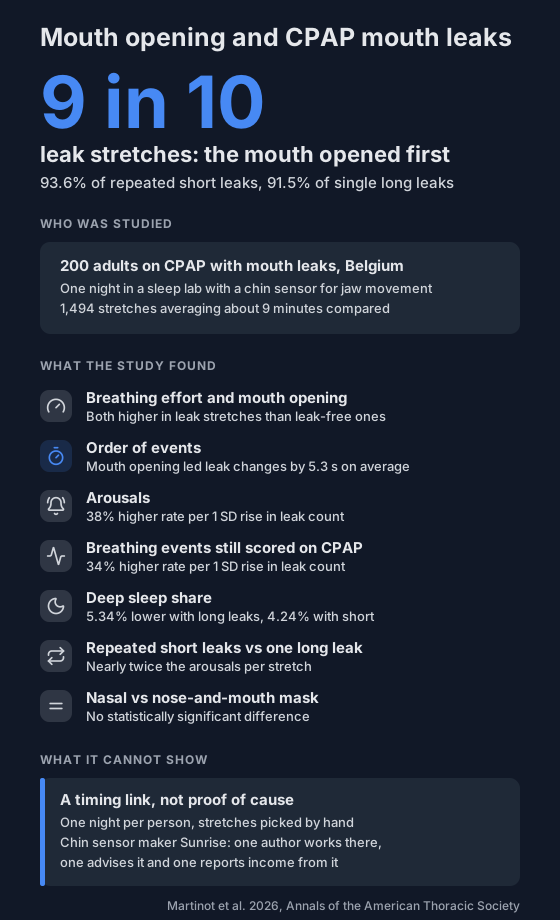
Mouth leaks on CPAP are usually put down to the mask. A 2026 study from Belgium looked at what happens just before a leak starts.
It put a small movement sensor on the chin of 200 people on CPAP. In about 9 in 10 leak stretches, the mouth opened first and the leak followed. Three of the five authors report ties to the company that makes the sensor.
Who was studied?
- 200 adults with obstructive sleep apnea, already on CPAP, at one hospital sleep lab in Namur, Belgium, between 2021 and 2023.
- Only people whose CPAP data showed mouth leaks were included.
- 62.5% were men. Median age 58, median BMI 33.6.
- Before CPAP, their sleep studies had found a median of 37.7 breathing events per hour.
- All of them used CPAP at least 4 hours a night on at least 70% of nights. The average was 6.5 hours.
- 75% used a nasal mask and 25% a mask over the nose and mouth.
What did they measure?
Each person spent one night in the lab on their own mask and an auto-adjusting ResMed AirSense 10.
- A full sleep study recorded sleep stages, arousals and breathing events.
- The CPAP machine logged leak flow.
- A chin sensor recorded jaw movement. Its swings track breathing effort, and how far the jaw drops shows mouth opening.
The team picked 1,494 stretches of the night by hand from the leak trace, about 9 minutes long on average:
- No leak: 664 stretches.
- Repeated short leaks: 466 stretches with 3 or more leaks under 2 minutes each.
- One long leak: 364 stretches with a single leak of 2 minutes or more.
What came first?
A timing test checked whether changes in mouth opening came before changes in leak flow, or the other way round.
- Changes in mouth opening came first in 93.6% of repeated short leak stretches and 91.5% of long leak stretches.
- On average it led the leak by 5.3 seconds.
- The reverse, leaks coming before mouth opening, wasn't supported.
- Breathing effort and mouth opening were both higher in leak stretches than in leak-free ones, more so with repeated short leaks.
The lowest leak flow stayed under 5 L/min in every group. The authors read that as a sign the mask was sealing between leaks, so a badly fitting mask was unlikely to be the main cause.
What went with the leaks?
The study compared leak stretches with leak-free ones, allowing for stretch length and CPAP pressure.
- Arousals: 38% higher rate for each 1 standard deviation rise in the number of leaks.
- Breathing events still scored on CPAP: 34% higher rate for the same rise.
- Deep sleep: its share of sleep was 5.34% lower with long leaks and 4.24% lower with repeated short leaks.
- Short vs long: repeated short leaks went with nearly twice the arousals of one long leak (1.89 times).
- Pressure: the machine's pressure was higher during leak stretches, a median of about 9 to 9.5 cmH2O against 7 in leak-free ones.
There was no statistically significant difference between nasal and nose-and-mouth masks in jaw movement, leak flow or how closely the two tracked each other. The authors say a nose-and-mouth mask may change where the air escapes without stopping the mouth from opening.
What can't it tell you?
- Who made the sensor. One author works for Sunrise, the company that makes the chin sensor. The first author is a scientific advisor to it, and a third reports Sunrise income for medical education. The paper reports no funding.
- Other ties. The last author reports income from ResMed for medical education, and ResMed made a donation to another author's university.
- Cause. The timing test shows what came first, not what caused what. The authors say something else, like arousals or a blocked nose, could drive both. The timing results in the main text cover mouth opening and leak flow only. That breathing effort comes before mouth opening is the authors' proposed mechanism, based on the higher effort seen during leaks; the main text doesn't report a timing test for it.
- One night. It was a single lab night per person, so it can't say whether leaks affect how long people keep using CPAP.
- Who was picked. Everyone had mouth leaks, and the stretches were chosen by hand. It doesn't tell you how common this is in everyone on CPAP.
- Breathing event counts during leaks. Events were scored from the CPAP airflow, which misses air going out through the mouth. The authors say that could skew those counts.
- Other causes. The authors say this isn't the only route to mouth leaks. The mouth can also fall open passively during some breathing pauses.
The authors list options they think may help when leaks continue, from mask fit and humidity to chin straps and oral appliances. This study didn't test any of them.
What can you do with this?
Your CPAP report shows total leak, not where the air went or what came before it. If leaks keep showing up on it, bring the report to your clinic.
- Does CPAP mask leak predict CPAP use? covers another 2026 study on leak.
- Why events still show up on CPAP covers the events-per-hour figure.
An overnight oximeter can't see leaks or jaw movement. It logs your oxygen and pulse through the night, mask on or off. Tracking your oxygen alongside CPAP explains what that adds.
Not a medical device. Does not diagnose, treat or prevent any condition. Discuss results and changes with a clinician.
References
- Martinot JB, Le-Dong NN, Clause D, Malhotra A, Pépin JL. Respiratory Effort-Driven Mandibular Opening as a Mechanism of Air Leak During CPAP Therapy. Annals of the American Thoracic Society. 2026. Online ahead of print. doi:10.1093/annalsats/aaoag253