Left vs Right Side Sleeping and Sleep Apnea
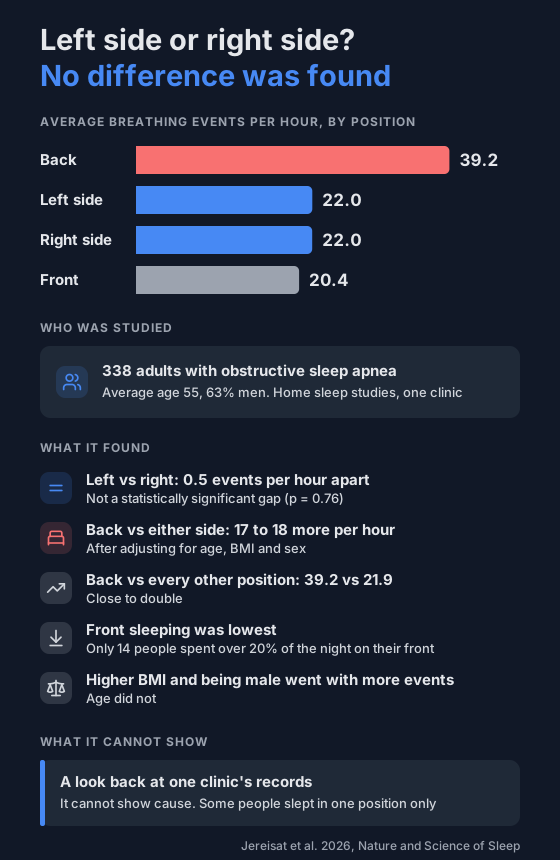
A 2026 study of 338 adults with sleep apnea found no difference in breathing events between the left and right side. Back sleeping had nearly double the events of other positions.
You've probably read that side sleeping beats back sleeping if you have sleep apnea. But does it matter which side?
A study published in September 2026 checked. It found no statistically significant difference between left and right.
Who was in the study?
- 338 adults with obstructive sleep apnea, from one outpatient sleep clinic.
- Average age 55, average BMI 33, and 63% were men.
- Each had a home sleep study lasting more than 6 hours.
The researchers counted breathing events per hour in each position. An event is a pause or partial drop in airflow lasting 10 seconds or more.
What did it find?
Average events per hour:
- Back: 39.2
- Left side: 22.0
- Right side: 22.0
- Front: 20.4
Every position other than the back combined came to 21.9, so back sleeping was close to double.
The team then counted only positions held for more than 20% of the night, and adjusted for age, BMI and sex.
- Left and right were 0.5 events per hour apart, which wasn't statistically significant.
- Back sleeping had 17 to 18 more events per hour than either side.
What about sleeping on your front?
It had the lowest figure. But only 14 people spent more than 20% of the night on their front, so the authors call that result exploratory.
Did anything else matter?
- Higher BMI went with more events, about 0.37 per hour for each BMI point.
- Men had about 5.5 more events per hour than women.
- Age wasn't linked to the number of events.
- In the group with the most events, the averages were 67.8 on the back, 46.8 on the left and 49.3 on the right.
Does this settle it?
No. The authors cite a 2012 study of 131 patients where the left side had more events than the right, 30.2 against 23.6. A 2015 study of 327 patients found no gap.
They also cite a 2025 analysis of 19 trials, where positional therapy lowered events on the back but did less than CPAP overall.
What doesn't it tell you?
- Cause. It looks back at existing records, so it can't show cause.
- Everyone. It covers one clinic, using home sleep tests.
- Each person. Some people slept in only one position.
- Other factors. Other health conditions and medication weren't accounted for.
What can you do with this?
Note which position you slept in, then compare your overnight oxygen for back and side sleeping. Record several nights of each before comparing.
An oximeter records oxygen dips, not breathing events, and you can share with your doctor.
Not a medical device. Does not diagnose, treat or prevent any condition. Discuss results and changes with a clinician.
References
- Jereisat RA, Qaryouti H, Alsawalha H, Maksoud A, Abdeen Y. The Effect of Different Sleep Positions on the Severity of Obstructive Sleep Apnea: A Retrospective Study. Nature and Science of Sleep. 2026;18:627693. doi:10.2147/NSS.S627693