EmbracePlus Wristband SpO2 Accuracy Tested
A 2023 lab study compared the Empatica EmbracePlus wristband with arterial blood in 15 healthy adults sitting still. Its typical error was 2.4 points. All the authors work for or are paid by Empatica and hold its shares.
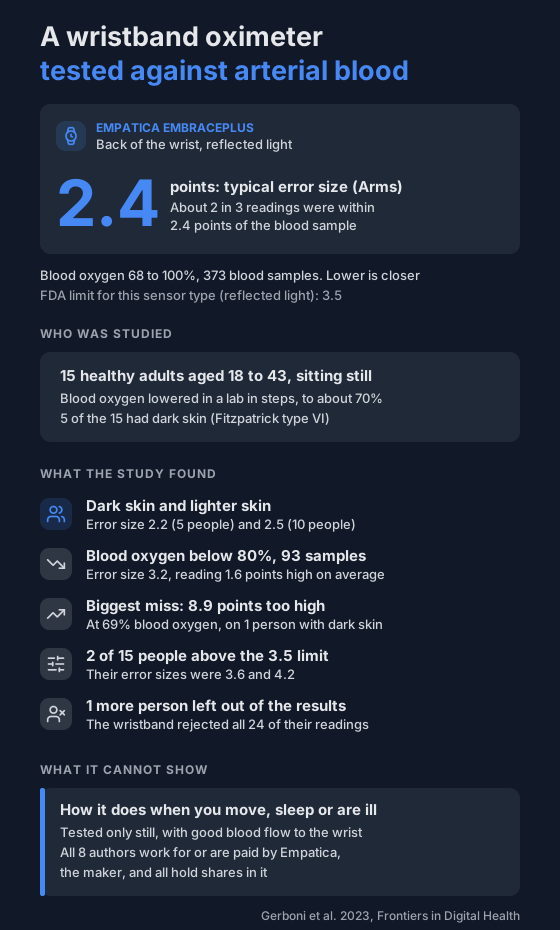
Wrist-worn oximeters are thought to be less exact than fingertip ones. The back of the wrist has less blood flow, and the sensor reads light bounced back from the skin rather than shone through a finger. A 2023 study put one wristband, the Empatica EmbracePlus, through the lab test that medical oximeters go through.
One thing to know first: all eight authors hold shares in Empatica and get a salary or consulting fees from it. One of them co-founded the company and chairs its board.
Who was studied?
- 16 healthy adults aged 18 to 43: 8 women and 8 men.
- 5 had dark skin, rated Fitzpatrick type VI.
- Each sat half-reclined and still for about 45 minutes, with the wristband on.
- They breathed a gas mix that lowered their blood oxygen in steps, from room air down to about 70%, twice.
- Each reading was compared with blood taken from an artery in the wrist.
The test ran at a hypoxia lab at the University of California San Francisco between June 2021 and January 2023.
What's Arms?
Arms is short for accuracy root mean square. It's a single number for how far the readings sit from the blood sample, counting both a steady lean high or low and random scatter. Lower is closer.
The paper reads its result as about 2 in 3 readings landing within that many points of the blood value. The FDA limit for this kind of sensor, which reads reflected light, is 3.5. For clip-on fingertip sensors, the same FDA guidance sets 3.0.
What did it find?
Results come from 15 of the 16 people and 373 blood samples.
- Overall. Arms was 2.4 points.
- Average lean. Readings sat 0.05 points above the blood sample on average.
- Spread. The paper's 95% range ran from 4.7 points too low to 4.8 points too high.
By blood oxygen level:
- 90 to 100%. Arms 2.2, reading 1.2 points low on average.
- 80 to 90%. Arms 1.9.
- Below 80%. Arms 3.2, reading 1.6 points high on average, from 93 samples.
So the error grew at the lowest levels, and there the wristband tended to read high.
Two of the 15 people had an Arms above 3.5: 3.6 and 4.2. 26 readings, about 7%, fell outside that 95% range. The largest was 8.9 points too high, at 69% blood oxygen.
What about darker skin?
- Dark skin (5 people). Arms 2.2, reading 0.1 points high on average.
- Lighter skin (10 people). Arms 2.5, reading 0.04 points high on average.
Women came out at 1.9 and men at 2.9. All four groups were under 3.5.
Five people is a small group, though. And the person with the highest Arms, 4.2, and the biggest misses had dark skin. For the wider picture, see pulse oximeters and skin tone.
Who was left out?
The wristband has a built-in quality check. When the signal is poor or the wearer moves, it gives no reading rather than a shaky one.
For one participant, it rejected all 24 readings, for motion or a poor signal. The authors think stress during the test may have played a part. That person isn't in the results.
The authors also took each reading from a 10-second window, moved to a stretch with a clean signal, to skip small movements such as when blood was drawn.
What can't it tell you?
- Movement and sleep. Everyone sat still with hands at room temperature, so this says nothing about a night in bed or a walk. The device's US clearance covers readings taken still and with good blood flow.
- Other people. All were healthy and 43 or younger, and people with serious illness were left out.
- Independence. People paid by Empatica wrote the paper, and Empatica owns the sensor data, which isn't publicly available. The paper says no outside funding was received.
- Fingertip comparison. Two fingertip oximeters were worn to line up the timing, but the paper gives no results for them.
The authors say testing in real-life conditions such as sleep, and in people with lung conditions or sleep apnea, is still to come.
What can you do with this?
This is one small, maker-run lab test of one wristband, on people sitting still. It's the kind of test to look for, but it doesn't show how a wristband holds up overnight.
Movement and poor blood flow are common reasons oximeters misread. See motion, cold hands and accuracy and ring vs fingertip vs wrist oximeters.
For similar lab tests, read three smartwatches in low oxygen and a wearable ring oximeter in low oxygen. Choosing one? See what to check before buying an oximeter.
Not a medical device. Does not diagnose, treat or prevent any condition. Discuss results and changes with a clinician.
References
- Gerboni G, Comunale G, Chen W, Lever Taylor J, Migliorini M, Picard R, Cruz M, Regalia G. Prospective clinical validation of the Empatica EmbracePlus wristband as a reflective pulse oximeter. Frontiers in Digital Health. 2023;5:1258915. doi:10.3389/fdgth.2023.1258915
- US Food and Drug Administration. Pulse Oximeters - Premarket Notification Submissions [510(k)s]: Guidance for Industry and Food and Drug Administration Staff. March 2013. fda.gov