Wearable Ring Oximeter Tested in Low Oxygen
A 2024 lab study lowered blood oxygen in 11 healthy adults and compared a wearable ring oximeter with arterial blood. The ring's maker paid for the study and employs the authors.
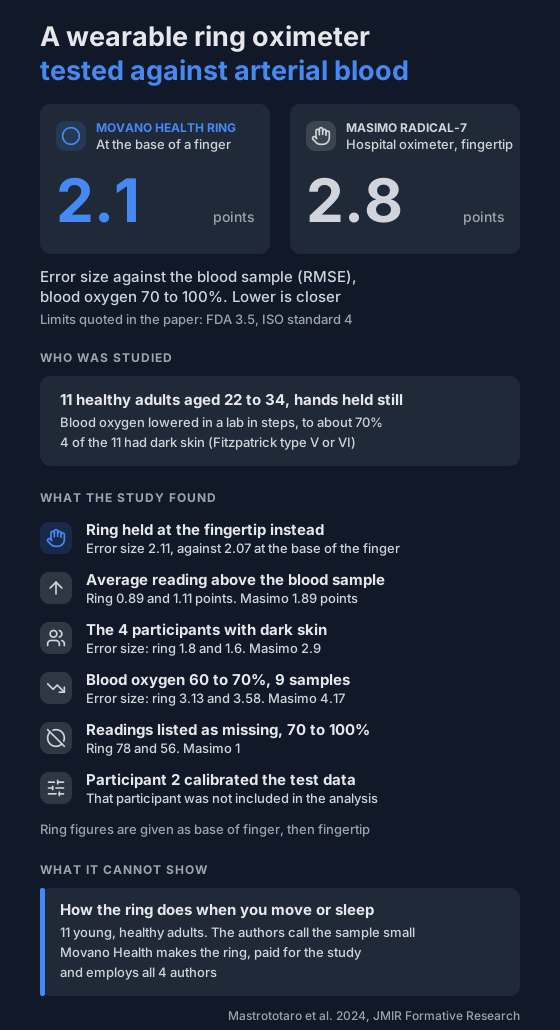
Wearables that show blood oxygen are mostly sold for fitness and general wellness. Their readings are often thought to be less exact when oxygen is low, and on darker skin. A 2024 study put a wearable ring oximeter through the lab test that medical oximeters go through.
One thing to know first: Movano Health makes the ring, paid for the study, and employs all four authors, who also hold its stock or stock options.
Who was studied?
- 11 healthy non-smokers aged 22 to 34: 5 women and 6 men.
- 4 had dark skin, rated Fitzpatrick type V or VI on the index finger.
- Each wore two rings: one at the base of a finger, and one held at the fingertip.
- They also wore a Masimo Radical-7, a hospital fingertip oximeter.
- They breathed a controlled gas mix that lowered their blood oxygen in steps, from room air down to about 70%.
- Their hands stayed still on arm boards the whole time.
- Each reading was compared with blood taken from an artery in the wrist.
The test was run at the Hypoxia Research Laboratory at the University of California San Francisco, over two days in October 2022.
What did it find?
The paper reports error size as root mean square error (RMSE): lower means closer to the blood sample. It quotes two upper limits for a medical oximeter: 3.5 from FDA guidance and 4 from the ISO standard.
Across blood oxygen of 70 to 100%:
- Ring at the base of the finger. RMSE 2.07, from 236 readings.
- Ring at the fingertip. RMSE 2.11, from 258 readings.
- Masimo Radical-7. RMSE 2.80, from 313 readings.
All three were under both limits.
All three also read higher than the blood sample on average: the ring by 0.89 points at the base of the finger and 1.11 at the fingertip, and the Masimo by 1.89.
Between 60 and 70% there were only 9 blood samples. There, the RMSE was 3.13 and 3.58 for the ring and 4.17 for the Masimo.
What about darker skin?
The authors looked at the 4 participants with dark skin separately.
- Ring: RMSE 1.8 at the base of the finger and 1.6 at the fingertip.
- Masimo: RMSE 2.9, reading 2.2 points above the blood sample on average.
The paper says the Masimo read further above the blood sample at lower oxygen levels in this group. That's 4 people, and the paper calls it a secondary analysis. For the wider picture, see pulse oximeters and skin tone.
What can't it tell you?
- Movement and sleep. Hands were held still, so this says nothing about readings while you move or over a whole night.
- Other people. The authors say a small sample of young, healthy adults may not apply to younger, older, more diverse or ill people.
- Missing readings. In the 70 to 100% range, the paper's tables list 78 missing readings for the ring at the base of the finger and 56 at the fingertip, against 1 for the Masimo. The paper says readings were missed or excluded for dropped signals or a signal that didn't settle at a steady level.
- Calibration. The paper says participant 2 was used to calibrate the test data and was not included in the analysis.
- Skin tone scales. The authors call the Fitzpatrick and Monk scales subjective and not built for this job.
- Who ran it. The university lab ran the sessions, and the paper says ring data was passed to the lab for independent analysis. Its acknowledgments say two of the Movano authors performed the data analysis.
- The second hospital oximeter. A Nellcor N-595 was also worn, but the paper gives no results for it.
What can you do with this?
Not much yet as a buyer. This is one small, maker-funded lab test of one ring, on people sitting still.
It does show what this kind of accuracy test involves: readings checked against arterial blood, at low oxygen, across skin tones. You can ask whether any oximeter you're considering has been through one. See what to check before buying an oximeter.
For a similar test of a smartwatch, read Apple Watch vs a fingertip oximeter in low oxygen. For the basics, read how accurate pulse oximeters are.
Not a medical device. Does not diagnose, treat or prevent any condition. Discuss results and changes with a clinician.
References
- Mastrototaro JJ, Leabman M, Shumate J, Tompkins KL. Performance of a Wearable Ring in Controlled Hypoxia: A Prospective Observational Study. JMIR Formative Research. 2024;8:e54256. doi:10.2196/54256
- US Food and Drug Administration. Pulse Oximeters - Premarket Notification Submissions [510(k)s]: Guidance for Industry and Food and Drug Administration Staff. March 2013. fda.gov