ECG Patch Sleep Test Plus an Oximeter
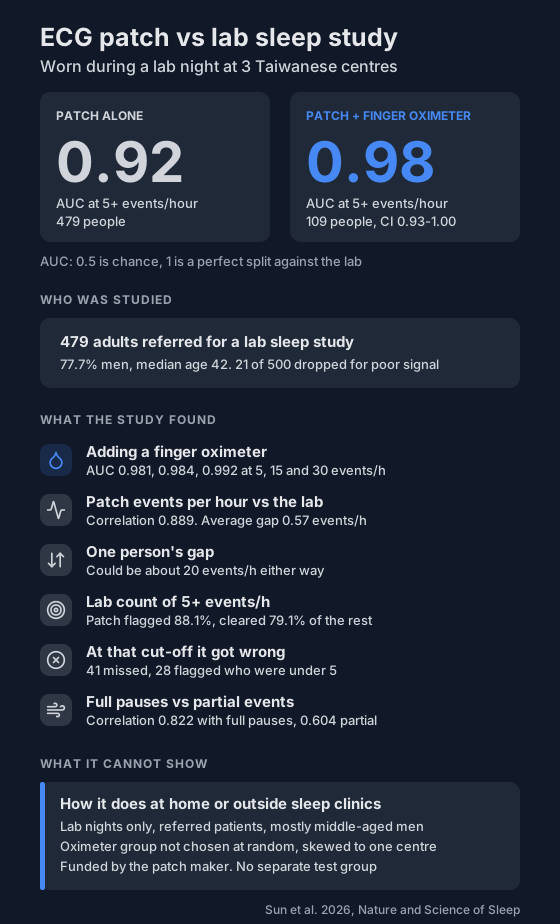
A 2026 study had 479 adults wear an ECG chest patch during a lab sleep study in Taiwan. Its event count separated people above and below 5 lab events an hour well (AUC 0.92), and in 109 people who also wore a finger oximeter, the combination reached 0.98. The patch maker funded it.
Standard home sleep tests use several sensors: a nose tube, chest belts and a finger oximeter. Some newer ones use a single ECG patch on the chest and estimate breathing events from how the heartbeat and ECG signal change with breathing.
A 2026 study in Taiwan checked one of those patches against a full lab sleep study on the same night. The patch did well on its own. In the people who also wore a finger oximeter, adding its oxygen dip count gave a higher AUC still.
What did the oximeter add?
109 people wore a fingertip pulse oximeter alongside the patch. The study combined the patch's events per hour with the oximeter's oxygen desaturation index (ODI) and compared that with the lab.
The measure was the AUC, which runs from 0.5 (no better than chance) to 1 (a perfect split between people above and below a cut-off).
| Lab cut-off | Patch alone (479 people) | Patch + oximeter (109 people) |
|---|---|---|
| 5+ events an hour | 0.923 | 0.981 |
| 15+ events an hour | 0.929 | 0.984 |
| 30+ events an hour | 0.967 | 0.992 |
Two things to keep in mind:
- The two columns are different groups, so it's not a straight head-to-head.
- The oximeter group wasn't picked at random. It depended on whether a centre had an oximeter at the time, so more of them came from one hospital. The authors say to read these numbers with caution.
There's a reason oxygen dips line up so well with the lab count here. The lab only counted a partial breathing event if it came with an oxygen drop of at least 4%. On the lab's own recordings, its oxygen dip count and its breathing event count correlated at 0.987. For more on that link, see does ODI track breathing events.
Who was studied?
- 500 adults booked for a lab sleep study at three hospitals in Taiwan, between 2019 and 2021.
- 21 were dropped because the patch signal was too poor to analyse, leaving 479.
- 77.7% were men, the median age was 42 and the median BMI was 27.5.
- All were referred because a doctor already suspected sleep apnea.
- On the lab study, 345 had 5 or more breathing events an hour and 157 had 30 or more.
Everyone wore the patch on the left side of the chest during the lab night. The patch maker's software turned the ECG into a breathing event count. The exact settings are the company's own and weren't published.
How close was the patch alone?
As a group, very close.
- The patch's count and the lab's count correlated at 0.889.
- Agreement (ICC) was 0.955 on a 0 to 1 scale.
- On average the patch read 0.57 events an hour higher than the lab, a gap the authors call small.
For one person, less so. The patch could read about 20 events an hour above or below the lab, and the spread was wider at higher counts. The authors say the two numbers aren't interchangeable for an individual.
At the 5 events an hour cut-off:
- Of the 345 people at or above it on the lab study, the patch flagged 304 (88.1%) and missed 41.
- Of the 134 below it, the patch cleared 106 (79.1%) and flagged 28.
At 30 or more events an hour, it flagged 90.4% and cleared 90.1% of the rest.
The patch tracked full breathing pauses (correlation 0.822) better than partial events (0.604).
What can't it show?
- Home use. Every recording was made in a sleep lab.
- Other people. Everyone was a referred patient, mostly middle-aged men. The authors say that may make the results look better than they'd be in a wider group.
- The oximeter result's strength. It's from a subgroup that wasn't randomly chosen.
- Outside checking. The results weren't tested on a separate group of people.
- Funding. The patch maker, Largan Health AI-Tech, paid for the study. The authors say it had no role in the design, analysis or writing.
The authors also list:
- The patch counted events over the whole recording, not just sleep time, so it may read low in people who lie awake a lot.
- Broken sleep from other causes, like insomnia or depression, could look like breathing events to the patch.
- The lab used the stricter 4% oxygen dip rule. See 3% vs 4% rules.
- Sleep position wasn't analysed, and the study didn't test whether the patch can tell central breathing pauses from obstructive ones.
What can you take from it?
An oxygen dip count is a simple number that lines up well with breathing events in a lab. That's true in other studies too, like this oximeter-only home test.
If you track your overnight oxygen, you can log your ODI night to night and see how it trends. If it's high or you have symptoms, share your recordings with a doctor. The authors say the patch is an add-on, not a replacement for a sleep study, and a home oximeter isn't a sleep study either.
Not a medical device. Does not diagnose, treat or prevent any condition. Discuss results and changes with a clinician.
References
- Sun CY, Hang LW, Chang ET, Perng DW, Huang SF, Lin FC, Su KC, Shiao TH, Liu YY, Chen YM, Chou KT. The Effectiveness of a Novel Sleep Test Based on Cardiopulmonary Coupling to Detect Obstructive Sleep Apnea: A Multicenter Prospective Study. Nature and Science of Sleep. 2026;18:581103. doi:10.2147/NSS.S581103