Early Bedtime, Blood Pressure and Sleep Apnea
In a 2026 study of 2,660 adults with sleep apnea, 56.6% of those who went to bed before 10pm had high blood pressure, against 36.9% and 30.7% of later sleepers. It can't show why.
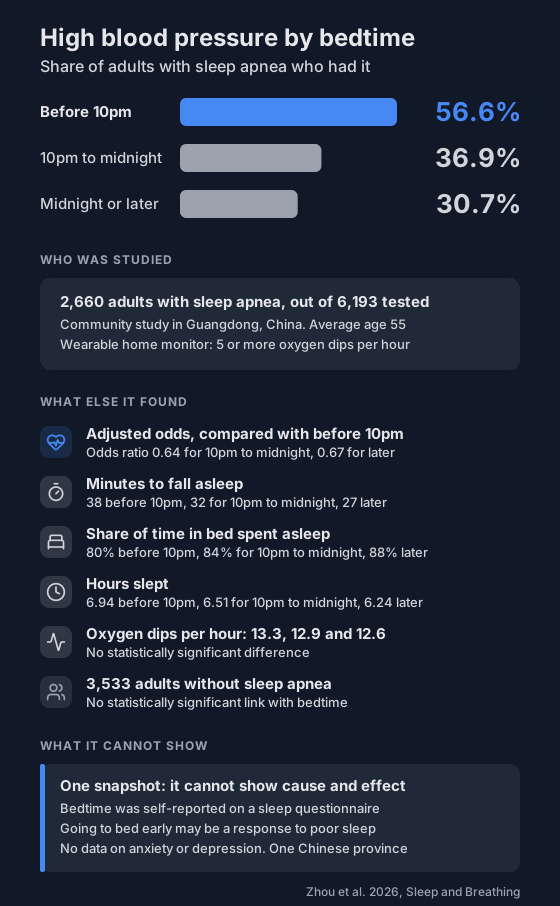
Sleep apnea and high blood pressure often turn up together. A study published in 2026 looked at whether the time people go to bed lines up with that.
Among adults with sleep apnea, those who went to bed before 10pm had high blood pressure more often than those who went to bed later. The study can't tell you why, and it isn't a reason to change your bedtime.
Who was studied?
- 6,193 adults from two community health surveys in Guangdong Province, China.
- Each wore a wearable home sleep monitor for a night. It records blood oxygen, pulse rate and movement.
- 2,660 of them (42.95%) had 5 or more oxygen dips per hour, which the study counted as sleep apnea. That figure is the oxygen desaturation index.
- Those 2,660 had an average age of 55, and 58.5% were women.
- Bedtime came from a sleep questionnaire: each person's usual bedtime over the past month.
- High blood pressure meant an average top reading of 140 mmHg or above, an average bottom reading of 90 mmHg or above, taking blood pressure medication, or having been told by a doctor they had it.
What did it find?
Of the 2,660 adults with sleep apnea, 1,005 (37.8%) had high blood pressure. By usual bedtime:
- Before 10pm (316 people): 56.6%
- 10pm to midnight (1,713 people): 36.9%
- Midnight or later (631 people): 30.7%
The researchers then adjusted for age, sex, BMI, ethnicity, smoking, alcohol, exercise, diabetes, blood fats, oxygen dips per hour and the sleep measures below. Compared with the before-10pm group, the odds of high blood pressure were lower in both later groups:
- 10pm to midnight: odds ratio 0.64 (95% CI 0.48 to 0.86)
- Midnight or later: odds ratio 0.67 (95% CI 0.47 to 0.95)
Each hour later in bedtime went with a 0.89 mmHg lower top reading and a 0.46 mmHg lower bottom reading.
Did early sleepers sleep differently?
Yes. The before-10pm group spent longest asleep but reported the poorest sleep.
| Before 10pm | 10pm to midnight | Midnight or later | |
|---|---|---|---|
| Hours slept | 6.94 | 6.51 | 6.24 |
| Minutes to fall asleep | 38 | 32 | 27 |
| Share of time in bed spent asleep | 80% | 84% | 88% |
| Insomnia score, higher is worse | 7.1 | 6.5 | 5.2 |
| Oxygen dips per hour | 13.3 | 12.9 | 12.6 |
The difference in oxygen dips per hour was not statistically significant.
The authors suggest that going to bed early may be a response to sleeping badly. They also note that people tend to shift towards earlier hours as they age.
Was it the same for everyone?
- Without sleep apnea. In the 3,533 adults with fewer than 5 oxygen dips per hour, the link with bedtime was not statistically significant.
- Age 60 and over. The link showed up in this group (odds ratios 0.60 and 0.65). The paper's text gives no figures for the two younger age groups. The test for a difference between age groups was not statistically significant.
- More oxygen dips. The link was seen in people with 5 to under 15 dips per hour. It faded and was not statistically significant at 15 to under 30 and at 30 or more. The authors note the 30-or-more group was small.
What can't it tell you?
- Cause. It's a cross-sectional study, a single snapshot. It can't show that bedtime raises or lowers blood pressure. Poor sleep, or some other difference between the groups, could explain the gap.
- Actual bedtimes. Bedtime, hours slept and time to fall asleep were self-reported, not measured.
- Mental health. The authors had no data on anxiety or depression.
- Who has sleep apnea. The home monitor is less accurate than a lab sleep study, so some people may have been put in the wrong group.
- Everyone. The data come from one province in China.
The authors say longer-term studies are needed to confirm the link.
What can you do with this?
Nothing in this study says moving your bedtime will change your blood pressure.
- If your blood pressure is high, or you take a long time to fall asleep most nights, tell your doctor.
- An overnight oximeter also reports oxygen dips per hour, the measure this study used. It can't tell you whether you have sleep apnea, but you can share the recordings with your doctor.
- For more on the link itself, see oxygen dips and blood pressure and wearables, sleep apnea and blood pressure.
Not a medical device. Does not diagnose, treat or prevent any condition. Discuss results and changes with a clinician.
References
- Zhou R, Shan G, Hu Y, Feng T, Lao M, Zhang R, Wu S, Chen J, Ou Q. Association of bedtime with co-morbid hypertension in OSA: a community-based study. Sleep and Breathing. 2026;30(2):96. doi:10.1007/s11325-026-03579-1