CPAP, BiPAP or Oxygen: 5-Year Survival
A Colombian study followed 3,039 adults with obstructive sleep apnea. 95.6% of regular CPAP users were alive five years later, against 80.6% of people on oxygen therapy. It can't show cause.
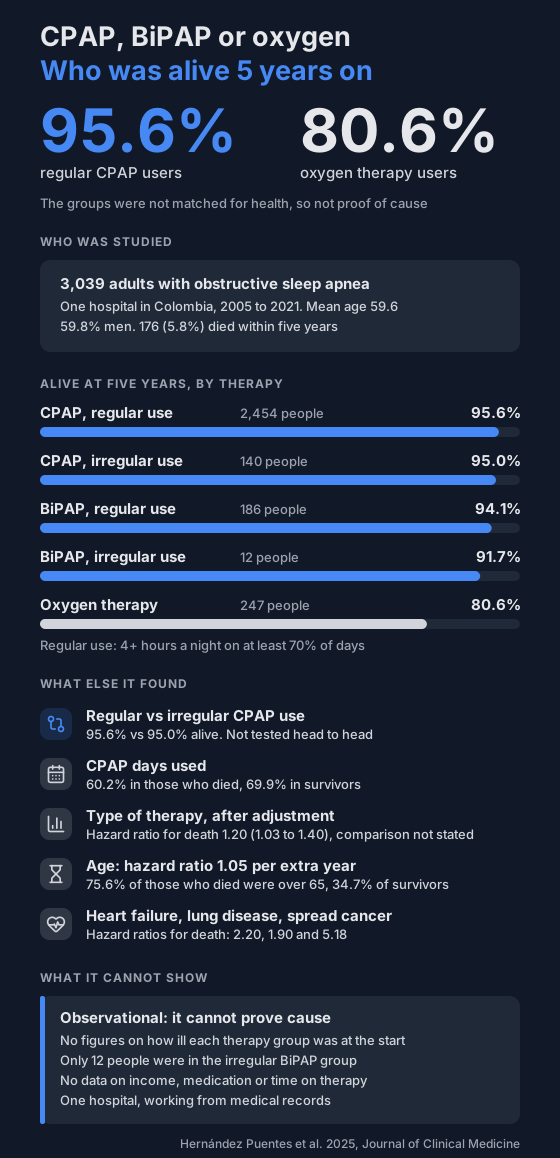
The authors say most sleep apnea trials compare CPAP with a placebo, a sham machine or education. A study published in December 2025 compared three therapies instead: CPAP, BiPAP and oxygen.
It also split people by how regularly they used their machine. The biggest gap wasn't between regular and irregular users. It was between the oxygen group and everyone else.
Who was in the study?
- 3,039 adults with obstructive sleep apnea, followed at one hospital in Colombia between 2005 and 2021.
- All had more than 5 breathing events an hour on a sleep study, plus symptoms like snoring or daytime sleepiness.
- Mean age 59.6, and 59.8% were men.
- 61.7% had high blood pressure and 21.7% had diabetes.
- The researchers went back through medical records and machine downloads.
Regular use meant at least 4 hours a night on at least 70% of days.
How many were alive five years later?
176 people died within five years, which is 5.8%.
By therapy:
- CPAP or auto-CPAP, regular use (2,454 people): 95.6% alive.
- CPAP or auto-CPAP, irregular use (140 people): 95.0%.
- BiPAP, regular use (186 people): 94.1%.
- BiPAP, irregular use (12 people): 91.7%.
- Oxygen therapy (247 people): 80.6%.
The difference across the five groups was statistically significant (p < 0.001).
Did regular use matter?
The paper's conclusion says survival was tied to how regularly people used their machine. The numbers behind that:
- Regular and irregular CPAP users were 0.6 percentage points apart.
- The irregular BiPAP group was 12 people, and one of them died.
- The paper reports one test across all five groups. It doesn't test regular against irregular use on their own.
Looking at it the other way round, people who died had used CPAP on fewer days: 60.2% against 69.9% for survivors. The share of days with more than 4 hours of use was also lower, 62.1% against 69.2%, but that gap wasn't statistically significant.
For more on machine use, see sticking with CPAP.
Why was the oxygen group so different?
The study can't say.
- The paper doesn't say why those 247 people were on oxygen and not a pressure machine.
- It doesn't report age or other illness for each therapy group.
- The authors point out that oxygen doesn't open a blocked airway.
- They also say BiPAP usually goes to people with more advanced breathing problems, who more often have other illness and start with a worse outlook.
Other illness was strongly tied to who died. 60.2% of those who died had chronic lung disease, against 20.4% of survivors. For heart failure it was 39.2% against 10%.
What else was linked to dying?
The authors ran a model that adjusted for age, sex, BMI, smoking and other conditions. These stayed linked to a higher rate of death, shown as hazard ratios:
- Age: 1.05 for each extra year.
- Heart failure: 2.20.
- Chronic lung disease: 1.90.
- Cancer that had spread: 5.18.
Type of therapy also stayed linked to the rate of death, with a hazard ratio of 1.20 (95% confidence interval 1.03 to 1.40). The paper's text calls it therapy type, its table labels the row as positive pressure therapy, and neither says which groups it compares. So it doesn't tell you how any one therapy compares with another.
75.6% of the people who died were over 65, against 34.7% of survivors.
What doesn't it tell you?
- Cause. It's observational. Nobody was assigned a therapy at random, so the reason behind each choice may explain the gap.
- How sick each group was. No breakdown by therapy group.
- Unmeasured factors. The authors list income, medication and how long people had been on therapy.
- Everyone. One hospital. The authors add that altitude in Colombia may add to low oxygen at night.
- Record quality. The data came from medical records, which can have gaps.
The study was funded by a university grant, and the authors declare no conflicts of interest.
A Polish study with up to 20 years of follow-up looked at the same question for CPAP alone. See CPAP and long-term survival.
What can you do with this?
This study isn't a reason to change what you've been prescribed. If you have questions about your therapy, take them to your clinician.
If you use CPAP or BiPAP, your machine records hours of use each night. You can log overnight oxygen alongside it. See tracking oxygen with CPAP and sharing data with your doctor.
An oximeter can't tell you whether your therapy is working or whether to change it.
Not a medical device. Does not diagnose, treat or prevent any condition. Discuss results and changes with a clinician.
References
- Hernández Puentes JS, Bastidas AR, Tuta Quintero EA, Acosta Otero JD, Leyton Franco V, Castro Córdoba JD, López Nuñez LM, Lenhardt Guaqueta I, Mora Vega A, Martínez Sáenz PS, Faizal Gomez CK, Vaca Espinosa MC, Cardona Molina CF, Diaz Romero G, et al. Positive Airway Pressure Therapies and Oxygen Therapy in Obstructive Sleep Apnea (OSA): 5-Year Survival. Journal of Clinical Medicine. 2025;14(24):8647. doi:10.3390/jcm14248647