What Predicts CPAP Hours? 136 Trials Pooled
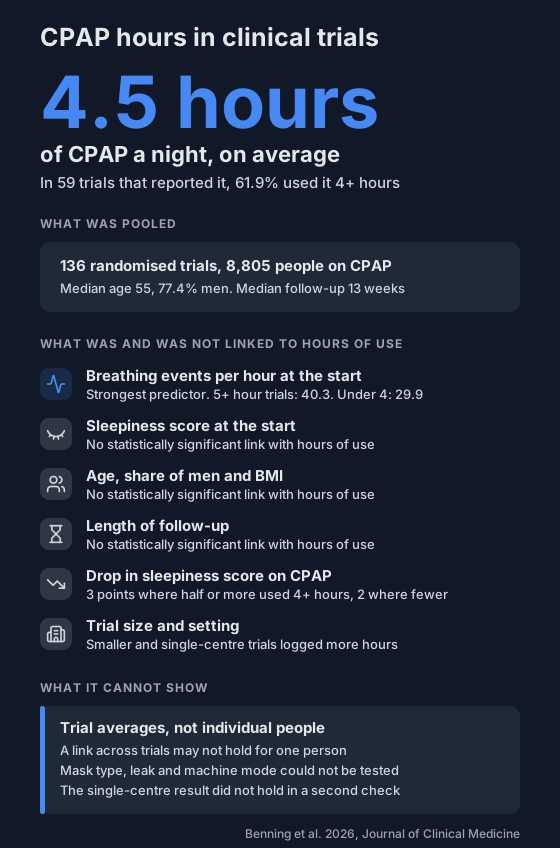
A 2026 meta-analysis pooled 136 randomised trials. Average CPAP use was 4.5 hours a night, and trials with more breathing events per hour at the start logged more hours.
It's often said that the sleepier you are, the more you'll use CPAP. A meta-analysis published in April 2026 checked that against 136 randomised trials.
Across the trials, sleepiness at the start wasn't a statistically significant predictor of hours of use. The number of breathing events per hour was.
These are trial averages, so they can't predict how much any one person will use CPAP.
What was pooled?
- 136 randomised trials that compared CPAP with no CPAP, sham CPAP or a placebo, found by a PubMed search covering 1984 to the end of 2024.
- 8,805 adults with obstructive sleep apnea on CPAP, according to the results section. The paper's summary and discussion say 8,827.
- Median age 55, 77.4% men, median BMI 31.
- 35.7 breathing events per hour on average at the start.
- Trials had to report objectively measured CPAP use to be included.
- Median follow-up was 13 weeks.
It used each trial's averages, not each person's data.
How much was CPAP used?
- 4.5 hours a night on average, across the 128 trials that gave hours per night.
- 71.3% of trials averaged 4 hours or more, 34.1% averaged 5 or more, and 7.8% averaged 6 or more.
- In the 59 trials that reported it, 61.9% of people on average used CPAP for at least 4 hours a night.
The authors compare this with a cloud database of over 2.6 million CPAP users, where use at 90 days was 5.1 hours a night.
What went with more hours?
Breathing events per hour at the start was the strongest predictor.
- Each extra event per hour went with 0.02 more hours of CPAP a night (95% CI 0.01 to 0.04). Worked out from that figure, 10 more events per hour is about 12 more minutes.
- Trials averaging 5 or more hours started at 40.3 events per hour. Trials averaging under 4 hours started at 29.9.
- It explained about 11% of the spread in hours between trials, so most of the spread is down to something else.
- The link stayed statistically significant in two further models, one adjusting for BMI and the type of sleep study, the other for sleepiness score.
Two features of the trials themselves also went with more hours:
- Smaller trials. A median of 23 people on CPAP in trials averaging 5 or more hours, against 34 in trials averaging under 4.
- Single-centre trials. 81.8% of the trials averaging 5 or more hours were single-centre, against 56.8% of those averaging under 4. This one stopped being statistically significant when trials with risk-of-bias concerns were left out.
What didn't?
There was no statistically significant link between hours of use and any of these:
- Sleepiness score at the start.
- Age.
- The share of men in the trial.
- BMI.
- Length of follow-up.
Sleepiness did show up one other way. In trials where at least half the people used CPAP for 4 or more hours, the sleepiness score fell by a median of 3 points. Where fewer did, it fell by 2. That doesn't show which came first. Across the trials that reported it, the size of the drop had no statistically significant link with average hours.
A 2026 review of who sticks with CPAP read the wider research differently on both points. It lists daytime sleepiness among the things that go with more use, and says the count of breathing events can't be used to predict who keeps using CPAP. This paper cites another review that found the evidence on events per hour, sleepiness, BMI and age conflicting. The authors say one possible reason sleepiness didn't show up here is that they had trial averages, not each person's data.
What can't it tell you?
Limits the authors state:
- Averages, not people. A link between trial averages is less precise than one from each person's data, and may not hold for an individual.
- Missing predictors. Mask type, mask leak and machine mode weren't reported often enough to test. Neither were oxygen measures like time below 90%.
- Who was in the trials. Mostly middle-aged men with a high BMI. The authors say the results may not carry over to women.
- Big differences between trials. They stayed large even after adjusting.
Limits we noticed:
- The search used one database, plus the reference lists of earlier meta-analyses.
- 33 otherwise eligible trials reported no CPAP hours at all and were left out.
- The paper is aimed at people designing trials, not at CPAP users.
The paper says it had no external funding, and the authors declare no conflicts of interest.
What can you do with this?
These are our suggestions, not the study's findings.
- Your CPAP machine records your hours. Look at your own, not an average.
- Mask leak wasn't tested here. A separate study looked at mask leak and nightly use.
- If you own an overnight oximeter, you can track your oxygen alongside CPAP and take the recordings to your next appointment.
- Struggling to keep the mask on? Tell your sleep clinic.
Not a medical device. Does not diagnose, treat or prevent any condition. Discuss results and changes with a clinician.
References
- Benning L, Bousraou Z, Bradicich M, Ulrich S, Schwarz EI. Adherence to CPAP in Randomized Controlled Trials in Obstructive Sleep Apnoea - A Meta-Analysis and Investigation of Predictors. Journal of Clinical Medicine. 2026;15(9):3264. doi:10.3390/jcm15093264