CPAP Comfort Settings and Hours of Use
ResMed data on 394,919 new CPAP users: comfort settings matching a model's pick went with 4.5 percentage points more people meeting the 4-hour use rule than defaults.
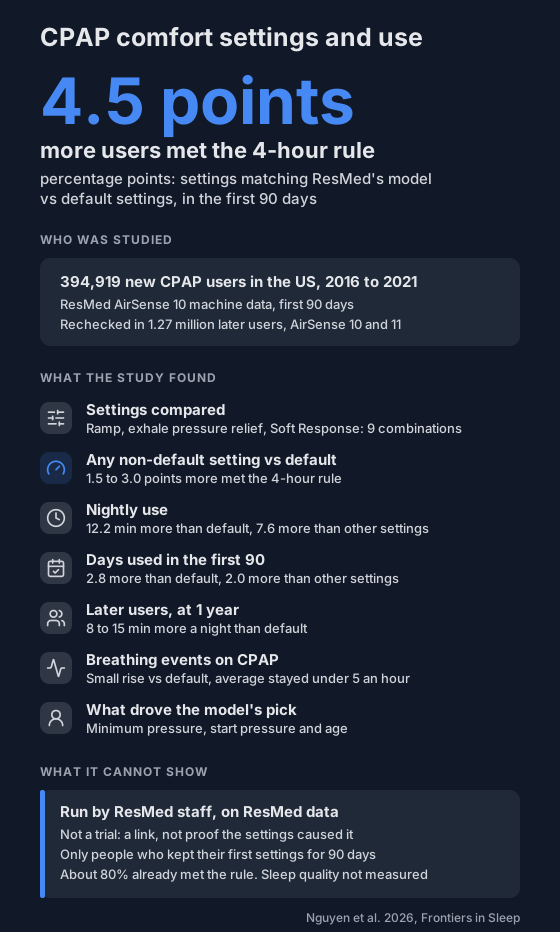
CPAP machines come with comfort settings that soften how the air pressure feels. The authors say they're often left on the machine's defaults.
A 2026 analysis from ResMed, the maker of the AirSense machines, asked whether picking these settings for each person goes with more use. The rise it found was small: a few percentage points.
Who ran it?
- All seven authors work for ResMed, and ResMed paid for the study.
- The data come from ResMed's own cloud platform and app, and aren't public.
- The model behind the picks is a ResMed product the authors say has US FDA clearance.
That doesn't make the numbers wrong. It does mean outside researchers can't rerun the analysis on the same data.
What are the comfort settings?
The study looked at three settings on the AirSense 10:
- Ramp. Starts at a lower pressure and builds up as you fall asleep. "Auto" waits until the machine thinks you're asleep.
- Exhale pressure relief (EPR). Drops the pressure a little when you breathe out, by 1, 2 or 3 cmH2O.
- Soft Response. Makes pressure rise more slowly when the machine responds to breathing events.
Minimum pressure and start pressure weren't settings the model picked. They were inputs: things it took into account when choosing comfort settings.
Who was studied?
- 394,919 new CPAP users in the US who started on an AirSense 10 between 2016 and 2021.
- 42% were over 60, and 59% were men.
- All used the auto-adjusting mode and one of 9 common comfort setting combinations.
- Everyone kept their first settings for the whole 90 days.
The authors then rechecked the results in about 1.27 million later users, from 2022 to 2025, on the AirSense 10 and the newer AirSense 11.
"Meeting the rule" here means the US Medicare rule: at least 4 hours a night on at least 70% of nights, over any 30 days in a row in the first 90. About 80% of this group already met it.
What did it find?
A machine learning model picked the settings it expected to give each person the best chance of meeting the 4-hour rule. The authors then compared people whose actual settings happened to match that pick with similar people on other settings.
Compared with 5,339 people left on the default settings, the 5,875 whose settings matched the pick had:
- 4.5 percentage points more people meeting the 4-hour rule (95% CI 2.5 to 6.6).
- 12.2 more minutes of use a night.
- 2.8 more days with any use in the first 90 days.
Compared with 87,375 people on other settings chosen by a clinician or themselves, the gaps were smaller: 3.7 points, 7.6 minutes and 2.0 days.
Looking at everyone at once, using any non-default setting went with 1.5 to 3.0 points more people meeting the rule, depending on the method.
Did it hold up in later users?
On minutes of use, yes. Compared with each machine's default settings, matched settings went with:
- AirSense 10: 8.4 more minutes a night at 90 days, and 8.0 at 1 year.
- AirSense 11: 20.4 more minutes a night at 90 days, and 15.2 at 1 year.
The later check reported minutes and days of use, not the share meeting the 4-hour rule.
Were there trade-offs?
The authors looked at breathing events and mask leak in the later users:
- Breathing events per hour on CPAP. Slightly higher than with default settings, by 0.29 to 0.35 an hour at 90 days. The average stayed under 5 an hour.
- Compared with other non-default settings, breathing events were similar at 90 days and a little lower at 1 year.
- Mask leak. No change against AirSense 10 defaults and slightly lower than AirSense 11 defaults, but slightly higher than with other non-default settings.
The authors also note that pressure relief and Ramp lower the pressure delivered for part of the night, and Soft Response slows the machine's response to breathing events. In some people that could mean more events.
What did the model take into account?
Minimum pressure, start pressure and age mattered most. The model more often picked exhale pressure relief for people on higher pressures. For people on the lowest pressures, it more often picked no pressure relief at all.
What doesn't it tell you?
- Cause. This is a look back at existing data, not a trial. Nobody was assigned settings. The authors call the results "hypothesis-generating".
- Who got which settings. Clinicians may have chosen settings for reasons the data don't show, such as how much risk they saw in a patient.
- Missing details. Income and social background, insurance, coaching, insomnia, mental health and exact mask model weren't recorded. Breathing events at the start were self-reported in an app.
- People who changed settings. Anyone who changed their settings in the first 90 days was left out, so people who struggled early may be missing.
- Less common settings. Soft Response was rare in the data. With only the 4 most common combinations, the results pointed the same way but weren't statistically significant.
- How people felt. Sleep quality, daytime functioning and satisfaction weren't measured. More hours of use doesn't on its own show anyone felt better.
- Other machines. Only ResMed machines were studied.
The paper also has a few slips. It rounds the 4.5 point gap to "4%" and prints two of the minutes figures with a stray minus sign. The tables give the numbers used here.
What can you do with this?
- Your machine's comfort settings are set up with your CPAP provider or sleep clinic. Settings like pressure relief can affect how well CPAP keeps your airway open, so any change is something to discuss with them.
- If CPAP feels uncomfortable, tell them what you notice: struggling at the start of the night, trouble breathing out, waking when the pressure rises.
- For the wider picture, see what a review found about sticking with CPAP and which early CPAP problems went with less use.
Want to see what your oxygen does on CPAP nights? Here's how to track your oxygen alongside CPAP.
Not a medical device. Does not diagnose, treat or prevent any condition. Discuss results and changes with a clinician.
References
- Nguyen C, Jayawardane H, Emami H, Liu N, Achary B, Armitstead J, Wimms A. Personalized comfort settings in positive airway pressure machines using a causal inference approach: a retrospective observational analysis. Frontiers in Sleep. 2026;5:1883557. doi:10.3389/frsle.2026.1883557