COPD Sleep Types and Survival: A 2026 Study
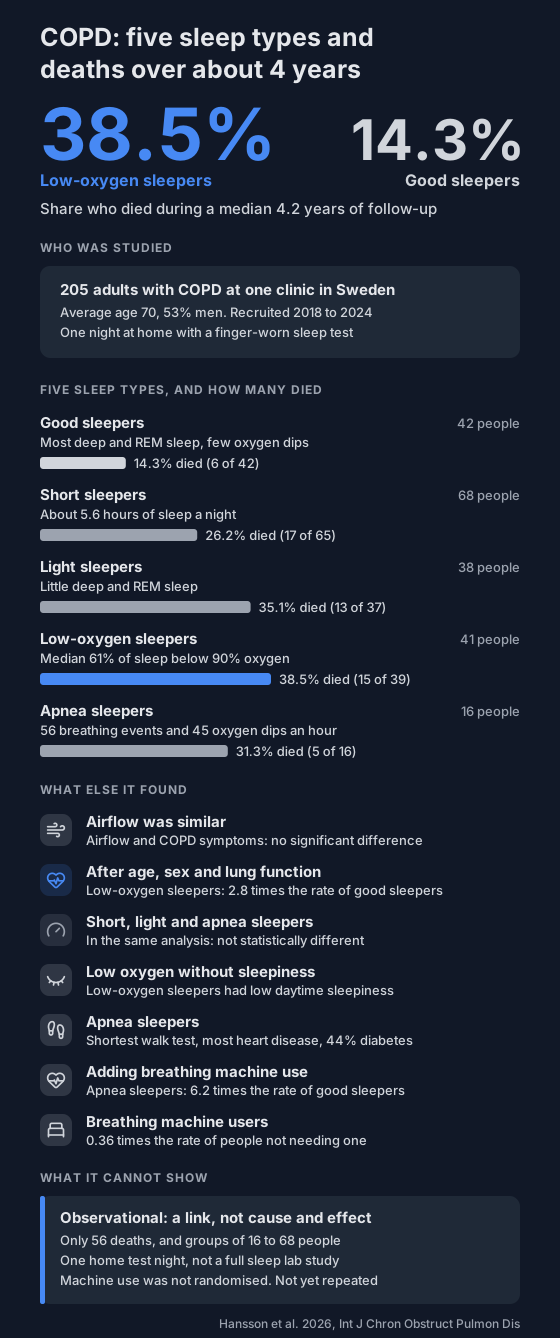
A Swedish study sorted 205 people with COPD into five sleep types from one home sleep test. 38.5% of the low-oxygen group died over a median 4.2 years, against 14.3% of good sleepers, despite similar airflow.
COPD is usually graded by lung function: how much air you can blow out in one second. Sleep doesn't come into it. A Swedish study published in October 2026 asked whether how people with COPD sleep tells you something lung tests don't.
It sorted 205 people into five sleep types from one night's home test. The group with the most time at low oxygen had the highest death rate over about four years, though their airflow and COPD symptoms were not significantly different from the other groups.
Who was in the study?
- 205 adults with COPD from one hospital COPD clinic in Gothenburg, Sweden, recruited between 2018 and 2024.
- Average age 70, 53% men.
- On average, they could blow out 55% of the air expected in one second for their age and size.
- Nobody had a known sleep apnea finding before joining.
- Each did one night at home with a WatchPAT, a wrist unit with a finger probe that records oxygen, pulse and movement and estimates sleep stages and breathing events.
How were the five types found?
The researchers fed 15 sleep measures into a computer method that groups people with similar patterns. They included sleep time, deep and REM sleep, oxygen dips per hour, the lowest oxygen, time below 90% and a daytime sleepiness score. The names were added afterwards to describe each group.
- Good sleepers (42): the most deep and REM sleep, fewest awakenings, about 3 oxygen dips an hour.
- Short sleepers (68): a median 5.6 hours of sleep.
- Light sleepers (38): the longest sleep, 7.1 hours, but little deep and REM sleep.
- Low-oxygen sleepers (41): a median 61% of sleep below 90% oxygen, and a lowest reading of 76%.
- Apnea sleepers (16): 56 breathing events and 45 oxygen dips an hour, a lowest reading of 66.5%, and the sleepiest by day.
The low-oxygen group had plenty of breathing events too, a median of 31 an hour. What set them apart was the long stretches below 90%. For more on that measure, see what T90 is.
What did it find about survival?
199 people could be followed up, for a median of 4.2 years. 56 of them died. Before any adjustment, survival differed across the five groups.
- Good sleepers: 14.3% died (6 of 42).
- Short sleepers: 26.2% (17 of 65).
- Light sleepers: 35.1% (13 of 37).
- Low-oxygen sleepers: 38.5% (15 of 39).
- Apnea sleepers: 31.3% (5 of 16).
After allowing for age, sex and lung function, low-oxygen sleepers had 2.8 times the death rate of good sleepers. The confidence interval was wide, 1.05 to 7.44. The differences for the other three groups were not statistically significant at that stage.
What about breathing machines?
Some people started a breathing machine at night (CPAP or similar) after the sleep test. In their discussion, the authors say over 80% of apnea sleepers did, against about half of low-oxygen sleepers.
When the researchers added machine use to the analysis:
- Low-oxygen sleepers came out at 3.2 times the death rate of good sleepers.
- Apnea sleepers came out at 6.2 times, with a very wide range, 1.56 to 24.38.
- People using a machine had 0.36 times the death rate of people who didn't need one.
- People who were advised to use one but never started were not statistically different from people who didn't need one.
The machines were started after the test and weren't assigned at random. So the authors call this a lead to test, not proof that the machine made the difference.
What else differed between the groups?
The sleep types lined up with things the computer never saw:
- Low-oxygen sleepers had the lowest lung gas transfer, lower daytime oxygen and a shorter 6-minute walk.
- Apnea sleepers walked the least (231 m against 400 m for good sleepers), had the most heart disease and 44% had diabetes.
- Good sleepers had the fewest heart problems and the lowest inflammation marker.
- Light sleepers had more depression, high blood pressure and an irregular heartbeat.
Low-oxygen sleepers weren't sleepy by day. The authors say asking about sleepiness alone can miss low oxygen at night in COPD. There's more on that in sleep apnea without sleepiness.
What can't it show?
- Cause. It's observational. It shows a link between sleep type and death, not that low oxygen caused the deaths.
- Precision. The survival analysis was exploratory, with only 56 deaths and small groups, so the estimates are rough. Across all five groups together, the adjusted difference wasn't statistically significant.
- The groups themselves. They came from one grouping method, and the groups were only weakly separated (a separation score of 0.089, where 1 is a perfect split). The authors say the five-group split isn't fixed, and it shifted when they changed the method.
- The test. One night on a home device that estimates sleep stages indirectly, not a full sleep lab study.
- Other people. One Swedish clinic, and no second group to check the results against yet.
- Cause of death wasn't available for everyone.
- Ties. One author reports equipment support from Itamar Medical, which makes the WatchPAT, listed as outside this work.
What can you do with this?
If you have COPD, your overnight oxygen is a separate piece of information from your lung test. An overnight oximeter shows how long you spend below 90% and how often your oxygen dips. It can't tell you which sleep type you'd fall into.
For how COPD and sleep apnea add up at night, see COPD, sleep apnea and overnight oxygen. To take your recordings to an appointment, here's how to share them with your doctor.
Not a medical device. Does not diagnose, treat or prevent any condition. Discuss results and changes with a clinician.
References
- Hansson D, Lisik D, Andersson A, Zou D, Hedner J, Vanfleteren LEGW, Grote L. Why Sleep Matters in COPD: Cluster-Derived Sleep Phenotypes Reveal Distinct Physiological, Comorbidity and Survival Profiles. International Journal of Chronic Obstructive Pulmonary Disease. 2026;21:608140. doi:10.2147/COPD.S608140