Sleeping Pills and COPD: A 2026 Review
A 2026 meta-analysis of benzodiazepine-type sleeping pills in people with COPD found about 44 more minutes of sleep in short trials, and about twice the odds of flare-up emergency visits in long-term observational studies.
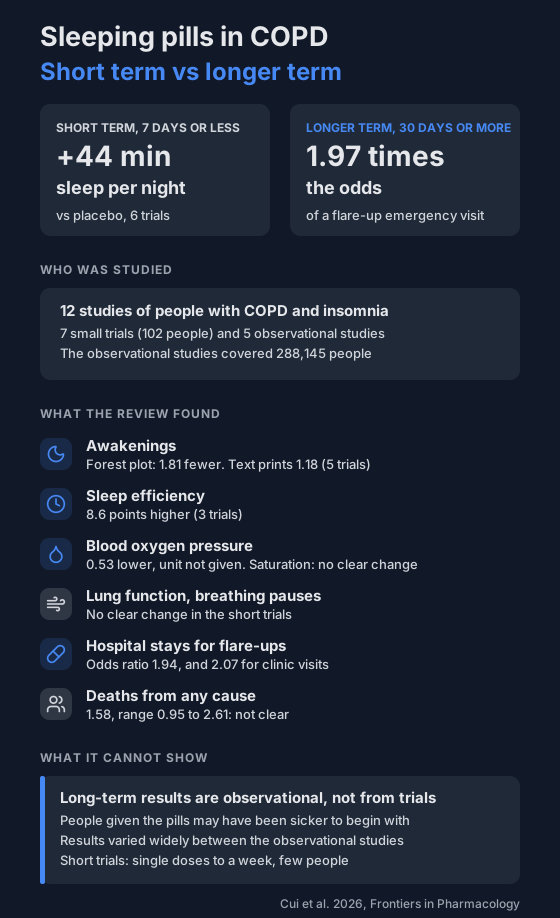
Whether sleeping pills suit people with COPD is still debated. A 2026 meta-analysis pooled the evidence for people with COPD and insomnia. It looked at short-term sleep and oxygen results from trials, then at long-term outcomes from observational studies.
The pills here are benzodiazepines and the newer "Z-drugs" such as zolpidem. The authors call the group benzodiazepine receptor positive allosteric modulators.
Who was in the studies?
- 12 studies, found by searching four databases up to March 2025.
- 7 randomised trials with 102 people in total, mostly single nights or short courses compared with placebo.
- 5 observational studies (3 cohort, 2 case-control) with 288,145 people, mostly from Taiwan and Canada.
- Everyone had COPD.
- People with sleep apnea, restless legs, opioid use or PTSD were excluded.
- The authors say the review was registered in advance (PROSPERO).
The short-term results (7 days or less) come from the trials. The long-term results (30 days or more) come from the observational studies.
What did the short trials find?
Against placebo:
- Total sleep time was 44 minutes longer (6 trials).
- Awakenings were about 1.8 fewer per night (5 trials).
- Sleep efficiency was 8.6 points higher (3 trials).
The awakenings figure comes from the paper's forest plot (-1.81, 95% CI -3.05 to -0.56). Its results text prints -1.18, which looks like a typo, since that range is centred on -1.81.
The paper says sleep efficiency was scored with a visual analogue scale and the Digit Symbol Substitution Test.
The paper's pooled head counts run higher than 102 (300 for total sleep time). Its forest plots list each dose and placebo comparison separately, so the same people are counted more than once.
What happened to oxygen and breathing?
- Arterial oxygen pressure (PaO2). It was 0.53 lower during sleep with the pills (3 studies). The paper gives no unit, and one 12-person trial carries 95% of the weight in this result. The results section gives p = 0.010 and the abstract gives p = 0.008.
- Oxygen saturation (SaO2). There was no clear difference. The pooled change was -0.17 (4 studies, p = 0.61).
- Lung function (FEV1). No clear difference, from 2 studies.
- Breathing pauses. No clear difference, from 2 studies.
The authors suggest PaO2 picks up small changes that saturation misses. They say a small fall usually matters little in stable COPD, but that the same fall during a flare-up can mean a bigger saturation drop. They also note the trials used standard or low doses, and mostly single doses or short courses.
What did the long-term studies show?
Compared with people who didn't take the pills:
- Emergency visits for a COPD flare-up: odds ratio 1.97 (95% CI 1.76 to 2.19, 2 studies).
- Clinic visits for a flare-up: 2.07 (1.51 to 2.82, 2 studies).
- Hospital stays for a flare-up: 1.94 (1.07 to 3.52, 2 studies).
- Death from any cause: 1.58 (0.95 to 2.61, 3 studies, p = 0.08).
These pooled results covered about 115,000 of the 288,145 people.
The range for deaths includes 1, so that result was not statistically clear. The results section calls it close to significance, while the abstract and discussion describe it as a significant rise.
Did the type of pill matter?
Possibly, but the evidence is thin. Only one study sat in each of the Z-drug and mixed-use groups, and results varied a lot, so the authors say to read these with caution.
- Hospital stays: odds ratio 2.22 for Z-drugs and 2.68 for mixed use, against 1.09 for benzodiazepines alone.
- Clinic visits: 2.24 for Z-drugs, 3.35 for mixed use, 1.90 for benzodiazepines alone.
- Deaths: 1.82 for Z-drugs, 1.91 for mixed use, 1.40 for benzodiazepines alone, where the range included 1 (0.67 to 2.67).
A separate study they cite looked at a different outcome. It found no statistically significant rise in respiratory failure with Z-drugs alone (0.85, 0.51 to 1.44).
The review could not test whether COPD grade or length of use changed the results. The studies didn't give enough data.
What can't this tell you?
- Cause. The long-term data are observational. Doctors may prescribe sleeping pills to people who are already sicker, so the pills may not be the reason for the extra visits. The authors say the results should not be read as proof of cause.
- How large the long-term effect is. The observational studies disagreed widely with each other (I2 of 89% to 94% for deaths, clinic visits and hospital stays). For deaths, the largest study had an odds ratio of 0.91, while the others ran from 1.40 to 2.36. Follow-up ran from 30 to 365 days.
- Why people took the pills. The two largest cohorts are described as mostly people with insomnia, and the authors can't rule out use for other reasons.
- Publication bias. The results section says no significant bias was found. The limitations section says the funnel plots for hospital stays and emergency visits looked lopsided, which may have inflated the estimates.
- Whether the sleep gains matter day to day. The authors say it's uncertain whether the gains on trial measures carry over to daytime function or quality of life.
- Long courses in trials. The trials were short. The 30-day-plus outcomes came only from the observational studies.
What did the authors conclude?
This is what the authors wrote, not advice for your own care.
- They call short-term use effective and safe, and say long-term use may speed up COPD progression.
- They write that long-term use is not recommended for routine sleep management in COPD, and that decisions should be individual.
- They point out that European and American guidelines list cognitive behavioural therapy for insomnia (CBT-I) first for chronic insomnia, with medication considered if it doesn't work or isn't available.
Their abstract and conclusion also mention better quality of life, which their discussion calls uncertain.
What can you do with this?
Decisions about sleeping pills sit with you and your prescriber. If you take one and have COPD, you can bring this review to the appointment.
An overnight oximeter shows what your saturation and pulse did on a given night. It can't show how a medicine is affecting you. You can share the recordings with your doctor so they have the numbers.
For more on overnight oxygen in COPD, see COPD sleep types and survival.
Not a medical device. Does not diagnose, treat or prevent any condition. Discuss results and changes with a clinician.
References
- Cui XJ, Xie B, Yi XQ, Li PF. Short-term sleep benefits versus long-term pulmonary risks: an updated meta-analysis of benzodiazepine receptor positive allosteric modulators in COPD patients with comorbid insomnia. Frontiers in Pharmacology. 2026;17:1636836. doi:10.3389/fphar.2026.1636836