Weighted Blanket Weight and Sleep Trial
Two 2026 crossover trials in 20 healthy adults each tried 7, 9 and 14 kg weighted blankets. Naps showed no significant gap. An overnight sleep-efficiency signal rested on 7 people and was not confirmed by two other analyses.
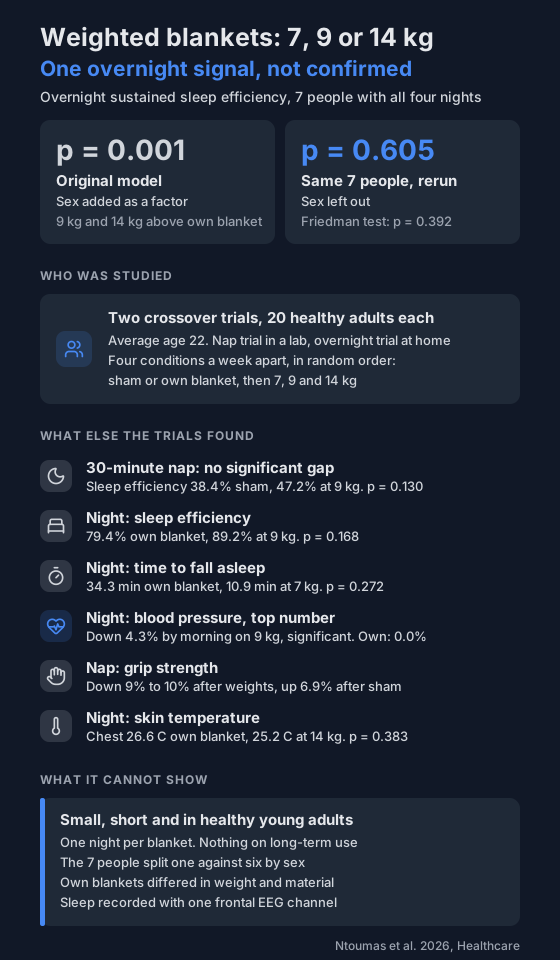
Weighted blankets are sold on the idea that more weight means calmer, deeper sleep. A paper published in October 2026 tried three weights, 7, 9 and 14 kg, and measured sleep with a portable EEG rather than asking people how they felt.
The headline is that most measures showed no significant difference. One overnight measure did, and the authors call that result exploratory.
Who was in the study?
It reports two small crossover trials, run separately. In a crossover trial, everyone tries every condition, so each person is their own comparison.
- Nap trial: 20 healthy students, average age 22, 13 women and 7 men. They lay down for 30 minutes in a lab.
- Overnight trial: 20 healthy volunteers, average age 22, 10 women and 10 men. They slept at home.
- People with insomnia or other known sleep disorders were excluded.
- Each person did four sessions a week apart, in random order.
- Nap conditions: a cotton sham blanket with no added weight, then 7, 9 and 14 kg blankets.
- Overnight conditions: their own blanket, then 7, 9 and 14 kg blankets.
The weights were fixed, not matched to body weight. Average body weight was about 70 kg in the nap trial and 68.5 kg in the overnight trial.
What happened in the nap trial?
No significant differences in any sleep measure.
- People slept for only 14 to 17 minutes on average out of the 30.
- Sleep efficiency was 38.4% under the sham blanket and 47.2% under 9 kg (p = 0.130). The 7 kg and 14 kg blankets were 38.2%, the same as each other.
- Time to fall asleep was 8.0 minutes on sham and 5.4 minutes on 9 kg (p = 0.169).
- Self-rated relaxation rose after lying down in every condition, including the sham. The biggest rise was 20.3% with 9 kg, against 17.8% with the sham.
- Grip strength fell 9% to 10% after each weighted blanket and rose 6.9% after the sham. The authors read that as a possible sign of lower muscle tone or arousal.
- Heart rate and the top blood pressure number fell significantly after the sham and 7 kg conditions only.
What happened overnight?
Sleep was recorded at home with a portable EEG, plus skin temperature sensors on the chest and thigh.
- Sleep efficiency was 79.4% on people's own blankets, then 86.4% (7 kg), 89.2% (9 kg) and 88.0% (14 kg). That gap was not significant (p = 0.168).
- Total sleep time was 6.1 hours on own blankets and 7.3 to 7.5 hours on the weighted ones (p = 0.188).
- Time to fall asleep was 34.3 minutes on own blankets and 10.9, 19.6 and 16.8 minutes on the three weights (p = 0.272).
- Awakenings per night were 25.7 on own blankets and 20.5 to 25.6 on the weighted ones (p = 0.671).
- Chest and leg skin temperature did not differ significantly between blankets.
- The top blood pressure number fell 4.3% from bedtime to waking after 9 kg. It changed by 0.0% on own blankets, 1.7% on 7 kg and 0.8% on 14 kg. Only the 9 kg fall was significant, and the paper does not report a direct comparison between blankets.
What about the one significant sleep result?
The paper's one significant sleep result was "sustained sleep efficiency", total sleep time divided by time in bed after the first stage 2 sleep.
- It needs a value on all four nights. Only 7 of the 20 people had one.
- The original model, which added sex as a factor, found a significant condition effect (p = 0.001).
- Table 2 lists 79.1% on own blankets, 86.2% on 7 kg, 93.2% on 9 kg and 88.7% on 14 kg. In that model, pairwise tests put 9 kg and 14 kg above own blankets.
- Rerunning the same 7 people without sex as a factor gave p = 0.605.
- A rank-based test, the Friedman test, gave p = 0.392.
- The 7 people split one against six by sex.
The authors call this finding exploratory and dependent on the model chosen. It is not evidence that a heavier blanket raises sleep efficiency. The authors also say the study did not show an ideal weight.
What can't it tell you?
- Small and healthy. Two groups of 20 healthy young adults. It says nothing about older adults, people with insomnia, anxiety or pain, or people with sleep apnea.
- One night per blanket. It looked at acute effects, not weeks of use, and the paper says safety over long use wasn't studied.
- No significant difference isn't the same as no difference. With groups this small, the authors say smaller effects could have been missed.
- Uneven control nights. Own blankets weren't standardised, and light, noise and room temperature weren't controlled at home.
- A limited sleep recording. The portable EEG used one frontal channel, so small differences in sleep stages should be read cautiously.
- Carryover. The one-week gap between sessions was never tested for leftover effects.
- No verified sample size plan. The authors say the original sample size calculation could not be verified.
What can you do with this?
If you own a weighted blanket, don't expect the paper to tell you which weight to pick. It found no clear winner, and that includes the 9 kg result that stood out in one analysis.
If you want to see what a blanket does for you, compare a few nights with and without it. The overnight numbers in this trial varied a lot from person to person. For example, the standard deviation of time to fall asleep was about 28 minutes on own blankets, so one or two nights won't settle much. Heart rate, and how steady your nights look in an overnight log, are things you can track yourself. The trial did not measure blood oxygen.
For room conditions that may matter alongside, see bedroom temperature and air. For naps and heart rate variability, see nap HRV and mood by age.
Not a medical device. Does not diagnose, treat or prevent any condition. Discuss results and changes with a clinician.
References
- Ntoumas I, Antoniou N, Bourganos N, Stylou S, Kotsi A, Zarogiannis K, Katsiaribas G, Simou C, Gkiata P, Durrer CG, Flouris A, Giannaki CD, Karatzaferi C, Sakkas GK. Weighted Blanket Load and Sleep Outcomes During Daytime Napping and Overnight Sleep: Two Randomized Crossover Studies. Healthcare (Basel). 2026;14(20):3416. doi:10.3390/healthcare14203416