Mediterranean Diet and Sleep Quality Study
In 500 Spanish adults, a Mediterranean-style diet went with better self-rated sleep, but a wrist tracker worn for five days showed no clear difference.
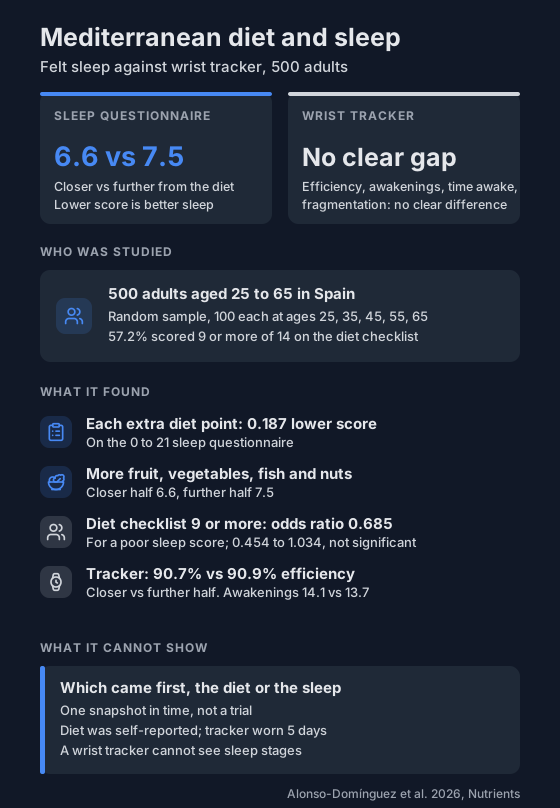
People who eat a Mediterranean-style diet often say they sleep better. A 2026 study from Spain asked a harder question: does a wrist tracker agree?
It found that diet went with how well people said they slept, but not with what the tracker recorded.
Who was in the study?
- 500 adults aged 25 to 65 from Salamanca and Ávila in central Spain.
- A random sample drawn from the regional health service list, with 100 people at each of ages 25, 35, 45, 55 and 65, half men and half women.
- Data was collected between May 2022 and April 2024.
- People with terminal illness and pregnant women were left out.
- 65.6% were employed and 48.8% had a university degree.
- Overall health was good, with a low average score on a comorbidity index (0.41).
How were diet and sleep measured?
- Diet: a 14-question checklist (MEDAS) that scores things like olive oil, vegetables, fruit, fish, nuts and red meat. Scores run from 0 to 14, and 9 or more counts as high adherence. The average was 8.8, and 57.2% scored 9 or more.
- Felt sleep: the Pittsburgh Sleep Quality Index, a 19-item questionnaire scored 0 to 21. Higher is worse. A score above 5 is usually read as poor sleep, and the group average was 7.1.
- Recorded sleep: an ActiGraph wrist device worn on the non-dominant wrist for five days in a row, including at least one weekend day. It estimates sleep and wake from movement.
The results were adjusted for age, sex, education, work, other health conditions, BMI, caffeine, alcohol, smoking and physical activity.
What did they find?
The questionnaire showed a link:
- Each extra point on the diet checklist went with a 0.187-point lower sleep questionnaire score (95% CI -0.354 to -0.021).
- The study also split people into two groups by what they ate.
- The group with more fruit, vegetables, fish, olive oil and nuts, and less red meat and fizzy drinks, scored 6.6.
- The other group scored 7.5.
The wrist tracker did not:
| Wrist tracker measure | Group eating closer to the Mediterranean pattern | Other group |
|---|---|---|
| Sleep efficiency | 90.7% | 90.9% |
| Time awake after falling asleep | 37.8 | 36.9 |
| Awakenings | 14.1 | 13.7 |
| Fragmentation index | 24.5 | 23.4 |
None of those gaps was statistically significant. The paper gives no unit for time awake.
One more result was borderline. Scoring 9 or more on the checklist went with lower odds of a poor sleep score (odds ratio 0.685, 95% CI 0.454 to 1.034), but that did not reach statistical significance (p = 0.072). For this model the paper counts a score of 5 or more as poor sleep, while its methods describe above 5 as the usual cut-off.
Why would the questionnaire and the tracker disagree?
The authors offer possible explanations, not findings:
- A wrist tracker works from movement. It can't see sleep stages, so changes in deeper or REM sleep may not show.
- How rested you feel in the morning isn't the same as how still you were.
- Mood and stress may shape how people rate their sleep, and the Mediterranean pattern has been linked to lower rates of low mood and anxiety.
The study didn't test any of these.
What can't this study tell you?
- Cause. It's a cross-section, one snapshot in time. It can't say whether the diet changed sleep, or whether people who sleep well find it easier to eat well.
- Diet detail. The checklist gives a score, not exact amounts of any nutrient.
- Short tracking window. Five days may miss week-to-week changes.
- What the tracker sees. It estimates sleep from movement, so it can't separate sleep stages.
- Size of the difference. The authors call 0.187 points per diet point modest, though they say it's similar to what non-drug sleep programmes achieve.
The authors call for longer follow-up studies and controlled trials.
What can you do with this?
"I slept well" and "my tracker says I slept well" can be different things.
If you track your own sleep, you can note how you felt each morning next to what the device records, and see how the two compare over a few weeks. PulseOxTracker's night notes let you add a short note to each night alongside your overnight oxygen and pulse data. For what a wrist or ring device can and can't tell you, see ring vs fingertip vs wrist oximeter.
Not a medical device. Does not diagnose, treat or prevent any condition. Discuss results and changes with a clinician.
References
- Alonso-Domínguez R, González-Sánchez J, Jiménez-Vaquero C, García-Yu IA, Sánchez-Aguadero N, Crespo-Sedano A, Recio-Rodríguez JI. Mediterranean Diet Adherence and Sleep Quality in Spanish Adults: Divergent Associations Between Subjective and Objective Measures. Nutrients. 2026;18(20):3305. doi:10.3390/nu18203305