Students vs Older Adults: Ring Data Compared
A 2026 Singapore study of 1,967 adults wearing an Oura ring for 4 weeks found students sat the most (634 min a day) and were active the least (320 min), while adults around 74 were active 420 min and sat 501. In working and older adults, swapping 30 minutes a day from sitting toward activity or sleep went with a lower BMI.
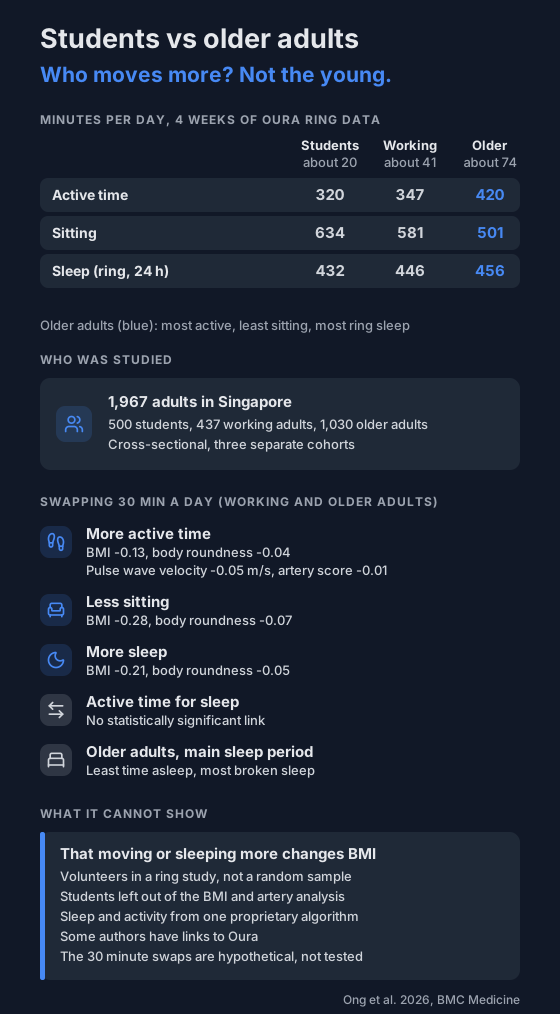
The usual picture is that people move less as they age. Young adults are meant to be the active ones. A 2026 Singapore study checked that with 4 weeks of Oura Ring data, and found the opposite.
University students sat the most, moved the least and had the least ring-counted sleep across the day. Adults around 74 were the most active and sat the least.
Who was studied?
- 1,967 adults in Singapore, from three separate cohorts.
- 500 university students (average age 19.9, 50.8% female).
- 437 working-age adults who worked at the same university (average age 41.1, 61.3% female).
- 1,030 community-dwelling older adults (average age 74.0, 53.5% female).
- Everyone was given an Oura Ring to wear for 4 weeks. People with fewer than 14 valid days were left out, which left 48,535 valid days in total.
What did the ring record?
The ring sorts each 5-minute block of the day by movement, using Oura's own algorithm. The paper splits the whole day into sleep, sitting (the lowest movement level while awake) and active time (light plus harder activity). Time with the ring off was counted as sitting.
Average minutes per day:
| Students | Working adults | Older adults | |
|---|---|---|---|
| Active time | 320 | 347 | 420 |
| Harder-activity part | 46 | 55 | 80 |
| Sitting | 634 | 581 | 501 |
| Sleep (24 hours) | 432 | 446 | 456 |
- The activity gap held on weekdays and weekends, and for light and for harder activity.
- Students were active about 30 minutes less on weekends than on weekdays. Working adults stayed about the same, and older adults looked much the same on both.
- Students' weekday activity clustered around the start and end of classes. Older adults were active through the day, apart from an afternoon dip.
Did older adults really sleep more?
Partly. The 456 minutes above is the time the ring counted as sleep over the whole 24 hours. For the main overnight sleep period, the paper says older adults actually spent the least time asleep. They had more broken sleep, more time awake after falling asleep and lower sleep efficiency. Those main-sleep figures are in the paper's supplement, not its main text, so they aren't quoted here.
The paper's discussion calls the 456 minutes time in bed: older adults spent the longest in bed, but not the most time asleep.
What did a 30 minute swap go with?
The authors then looked at how the split of the day related to body measures. This part used only the working-age and older adults, pooled together. The paper says the students' heart and metabolic measures weren't assessed, although its Table 1 still lists an average student BMI of 21.7.
Each figure is an estimate of what a typical person would differ by, after allowing for age, sex, sleep fragmentation, high blood pressure, diabetes, high cholesterol and smoking.
- 30 more minutes active (taken from the rest of the day): BMI 0.13 kg/m² lower, body roundness index 0.04 lower, pulse wave velocity 0.05 m/s lower and a combined artery score 0.01 lower.
- 30 fewer minutes sitting: BMI 0.28 lower and body roundness 0.07 lower.
- 30 more minutes asleep: BMI 0.21 lower and body roundness 0.05 lower. When time was swapped directly between two behaviours, sitting for activity went with lower BMI, body roundness, pulse wave velocity and the artery score. Sitting for sleep went with lower BMI and body roundness only. Swapping active time for sleep showed no statistically significant link either way. So the links came mostly from time taken out of sitting, and neither activity nor sleep came out ahead of the other.
Body roundness index is worked out from your waist and height, and a higher number means a rounder middle. Pulse wave velocity is how fast the pulse travels from the neck to the groin, and a higher number means stiffer arteries. The combined artery score averages pulse wave velocity with two other stiffness readings taken at the wrist, so a lower score means less stiff arteries.
What can't it show?
- It's a cross-section. The swaps are statistical estimates, not people changing their days, and the authors call them hypothetical. This study can't show that moving or sleeping more lowers BMI.
- The differences per 30 minutes are small, and the study didn't test whether a real change in routine would show up.
- The ring scores movement in 5-minute blocks, and the authors note it isn't known which time scale matters most for health.
- The students weren't in the BMI and artery analysis, so the study can't say whether their pattern leads to anything later.
- Everyone volunteered for a consumer-technology tracking study. They may not represent everyone.
- The older group was only ethnic Chinese by design. The authors reran the age comparison in Chinese participants with equal numbers of men and women, and saw the same pattern.
- Socioeconomic status couldn't be fully accounted for, and over half the students lived on campus.
- The ring's movement categories came from one proprietary algorithm. For ring accuracy, see smart rings and sleep stages.
- The authors' Oura links: everyone wore an Oura Ring provided for the study. One author sits on Oura's medical advisory board, and three authors joined the Oura-National University of Singapore Joint Lab in August 2026. The authors state the work was designed, funded and run only by the university, with funding from the university's sleep and cognition centre and the Lee Foundation. Oura is the device maker, so the ties are worth keeping in mind.
What can you do with it?
If you wear a ring or watch, you can look at your own split of the day.
- Compare your weekdays with your weekends. Check whether your activity drops on days off, as it did in the students.
- Compare time in bed with time asleep, since the two can differ more than you'd expect.
- Use the study's averages as context, not a target. The study can't say what your own numbers should be.
For another ring study in older adults, see Oura Ring in hospital.
Not a medical device. Does not diagnose, treat or prevent any condition. Discuss results and changes with a clinician.
References
- Ong JL, Qin S, Martin TH, Chua XY, Soon CS, Yilmaz G, Ling LH, Müller-Riemenschneider F, Koh WP, Chee MWL. 24h movement behaviours in university students compared to working age and older adults: wearable-based evidence and cardiometabolic health implications. BMC Medicine. 2026;24(1):485. doi:10.1186/s12916-026-05192-1