Sleep Apnea Waiting Times in England
A 2026 study of English health records found new sleep apnea cases on record nearly doubled from 2010 to 2019, the median wait from GP referral to starting CPAP was 194 days, and 42% of CPAP users had no sleep clinic visit afterwards.
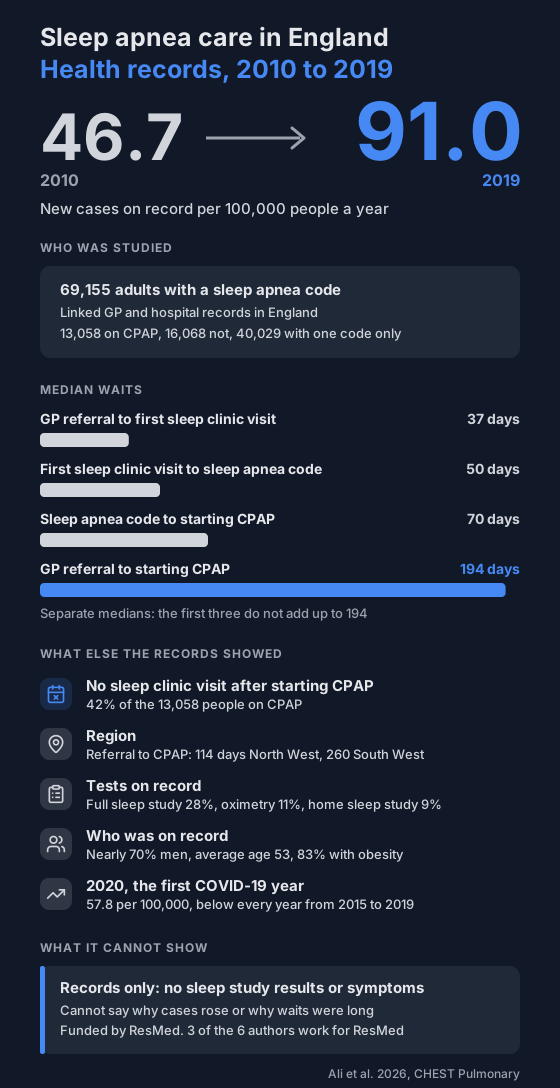
Waiting lists for sleep apnea care in England are often talked about, but hard numbers are rare. A 2026 study went through ten years of GP and hospital records to count new cases and time each step to CPAP.
Who was in the study?
- 69,155 adults in England with a sleep apnea code in their GP records between 2010 and 2019.
- GP records were linked to hospital records, so clinic visits and CPAP could be followed.
- Nearly 70% were men, the average age was 53 and 83% had obesity.
- Everyone had at least a year of records before and after their first sleep apnea code.
The records split them into three groups:
- 13,058 with sleep apnea confirmed who went on CPAP.
- 16,068 with sleep apnea confirmed who didn't.
- 40,029 with only a single sleep apnea code and nothing after it.
The authors say that single-code group could be unconfirmed cases, missed appointments or coding errors. They think many of the 16,068 not on CPAP had lower-grade sleep apnea managed with mouthpieces or lifestyle changes, since NICE only recommended CPAP for it from 2021. The records have no grade data, so this can't be checked, and the authors add that some of them were likely candidates for CPAP.
2020 was left out of the main results because of COVID-19.
How much did new cases go up?
- 2010: 46.7 new cases per 100,000 people a year.
- 2019: 91.0 per 100,000.
- Average across the decade: 65.1 per 100,000.
That's nearly double, and it rose every year. In 2020 it dropped to 57.8, which the authors put down to fewer clinic visits during the pandemic.
The study can't say why cases rose. The authors suggest rising obesity, more awareness among doctors, and a 2012 change to how sleep studies count breathing events, which was linked to more people meeting the threshold. The records can't show how much each of these contributed.
How long did people wait?
These are medians, meaning half waited longer and half less:
- GP referral to first sleep clinic visit: 37 days.
- First sleep clinic visit to a sleep apnea code: 50 days.
- Sleep apnea code to starting CPAP: 70 days.
- GP referral to starting CPAP: 194 days, over 6 months.
Each median was worked out on its own, so the first three don't add up to the 194.
The spread was wide. The middle half waited between 90 and 833 days from referral to CPAP.
It also depended on where you lived:
- North West: 114 days from referral to CPAP.
- North East: 121 days.
- London: 211 days.
- South West: 260 days.
The records don't say what caused the delays.
What happened after starting CPAP?
UK NICE guidelines say a first check-up should happen within a month of starting CPAP, then once a year once it's settled.
In the records:
- 42% of the 13,058 CPAP users had no sleep clinic visit after starting.
- 13% averaged half to one visit a year.
- 17% averaged one to two a year.
- 13% averaged more than three a year.
Remote check-ups were only recommended in the UK from 2021, so few would have been used here. The authors note any contact with the clinic should still show up in the records.
For one take on how often follow-up is needed, see yearly visit or on request.
Which tests were used?
- Full overnight sleep study: 28%.
- Overnight pulse oximetry: 11%.
- Home sleep study: 9%.
UK guidelines name the home sleep study as the main test, so the authors call it underused. They also say tests may simply have been left off the records.
What can't it show?
- Grade. The records have no sleep study results, so the study can't say how many events per hour anyone had.
- Symptoms. There's no data on how people felt.
- Why. It can't explain the rise in cases or the waits.
- Coding gaps. Anything missing or mis-entered in the records is missing from the study.
- Reach. It covers GP practices in England only, and only people with linked hospital records.
- Funding. ResMed, which makes CPAP machines, paid for the study and helped design it. 3 of the 6 authors work for ResMed and own shares, and two of them wrote the first draft.
What can you do with this?
If you've been referred, a wait of several months was typical in these records.
You can still keep a log of your nights in the meantime. An overnight oximeter records your oxygen and pulse, though it can't tell you whether you have sleep apnea. Here's how to share that with your doctor.
Already on CPAP and not heard from the clinic? Ask when your check-up is. See tracking your oxygen alongside CPAP for what you can log between visits.
Not referred yet? The sleep apnea risk check takes about a minute.
Not a medical device. Does not diagnose, treat or prevent any condition. Discuss results and changes with a clinician.
References
- Ali A, Deger M, Ghildiyal A, Alpert N, Hosnijeh FS, Boult S. Incidence, Characteristics, and Management Pathways of Obstructive Sleep Apnea in England: A 10-Year Retrospective Cohort Study. CHEST Pulmonary. 2026;4(1):100221. doi:10.1016/j.chpulm.2025.100221