CPAP Follow-Up: Yearly Visit or On Request?
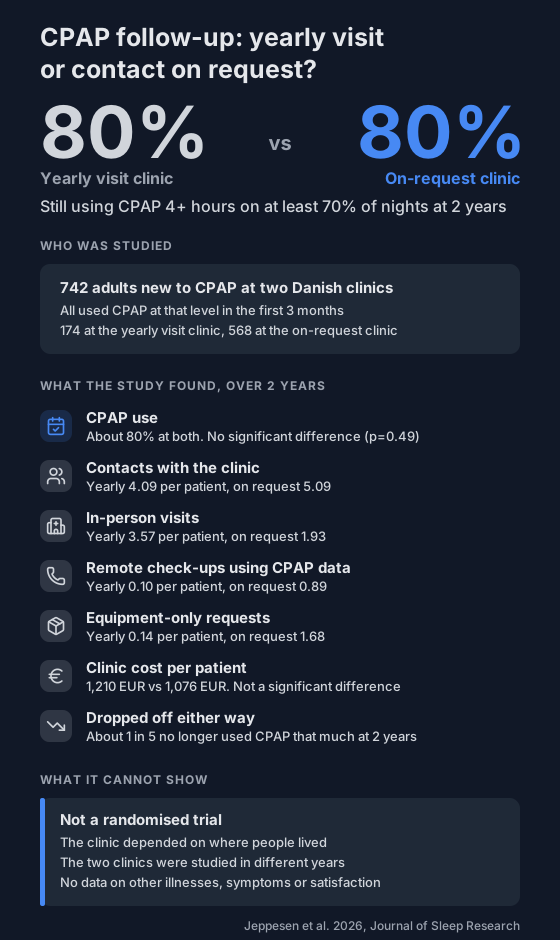
A 2026 Danish study compared 742 CPAP users at two clinics: one booked a yearly in-person visit, the other left contact up to the patient. About 80% at both were still using CPAP regularly after 2 years.
Many sleep clinics book CPAP users in for a check-up once a year. Others leave it to you to get in touch when something's wrong.
A Danish study published in 2026 compared two clinics that work these two ways. After 2 years, about 80% of patients at both were still using CPAP regularly.
Who was in the study?
- 742 adults who had just been told they had obstructive sleep apnea and started CPAP.
- Average age 56, and 71% were men.
- Everyone had used CPAP regularly in the first 3 months: at least 4 hours a night on at least 70% of nights. People who used it less got individual follow-up and were left out.
- People who handed the machine back within 2 years were also left out.
- All machines sent nightly usage data to the clinic. Nobody at either clinic watched that data unless the patient got in touch.
How did the two clinics differ?
Both saw patients in the first weeks, including a check at 6 to 8 weeks. After that:
- Yearly visit clinic (174 patients). A booked in-person visit about a year later. Most happened around month 16 after starting CPAP.
- On-request clinic (568 patients). No booked visit. Patients could phone or email, and had an app linked to their machine.
Which clinic you went to depended on where you lived, not on a random draw.
What did the study find?
CPAP use:
- About 80% at both clinics were still using CPAP regularly at 2 years.
- The trend before and after the yearly visit was not significantly different from the trend at the on-request clinic (p = 0.49).
- 89% at the yearly clinic had an in-person visit between months 7 and 21. At the on-request clinic, 21% did.
Contacts per patient over 2 years:
| Yearly visit | On request | |
|---|---|---|
| All contacts | 4.09 | 5.09 |
| In-person visits | 3.57 | 1.93 |
| Remote check-up using CPAP data | 0.10 | 0.89 |
| Remote contact without CPAP data | 0.28 | 0.58 |
| Equipment-only request | 0.14 | 1.68 |
So the on-request patients contacted the clinic more often (a statistically significant difference), but mostly by phone, email or video, and often just for mask parts and supplies.
Cost to the hospital:
- 1,210 EUR per patient at the yearly clinic and 1,076 EUR at the on-request clinic.
- That's 11% lower (134 EUR), but the difference was not statistically significant.
- The paper's text calls these averages and its table labels them medians.
- The figures don't count patients' travel or time off work.
- The authors note that a remote check-up that reviews the machine's data can take as long as an in-person visit.
What about the 1 in 5 who dropped off?
Everyone in the study started as a regular user. Two years later, about 20% at both clinics weren't using CPAP that much.
- Neither follow-up style picked these people up.
- The authors say that makes it too early to hand steady CPAP users over to primary care.
- They suggest clinics watch the usage data and step in when use falls, but this study didn't test that.
For more on what helps people keep going, see sticking with CPAP.
What can't it tell you?
- Cause. It wasn't a randomised trial. The two groups could differ in ways nobody measured.
- Like for like. More patients at the on-request clinic had 30 or more breathing events per hour before CPAP (60% vs 44%).
- Same period. The on-request clinic's data starts in 2015 and the yearly clinic's in 2020, so the COVID-19 pandemic affected them differently.
- Group size. The yearly clinic had only 174 patients.
- Other illnesses. There was no data on them.
- How people felt. Nothing on symptoms, quality of life, satisfaction or which style patients preferred.
- New or struggling users. Only people who used CPAP regularly from the start were included.
- Other countries. In Denmark CPAP is free and all supplies go through the sleep clinic.
- Usage counting. Nights with no data were counted as zero hours, which could mislabel nights when the connection failed.
What can you do with this?
How your follow-up works is up to your clinic. What the study does show is that, with either style, some regular users drifted off without anyone noticing.
- If your clinic leaves contact up to you, know how to reach them, and do it when the mask leaks, parts wear out or you're using it less.
- Check your machine's app from time to time. It shows your hours of use.
- Keep your own notes or recordings to bring along. Here's how to share oximeter data with your doctor.
- If you also wear an overnight oximeter, see tracking your oxygen alongside CPAP.
Don't change how you use CPAP without talking to your clinic.
Not a medical device. Does not diagnose, treat or prevent any condition. Discuss results and changes with a clinician.
References
- Jeppesen K, Wolff DL, Petersen SR, Kørvel-Hanquist A, Jacobsen JP, Kiær EK, Jennum PJ, Homøe P, Skjøt-Arkil H. Annual Versus Patient-Initiated Follow-Up in Sleep Apnoea Care: A Quasi-Experimental Study. Journal of Sleep Research. 2026;35(5):e70350. doi:10.1111/jsr.70350