Sleep Apnea, Stiff Arteries and Age
A 2026 study of 60 adults with higher-grade sleep apnea found stiffer arteries went with more breathing events and a lower oxygen nadir, but after allowing for age and other factors those links were no longer statistically significant, while age stayed strongly linked.
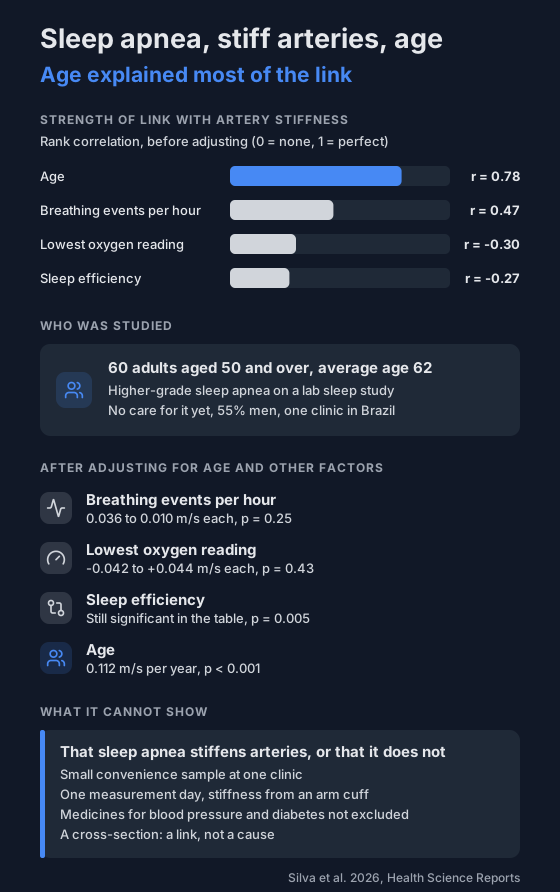
It's easy to assume that more breathing events at night means stiffer arteries. This 2026 study found that link in 60 adults. It then allowed for age and other factors, and the link with breathing events and with the lowest oxygen reading was no longer statistically significant. Age was the strongest predictor of stiffness.
It's a useful example of confounding: when two things both rise with a third, they can look linked to each other.
What is artery stiffness?
- Pulse wave velocity (PWV): how fast the pressure wave from each heartbeat travels along the arteries. Stiffer arteries carry it faster.
- The study estimated it with an arm cuff (a Mobil-O-Graph blood pressure monitor), taken seated in the morning, not with a finger oximeter.
- Stiffer arteries are linked to future heart and circulation problems in the wider research.
- Stiffness rises with age on its own, so any link with sleep apnea has to be separated from it.
Who was studied?
- 60 adults aged 50 and over at a lung clinic in a Brazilian military police hospital, between March 2023 and November 2024.
- Average age was 62, and 55% were men.
- Average BMI was 30.1.
- All had higher-grade sleep apnea found on a lab sleep study in the previous 90 days: 19 at the lower end of that range and 41 at the higher end.
- Breathing events averaged 38.7 per hour, and the lowest oxygen reading averaged 78.9%.
- None had care for sleep apnea yet.
- People who smoked, or had uncontrolled blood pressure or poorly controlled diabetes, were excluded.
- Half had high blood pressure, 32% had diabetes and 40% had high cholesterol.
What did it find before adjusting?
Each comparison used a rank correlation, where 0 means no link and 1 means a perfect one.
- Breathing events per hour: more events went with higher PWV (r = 0.47, p < 0.001).
- Lowest oxygen reading: a lower nadir went with higher PWV (r = -0.30, p = 0.02).
- Sleep efficiency: lower efficiency went with higher PWV (r = -0.27, p = 0.04).
- Time below 90% and average oxygen: no significant link with PWV. The paper does not show these data.
- Age: a much stronger link with PWV (r = 0.78, p < 0.0001).
In the unadjusted linear models, each extra breathing event per hour went with 0.036 m/s higher PWV, and each lower point of the nadir with 0.042 m/s higher.
What happened after adjusting for age?
The adjusted model allowed for age, sex, BMI, high blood pressure, diabetes and two classes of blood pressure medicine.
- Breathing events: 0.010 m/s per event per hour, down from 0.036, and no longer statistically significant (p = 0.25).
- Lowest oxygen reading: +0.044 m/s per point, with a wide interval, and no longer significant (p = 0.43). The sign flipped from the unadjusted model.
- Age: 0.112 m/s per year (95% CI 0.085 to 0.139, p < 0.001).
- The authors say the first links were largely explained by age-related changes in the arteries.
- Adding blood pressure, diabetes and medicines on top changed little.
One loose end: the text says only age stayed independent, but the adjusted table still shows sleep efficiency as significant (-0.015 m/s per point, p = 0.005). The paper doesn't explain the difference.
Why does this matter?
- Older adults tend to have both more breathing events and stiffer arteries, so a plain comparison mixes the two.
- Here, age sat behind much of what looked like a sleep link.
- That doesn't show sleep apnea has no effect on artery stiffness. With 60 people the study may be too small to find a modest one, and everyone was already in a narrow, higher-grade range, which limits the spread to compare.
- The paper's closing conclusion says stiffness rises as sleep apnea and sleep quality worsen. That rests on the unadjusted links; in the adjusted model, breathing events and the nadir were no longer significant.
What can't it show?
- It's a cross-section, so it can't show which came first or whether one causes the other.
- It's small, and a convenience sample from one clinic.
- Everyone had higher-grade sleep apnea, so it can't say how artery stiffness compares with people with none.
- Stiffness was estimated from an arm cuff, not measured directly along the aorta.
- The authors say they could not exclude people with well-controlled high blood pressure, cholesterol or diabetes, which also affect stiffness.
- It had one measurement day, and some sleep data were missing for three people.
- The paper reports no correction for running many comparisons.
- No specific funding. The authors declared no conflicts of interest.
For another study on pulse waves and breathing events, see blood vessel stiffening at sleep arousals.
What can you do with it?
- When a chart or a study links your overnight numbers to something else, ask whether age, weight or blood pressure could explain both.
- Track your own nights over time, so you compare you with you.
- A finger oximeter can't measure artery stiffness. It shows your oxygen and pulse, such as the nadir and ODI.
- If you're worried about your heart, blood pressure or sleep, talk to your doctor.
Not a medical device. Does not diagnose, treat or prevent any condition. Discuss results and changes with a clinician.
References
- Silva E, de Andrade JGT, de Camargos ERFG, Nunes OM, Neves GSP, Pereira PS, da Silva JFP, Mendes-Pinto D, Rodrigues-Machado MDG, Rezende BA. Associations between the severity of obstructive sleep apnea and arterial stiffness estimated by pulse wave velocity assessment: a cross-sectional study. Health Science Reports. 2026;9(3):e71861. doi:10.1002/hsr2.71861