Lung Clots and Sleep Apnea: A 2026 Study
A 2026 Spanish study compared 128 people who had a lung clot with 252 respiratory clinic patients and found more breathing events and oxygen dips per hour on a home sleep test taken at least three months after the clot.
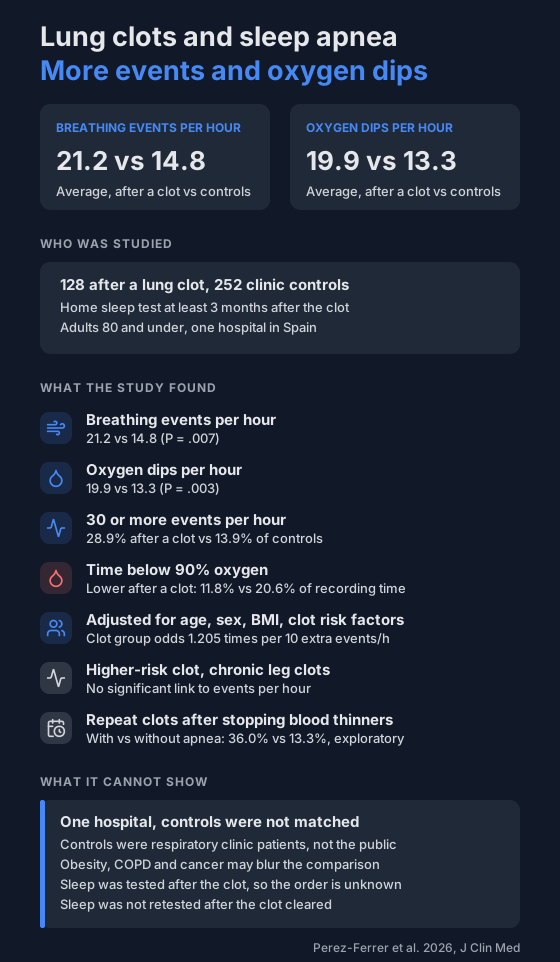
A lung clot (pulmonary embolism) and sleep apnea share risk factors like age and excess weight. A 2026 study from Spain asked whether people who had a clot also have more breathing events overnight than other people with lung problems. For a different study of testing within two weeks of a clot, see sleep apnea after a lung blood clot.
Who was studied?
- 128 adults who had a clot confirmed on a CT scan, recruited in hospital between July 2023 and July 2025.
- 252 adults from outpatient lung clinics who had a different respiratory problem and no past clot.
- Nobody was over 80, and nobody had known sleep apnea.
- The controls were not individually matched to the clot group.
Everyone did a home sleep test with nasal flow, chest and belly bands, a pulse oximeter and a body position sensor. For the clot group it was done at least three months after the clot, at a 3 to 6 month follow-up visit. The aim was to reduce the effect of the acute illness on the readings.
What did the sleep tests show?
| After a clot | Controls | |
|---|---|---|
| Average breathing events per hour | 21.2 | 14.8 |
| Average oxygen dips per hour (3% or more) | 19.9 | 13.3 |
| Met the study's criteria for sleep apnea | 55.5% | 42.1% |
| 5 to 14.9 events per hour | 22.7% | 32.9% |
| 30 or more events per hour | 28.9% | 13.9% |
The second row is the oxygen desaturation index. The clot group also reported more witnessed breathing pauses, daytime sleepiness and tiredness.
One result went the other way. The clot group spent less of the recording below 90% oxygen, 11.8% against 20.6% (see what T90 is). The authors say the controls' higher rate of COPD (23.8% against 14.1%) may partly explain it. They also note this differs from studies that tie time below 90% more closely to clot risk than events per hour.
Does it hold up after adjusting?
- Each extra 10 events per hour came with 1.205 times the odds of being in the clot group (95% CI 1.019 to 1.426), after adjusting for age, sex, BMI and established clot risk factors.
- The unadjusted figure was 1.259, and adjusting for age, sex and BMI alone gave 1.162.
- Among the 128 people with a clot, events per hour were not significantly linked to a higher-risk clot (34 people) or to chronic leg clots (24 people).
- People with a clot and sleep apnea more often had a high clot risk score on admission (69.0% against 43.9%), but the authors say age, obesity and other conditions may partly explain that.
- The two clot groups showed no statistically significant difference in chronic lung clots or deaths in the following year.
What about repeat clots?
55 people stopped blood thinners, and 13 had another clot within a year. Repeat clots happened in 36.0% of those with sleep apnea (9 of 25) and 13.3% of those without (4 of 30), P = 0.049. Events per hour showed a trend with repeat clots that was not statistically significant (P = 0.059). With so few people, the authors call this exploratory and say it needs larger studies.
What can't it show?
- It's a case-control study at one hospital, so it shows an association, not that sleep apnea causes clots or the reverse.
- The controls came from respiratory clinics, not the general public.
- The groups differed: the clot group had more obesity (63.3% against 46.0%), the controls more smoking and COPD.
- Within the clot group, those with sleep apnea were older and more often obese, and more of them had active cancer.
- The authors say leftover effects of obesity, COPD and cancer can't be ruled out.
- Neck circumference wasn't measured, and BMI may not capture body fat distribution.
- Sleep was tested only after the clot, so the study can't say which came first.
- Sleep wasn't retested after the clot was confirmed gone, so the authors can't say the events carry on without any clot left.
- CPAP was prescribed where it applied, but its use wasn't tracked or analysed.
- The test was a home sleep test, not a full sleep lab study.
- Of 402 clot patients assessed, 130 met the entry rules and 128 finished, and people over 80 or with a short life expectancy were left out.
What can you do with this?
Not much on its own. The study found a link in hospital and lung clinic patients, and it can't say what any one person should do. The authors suggest looking for sleep apnea at clot follow-up, especially in people with symptoms that fit. If you've had a clot and want to see your overnight oxygen, the session viewer lets you look at a night from your own oximeter. You can share those recordings with your doctor.
Not a medical device. Does not diagnose, treat or prevent any condition. Discuss results and changes with a clinician.
References
- Pérez-Ferrer P, Chiner E, Boira I, Piqueras JJ, Martínez-Sanchis A, Hernández-Blasco L. Obstructive Sleep Apnea and Pulmonary Embolism: Prevalence, Severity and the Association of Sleep-Disordered Breathing with Thromboembolic Disease. Journal of Clinical Medicine. 2026;15(20):7892. doi:10.3390/jcm15207892