Breathing Effort During Sleep and Death Risk
A 2026 study followed 16,083 people referred for suspected sleep apnea for about 15 years. Higher breathing effort during sleep went with a higher risk of death, though the top effort group lost statistical significance after adjusting for events per hour and oxygen.
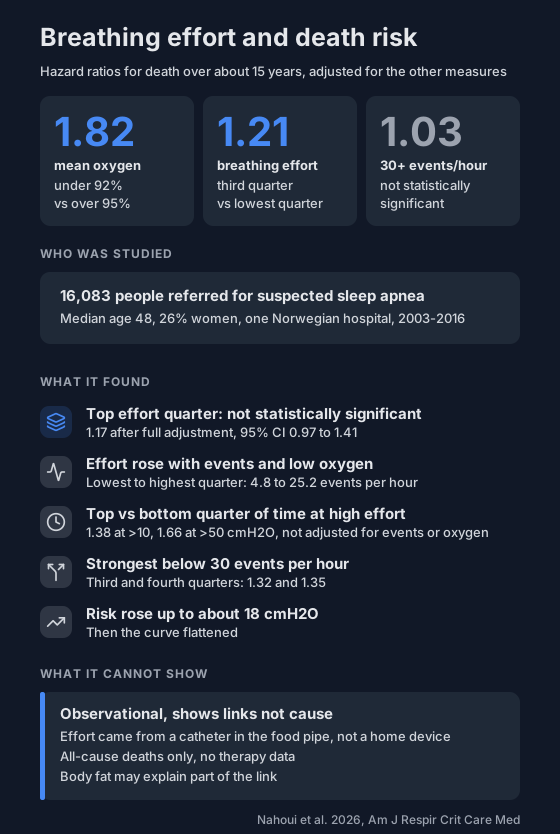
Sleep apnea studies usually describe a person by how many breathing events they have per hour and how low their oxygen goes. A 2026 study from Norway added a third measure, how hard a person has to work to breathe while asleep, and followed people for about 15 years.
What is breathing effort?
When the airway narrows, you pull harder on each breath, and the pressure inside your chest gets more negative. The researchers measured that with a thin catheter passed through the nose into the food pipe (esophagus). They report the result in cmH2O, as the median pressure over the night.
That's an invasive test that is rarely done. Earlier studies of death risk have mostly looked at events per hour and oxygen.
Who was in the study?
- 16,083 people referred to one hospital in Norway between 2003 and 2016 with suspected sleep apnea.
- Median age 48, and 26% were women.
- Median events per hour was 10, and 16% had 30 or more.
- Median mean oxygen overnight was 94%.
- Each person had an overnight recording in hospital, with the pressure catheter and a finger oximeter.
- Deaths were followed until June 2024, a median of 15 years.
What did it find?
1,497 people (9.3%) died during follow-up. The authors split effort into four equal groups, called quartiles. The cut-offs were 8.7, 12.8 and 18.4 cmH2O. A hazard ratio of 2 means the rate of death was twice as high as in the comparison group.
- Higher effort went with more events per hour (4.8 in the lowest group, 25.2 in the highest) and lower mean oxygen (95.1% against 93.3%).
- It also went with a higher BMI (25.8 against 32.2).
- Compared with the lowest group, the third and fourth had a higher risk of death after adjusting for age, sex, BMI and other health conditions, with hazard ratios of 1.29 and 1.37.
- After also adjusting for events per hour and mean oxygen, the third group stayed higher at 1.21 (95% CI 1.03 to 1.43).
- The fourth group's figure fell to 1.17 (95% CI 0.97 to 1.41), which was not statistically significant.
- A plot of the whole range rose until about 18 cmH2O, then flattened.
How did events per hour and oxygen compare?
In a secondary analysis, the authors ran the same models with each of these as the main measure.
- Events per hour: 30 or more was linked to a higher risk of death after adjusting for health conditions (1.23), but not once oxygen and effort were added (1.03, not statistically significant).
- Mean oxygen: under 92% was linked to higher risk than over 95%, and that held after all adjustments (1.82, 95% CI 1.50 to 2.20).
Each figure has its own comparison group, so don't read them as a ranking.
Does time at high effort matter?
The authors also looked at the share of the night spent above a series of pressure levels. They call this exploratory. These models adjusted for age, sex, BMI and health conditions, but not for events per hour or oxygen.
- At every level from 10 to 60 cmH2O, the people with the largest share of the night above it had higher risk than those with the smallest share.
- For the top quarter against the bottom, the hazard ratio was 1.38 above 10 cmH2O, 1.54 above 30 and 1.66 above 50.
- The authors say this suggests that both how deep the effort goes and how long it lasts matter.
Was it the same for everyone?
Not in the group with 30 or more events per hour.
- Below 30 events per hour, the third and fourth effort groups had hazard ratios of 1.32 and 1.35.
- At 30 or more, the third group's was 0.74 (95% CI 0.49 to 1.10), which was not statistically significant.
- The authors suggest one reason is that people in that group had more heart and blood vessel disease, which strongly affects risk of death.
- They also suggest some people with fewer events per hour still make large pressure swings, and a count of events alone could miss them.
What doesn't it tell you?
- Cause: it's an observational, retrospective study, so it shows what went together, not that effort caused deaths.
- Therapy: there's no data on CPAP or any other therapy, though the authors say many of these people went on to use positive airway pressure.
- Cause of death: deaths were counted from any cause, with no split for heart-related deaths.
- Body fat: effort rose with BMI, and the authors adjusted for BMI but had no waist or belly measures, so they can't rule out belly fat explaining part of the link.
- What drove the pressure: the data couldn't separate airway blockage from other causes such as heart failure or a higher drive to breathe.
- Catheter: its position was set by a marker and not checked, so values may not match other catheter systems.
- Sleep: it was a polygraphy, which doesn't record sleep, so time awake counted as sleep time.
- What was missing: there was no oxygen burden measure and no sleepiness data, and conditions came from hospital codes, which can under-count.
- Who: these were people referred to one hospital, so it may not apply to everyone who snores or wears an oximeter.
- Funding: the BEAMER project of the Innovative Medicines Initiative paid for it.
- Author ties: several authors report speaker fees or advisory roles with drug and device companies, and one lists ResMed and Philips Respironics.
What can you do with this?
This study's measure of breathing effort isn't something you can do at home. It needs the catheter, and the authors say simpler ways to estimate it still need testing.
A finger oximeter records what the study called mean oxygen, plus dips and pulse. The study found that mean oxygen was linked to risk of death after adjusting for the other measures, in this clinic group. That doesn't mean your own number predicts anything, and a low reading can have causes other than sleep apnea.
If you track overnight oxygen, you can log your average and your dips, and oxygen desaturation index (ODI) explains the dip count. For the other way of describing oxygen over a night, see two kinds of oxygen burden. If your numbers worry you, or you snore loudly or stop breathing in your sleep, share the recordings with your doctor.
Not a medical device. Does not diagnose, treat or prevent any condition. Discuss results and changes with a clinician.
References
- Nahoui H, Schirmer H, Einvik G, Øvrebotten T, Berge K, Myhre PL, Husby H, Hrubos-Strøm H. Respiratory effort during sleep predicts mortality in patients with suspected obstructive sleep apnea. American Journal of Respiratory and Critical Care Medicine. 2026;212(11):2803-2811. doi:10.1093/ajrccm/aamag344