Portable Oxygen vs Air on a Walking Test
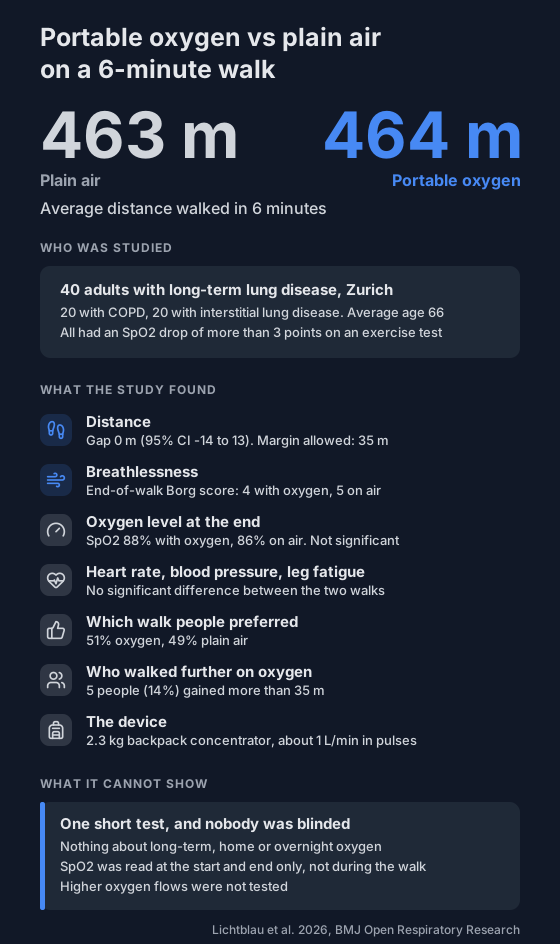
A 2026 crossover trial had 40 adults with COPD or interstitial lung disease do a 6-minute walk on plain air and on a portable oxygen concentrator. The average distance was the same, but breathlessness was lower with oxygen.
Some people with lung disease see their oxygen level drop when they walk. Doctors often prescribe a portable oxygen concentrator for that, and you'd expect it to let people walk further.
A trial published in September 2026 tested it. On a 6-minute walk, people covered the same average distance on plain air as with the concentrator. They did report less breathlessness with oxygen.
Who was in the trial?
- 40 adults at the University Hospital Zurich, Switzerland.
- 20 had COPD and 20 had interstitial lung disease.
- Average age 66. 26 were men and 14 were women.
- All had an SpO2 drop of more than 3 points on their most recent exercise test at the clinic, usually a 6-minute walk.
- People with very low oxygen at rest were left out.
- Three already used long-term oxygen at home.
New to the term? Read what SpO2 is.
What did they do?
Each person did two 6-minute walk tests, at least an hour apart, in random order.
- Plain air: nothing carried.
- Oxygen: a 2.3 kg portable concentrator in a backpack, with a nasal tube.
The concentrator was on its highest setting. It gives a 50 mL pulse of oxygen with each breath, which is about 1 litre a minute at 20 breaths a minute. Nobody was blinded, and the air walk had no dummy backpack. The researchers wanted it to match everyday use.
Three people didn't do the second walk.
How far did they walk?
- Plain air: 463 m on average.
- Portable oxygen: 464 m on average.
- Difference: 0 m (95% confidence interval -14 to 13 m).
The trial asked whether plain air was "non-inferior", meaning not worse by more than 35 m. 35 m is the smallest change in this test that's usually counted as meaningful in COPD. The authors note it may not fit interstitial lung disease as well, where the figure is less settled. Plain air passed that test in the whole group, in the COPD group and in the interstitial lung disease group.
Did oxygen change anything else?
- Breathlessness was lower with oxygen. The average Borg score at the end of the walk was 4 with oxygen and 5 on air, on a 0 to 10 scale. It was lower with oxygen in both disease groups.
- End-of-walk SpO2 was not significantly different. It was 88% with oxygen and 86% on air, starting from 96% and 94%.
- Heart rate, blood pressure and leg fatigue showed no significant difference.
Which did people prefer?
It was an even split: 51% preferred oxygen and 49% preferred plain air.
- People who preferred air said they felt no benefit, or that the weight, vibration and plastic smell bothered them.
- One said they breathe through their mouth when working hard, so the nasal tube didn't help.
- People who preferred oxygen said they coughed less, felt less breathless or felt they could walk faster.
- Two said they thought a higher flow would help more.
Preferring one walk didn't go with walking further on it.
Did anyone walk further on oxygen?
Yes, a few.
- 5 people (14%) walked more than 35 m further with oxygen.
- 3 more gained 20 to 35 m.
- The people who gained tended to be the ones who walked the shortest distance on air.
- Resting SpO2, end-of-walk SpO2, a lung gas-transfer test and functional class didn't go with who gained.
The authors call these estimates "highly unstable" because only five people were in the group.
Why might the distance be the same?
The authors give their best guesses, not a tested answer:
- The flow was low, about 1 litre a minute. Most earlier studies that showed a gain used higher flows, and several used 3 to 5 litres a minute or a face mask.
- Mouth breathing during exercise dilutes oxygen from a nasal tube.
- The concentrator may not have triggered on every breath.
- Carrying 2.3 kg may have cancelled out any gain.
- This group walked a long way already (463 m), which leaves little room to go further.
What doesn't it tell you?
- Anything long term. It was one 6-minute test. It says nothing about oxygen at home, overnight or over months.
- What oxygen did during the walk. SpO2 was read before and straight after, not continuously. The lowest point and the time spent low weren't measured.
- A blinded result. People knew which walk was which, which matters most for breathlessness and preference.
- Higher flows or other devices. One device at one setting was tested.
- People with bigger drops. Entry needed a drop of more than 3 points, not a fall below 88%, so some people's drops may have been small.
- Everyone. 40 people at one hospital, with 11 different kinds of interstitial lung disease in a group of 20.
The study was funded by the Swiss National Science Foundation. Philips Switzerland provided the concentrators.
What can you do with this?
This was one short walking test with one device. The authors say the lack of a distance gain "should not be interpreted as an absence of clinical benefit". If you use prescribed oxygen and have questions about it, take them to your doctor.
Two things are worth knowing:
- A fingertip reading before and after a walk misses what happened in between. A device that records continuously shows the whole walk, and you can share that recording with your doctor.
- Readings taken while you move are less reliable than readings at rest. Read how accurate pulse oximeters are.
If you get breathless on walks or see your readings drop when you're active, talk to your doctor.
Not a medical device. Does not diagnose, treat or prevent any condition. Discuss results and changes with a clinician.
References
- Lichtblau M, Wick C, Titz A, Müller J, Schneider SR, Hertig D, Bousraou Z, Vella A, Furian M, Kohler M, Schwarz EI, Ulrich S. Portable low-flow nasal oxygen versus ambient air in patients with chronic lung disease and exercise-induced hypoxaemia: a randomised controlled crossover non-inferiority trial. BMJ Open Respiratory Research. 2026;13(1):e004048. doi:10.1136/bmjresp-2025-004048