Pink Noise vs Earplugs for Noisy Nights
A 2026 sleep lab study played traffic, aircraft and alarm sounds to 25 healthy adults. Earplugs blunted most of the effects on deep sleep. Pink noise lowered REM sleep.
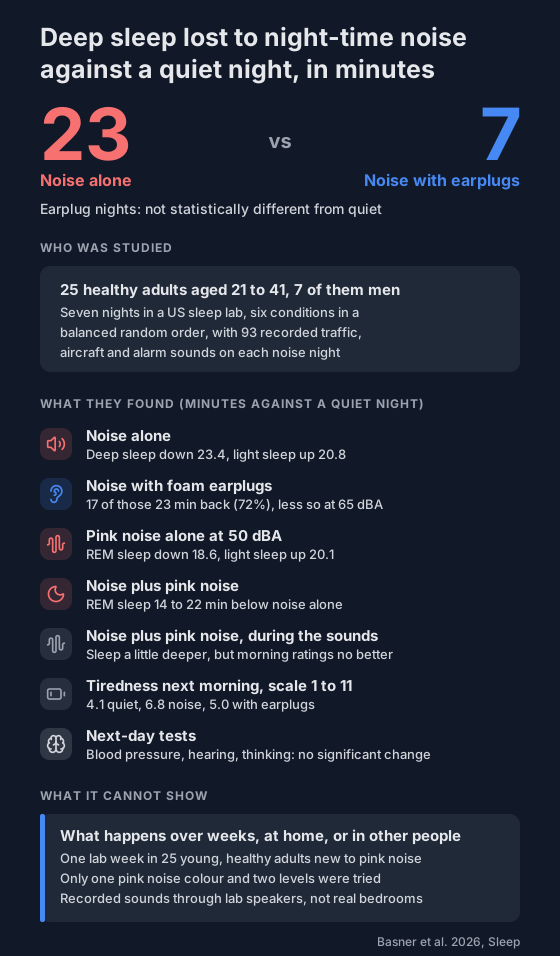
Plenty of people play pink noise or white noise to cover up traffic and other sounds at night. Earplugs are the other common option. A 2026 sleep lab study put both against intermittent noise and recorded the sleep stages.
Earplugs blunted most of the effects of the noise. Pink noise didn't, and on its own it lowered REM sleep.
Who was studied?
- 25 healthy adults aged 21 to 41, 7 of them men.
- None had sleep disorders or hearing loss, none smoked, and none had used steady background sound at night before.
- They slept 7 nights in a sleep lab in Philadelphia, one noise-free adaptation night and then six conditions in a balanced random order.
- Most people slept in all six conditions. One group's earplug night was swapped for a second quiet night after a recording failure, and one person dropped out after night 5.
- Sleep was recorded with electrodes on the head (polysomnography), scored by certified software.
- It was funded by the US Federal Aviation Administration.
- One author holds a patent on the sleep depth measure (ORP) the study used as a secondary outcome.
What were the nights?
- Quiet: no added noise.
- Noise: 93 recorded sounds a night, one every 4 to 6 minutes. Traffic, aircraft, drones, a train, a baby crying and a fire alarm, peaking at 45, 55 or 65 dBA.
- Pink noise alone: a steady hiss at 50 dBA all night.
- Noise plus pink noise: at 40 or at 50 dBA.
- Noise plus foam earplugs: they cut sound by 25.5 dB on average, with a range of 10.8 to 41.6 dB across people.
The authors chose peaks to match the louder end of what homes near airports get. 45 dBA is about the 62nd percentile of bedroom peaks near US airports, and 65 dBA about the 99th.
What did noise do to sleep?
- Deep sleep (stage N3) fell by 23.4 minutes against the quiet night, mostly swapped for light sleep (N2, up 20.8 minutes).
- Waking and brief arousals rose during the sounds, and sleep was lighter overall.
- Next morning people rated themselves more tired, sleepier, more tense and less happy, and said they had slept worse and woken too often.
- Tiredness on a 1 to 11 scale was 4.1 after a quiet night and 6.8 after a noise night.
What did earplugs do?
- Deep sleep was 6.5 minutes below the quiet night, which was not statistically significant.
- They gave back 16.9 of the 23.4 minutes lost, about 72%.
- No sleep measure differed significantly from the quiet night.
- Tiredness was 5.0 on the same scale, and none of the morning ratings differed significantly from the quiet night.
- At 65 dBA peaks the benefit broke down. Waking was more likely and deep sleep lower than on a quiet night, in an exploratory analysis of the minutes after each sound.
- Only 6.7% of the more than 38,000 bedroom noise events in a field study the authors cite went above 55 dBA.
- Asked about the earplugs, 86% said they slept better with them and 62% called them comfortable. Two people (9.5%) found them somewhat uncomfortable.
What did pink noise do?
On its own, at 50 dBA:
- REM sleep fell by 18.6 minutes against the quiet night, and light sleep rose by 20.1.
- Deep sleep, awakenings and the morning ratings did not differ significantly from a quiet night.
- The abstract says morning ratings were worse after pink noise, but the paper's tables and results show no significant difference for pink noise alone.
With noise events on top:
- REM sleep was 14.3 minutes lower with 40 dBA pink noise and 21.9 minutes lower with 50 dBA, against noise alone.
- Total sleep time was 13 to 16 minutes shorter than a quiet night, and time awake rose by 13 to 15 minutes.
- Deep and REM sleep together were down 42.6 and 44.8 minutes, against 30.5 with noise alone.
- Pink noise did soften the effect of the sounds a little. Awakenings during the noise events were 1.7 an hour fewer at 50 dBA than at 40, and sleep during the sounds was deeper than with noise alone.
- Deep sleep was 2.2 and 7.7 minutes higher than with noise alone, but those differences were not statistically significant.
- Morning ratings did not differ significantly from noise alone.
The authors suggest steady sound may keep the brain areas that start and hold REM sleep from working as usual. That's their explanation, and the study wasn't built to test it.
REM sleep rose across the study nights whatever the condition, from 91.9 minutes on night 2 to about 108 to 111 by night 5 to 7. The authors couldn't tell whether that was a REM rebound or people getting used to pink noise.
Did it affect the next day?
No. Blood pressure, heart rate variability, hearing thresholds, a cognitive test battery and a driving simulator showed no statistically significant differences between conditions (p above 0.65 for all). The authors say the study wasn't powered for these. Even in the worst case, people slept 7.1 hours on average, so the nights may not have been disturbed enough to show an effect.
What can't it show?
- Long-term use. It was one week in a lab. The authors say steady sound over months or years has not been tested, including for hearing.
- Who it applies to. Healthy young adults who had never used steady sound at night. Older people, children, babies and people with health conditions may differ.
- Other sounds. One pink noise colour at two levels. White noise, rain and fan sounds weren't tested, and nor were quieter noise events.
- Real bedrooms. Recorded noise played through speakers in a lab, not noise at home. The speakers didn't reproduce the lowest frequencies well.
- A small sample. 25 people. The next-day tests had low power.
The authors' discussion goes beyond the data on babies. They say their results caution against steady noise for newborns and toddlers, but they didn't study any.
What can you do with this?
The study found earplugs blunted most of the effects of intermittent noise on sleep stages, and pink noise did not. It doesn't tell you what to do in your own bedroom.
A pulse oximeter doesn't measure sleep stages, so it can't show REM or deep sleep. If you want to see whether a sound machine or earplugs change anything you can observe, such as overnight oxygen, pulse rate or how rested you feel, compare a few nights with and without. How many nights to record explains why one or two nights aren't enough.
For another test of earplugs, see eye mask and earplugs in pregnancy. On REM sleep and overnight oxygen, see REM sleep, oxygen dips and memory.
Not a medical device. Does not diagnose, treat or prevent any condition. Discuss results and changes with a clinician.
References
- Basner M, Smith MG, Cordoza M, Kayser MS, Carlin M, Ecker AJ, Gilad Y, Park-Chavar S, Rennie K, Schneller V, Walsh S, Shou H, Cao Q, Younes M, et al. Efficacy of pink noise and earplugs for mitigating the effects of intermittent environmental noise exposure on sleep. Sleep. 2026;49(5):zsag001. doi:10.1093/sleep/zsag001