Night Traffic Noise and Blood Vessels Trial
A 2026 crossover trial played recorded road traffic noise to 74 healthy adults overnight. The next morning an arm artery widened less than after a quiet night, and average heart rate was higher after 60 noise events.
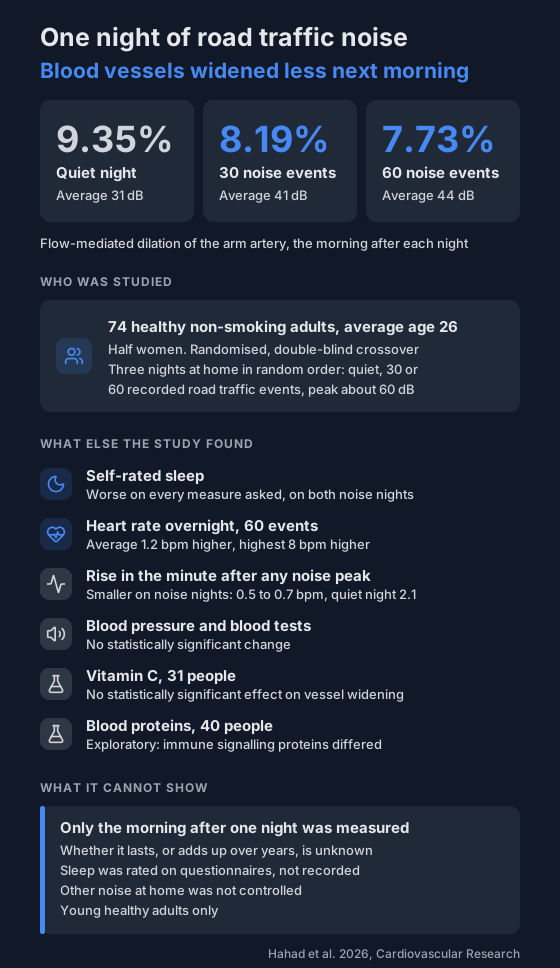
Road traffic is the main source of environmental noise in Europe, and long-term studies link it with heart and circulation problems. Those studies can't say what happens overnight, in the body, on a single noisy night.
This 2026 trial from a university hospital in Mainz, Germany, played recorded road traffic noise to healthy adults while they slept at home. The next morning, an artery in the arm widened less than after a quiet night.
Who was in the trial?
- 74 healthy, non-smoking adults aged 18 to 60. The average age was 26, and half were women.
- People with heart or circulation conditions, sleep disorders, regular medication, night shift work or hearing loss were left out.
- They lived in or near Mainz, and weren't living somewhere noisy at night.
Each person slept three nights at home, in a random order and a week apart (four weeks for women). At the start of each night, neither they nor the staff collecting data knew which night it was.
- Quiet night. No recorded noise. Average sound level in the room 31 dB.
- 30 events. Recorded road traffic noise, each event 75 seconds long, peaking at about 60 dB. Average 41 dB.
- 60 events. The same recording with twice as many events. Average 44 dB.
A sound level meter at head height checked that the sound played all night. They avoided alcohol, caffeine, nicotine and hard exercise for the whole study.
What did it find?
The main measure was flow-mediated dilation (FMD), taken the morning after each night. It's an ultrasound scan of the main artery of the upper arm, and it shows how far the artery widens after a blood pressure cuff is released. It's used in research as a marker of how well blood vessels respond.
- Quiet night: 9.35%.
- 30 events: 8.19%. That's 1.16 percentage points lower than the quiet night, and statistically significant.
- 60 events: 7.73%. That's 1.63 points lower, and statistically significant.
The difference between 30 and 60 events wasn't statistically significant, so the study can't say that more events lowered it further.
What about sleep and heart rate?
- Sleep. People rated their sleep as less restful after both noise nights, on every measure the study asked about, including overall quality, depth and trouble falling asleep. These were questionnaires, not a sleep recording.
- Average heart rate. On the 60-event night it was 1.23 beats a minute higher than the quiet night. The 30-event night wasn't significantly different.
- Highest heart rate. On the 60-event night it was 7.95 beats a minute higher than the quiet night, and 7.38 higher than the 30-event night.
- Morning blood pressure. No statistically significant difference.
The authors also looked at heart rate in the minute after each noise peak in the room. That includes unplanned sounds, not only the recordings. This result ran the other way from what you might expect. Heart rate rose more after those peaks on the quiet nights (average 2.08 beats a minute) than on the noise nights (0.73 with 30 events, 0.46 with 60). A heart rate spike after a noise peak was also more likely on the quiet nights. The authors suggest steady, scheduled events may cause a smaller response than sudden, unexpected ones. They also saw smaller effects on the second and third nights, which they say may mean people got used to the study. This analysis covered only 37 to 44 people per night type.
What did the blood tests show?
Blood taken each morning showed no statistically significant change in adrenaline, interleukin-6, cortisol, glucose, CRP (a marker of inflammation) or neutrophils.
The authors also ran an exploratory protein analysis. They compared the 20 people whose FMD fell most after noise with the 20 whose FMD fell least. The two groups differed in proteins linked to immune signalling. With 40 people and no correction described for the many proteins tested, that's a lead for later studies, not a finding.
Did vitamin C make a difference?
Part of the group took 2 g of vitamin C after the morning measurement, to test whether oxidative stress was involved. 31 people took it and 43 didn't. FMD was measured again two hours later.
There was no statistically significant difference between those who took it and those who didn't. The biggest gap, 1.02 points, was after the 60-event night (P = 0.09). The authors say a similar response after the quiet night may point to a general effect of vitamin C, not one tied to noise. They also say the subgroup was probably too small to tell.
What can't it show?
- One night only. It measured the morning after a single night. It can't say whether the effect lasts, or what years of noise do.
- Healthy young adults. The average age was 26. Older people or people with health conditions weren't studied.
- Sleep wasn't recorded. The sleep results come from questionnaires.
- Background noise. Home recordings picked up other sounds that weren't controlled.
- Not a measure of risk. The study didn't follow anyone for heart problems. The authors link the findings to earlier research on long-term noise, but this trial doesn't show that.
- Reporting. The paper's abstract says noise raised the odds of heart rate spikes after noise peaks (odds ratio 2.42). In the results section and Table 2, that same 2.42 is the odds on quiet nights compared with 60-event nights, and the discussion agrees. This article follows the tables.
- Funding. Public research and foundation funding. The authors report no conflicts of interest.
The average levels were below the 45 dB the WHO considers safe for long-term night-time road noise. The WHO figure is measured outdoors, though, and these were measured indoors.
What can you do with this?
The study didn't test earplugs or other ways of cutting the noise. The authors say evidence on earplugs for the heart and circulation is lacking and inconclusive.
If you wear an overnight pulse oximeter, you can look at your own heart rate on a noisy night against a quiet one. In PulseOxTracker you can add a note to each night about traffic, an open window or neighbours, then compare a few nights. Read how heart rate changed with alcohol or bedroom temperature and air for other things you can compare. On earplugs, see the eye mask and earplugs trial in pregnancy.
Not a medical device. Does not diagnose, treat or prevent any condition. Discuss results and changes with a clinician.
References
- Hahad O, Foos P, Hübner J, Große-Dresselhaus C, Schmidt FP, Ostad MA, Kuntic M, Hobohm L, Keller K, Schmitt VH, Köck T, Wild P, Schmidtmann I, Sørensen M, et al. A randomized, double-blind, crossover study of acute low-level night-time road traffic noise: effects on vascular function, sleep, and proteomic signatures in healthy adults. Cardiovascular Research. 2026;122(5):621-636. doi:10.1093/cvr/cvag028