Partner Sleep and Diet Quality in Couples
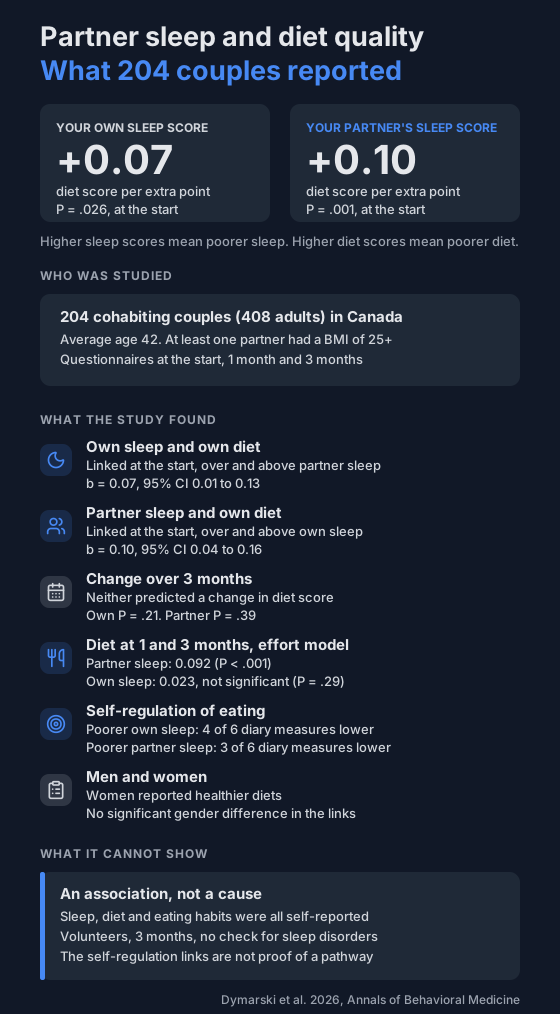
A 2026 study of 204 couples found that a partner's poorer sleep score went with a poorer diet score, over and above your own sleep. It did not predict change over 3 months.
In sleep-loss experiments, people ate more calories, snacked more and chose fattier food. Most of that work looked at one person at a time.
A 2026 study asked a different question: is your diet also linked to how well your partner sleeps?
Who was in the study?
- 204 couples living together in Canada, 408 adults in all. Average age was 42.
- At least one partner had a BMI of 25 or more and was trying to change their diet or physical activity.
- 92% of the couples were heterosexual.
- Couples had lived together for at least a year. The median relationship length was 12 years.
- People with an eating disorder, or who were pregnant, planning a pregnancy or breastfeeding, were left out.
- Volunteers were recruited through social media, radio, newspapers and community groups.
What did they measure?
- Sleep quality with the Pittsburgh Sleep Quality Index, a 19-item questionnaire about the past month. Scores run from 0 to 21, and higher means poorer sleep. The average was 6.85, which the authors say is above the usual cutoff for poor sleep.
- Diet quality with an 8-item questionnaire on how often people ate foods tied to healthier or less healthy patterns. Scores run from 0 to 16, and higher means poorer diet. The average was 6.73.
- Eating self-regulation with a short daily diary for 14 days after the first assessment. It covered six things, such as intending to eat healthily, planning how to eat healthily and feeling confident about it.
Both partners filled in the sleep and diet questionnaires at the start, at 1 month and at 3 months. 87% completed the 1-month round and 89% the 3-month round.
Is your own sleep linked to your diet?
Yes, at the start of the study. Each extra point on a person's own sleep score went with 0.07 more on their diet score (95% CI 0.01 to 0.13, P = .026).
Is your partner's sleep linked to your diet?
Yes, at the start of the study. Each extra point on a partner's sleep score went with 0.10 more on the other person's diet score (95% CI 0.04 to 0.16, P = .001). That is over and above the person's own sleep score.
The partner estimate was a little higher, but the authors did not compare the two directly, so the study does not show that the partner link is bigger.
Did it predict diet changes over 3 months?
No. Neither a person's own sleep score (P = .21) nor their partner's (P = .39) predicted a change in diet score over the 3 months.
Across the whole group, diet scores went down by about 0.37 points over 12 weeks, which means a healthier diet (P = .006). Sleep scores did not change significantly (P = .46). The authors note that nearly everyone (95.8%) was trying to change their diet, which fits that pattern.
What about the self-regulation diary?
Own sleep score was linked to lower action planning, self-efficacy (confidence), self-monitoring and effort. It was not significantly linked to intention (P = .127) or awareness of standards (P = .254).
A partner's sleep score was linked to lower intention, self-efficacy and effort. It was not significantly linked to action planning (P = .265), awareness of standards (P = .294) or self-monitoring (P = .14).
The authors then tested a pathway through the diary, using diet at 1 and 3 months as the outcome. In that model:
- A partner's sleep score was linked to the person's later diet score (0.092, P < .001). The person's own sleep score was not, once effort was in the model (0.023, P = .292).
- Own effort was linked to own later diet score. A partner's effort was not (P = .221).
- Effort accounted for about 54% of the link between a person's own sleep and their own diet, and about 19% of the link from a partner's sleep.
- Confidence (self-efficacy) accounted for about 39% and about 18%.
The authors stress that these are associations consistent with a pathway, not proof of one.
Did it differ for men and women?
Women reported healthier diets and more self-regulation than men. The authors expected a woman's poor sleep to be more strongly linked to her partner's diet than the reverse, but found no statistically significant gender differences in the links.
What can't it tell you?
- Cause. It is an observational study. It shows what went together, not what caused what. It cannot say whether poor sleep led to poorer eating, or the other way round.
- How sleep was measured. Sleep was a self-reported questionnaire. No device recorded it, so this says nothing about overnight oxygen or breathing.
- How diet was measured. Diet was also self-reported, and the questionnaire is short.
- Who took part. They were volunteers, mostly in couples where someone was already trying to change their diet.
- Sleep disorders. The study did not exclude people with a sleep disorder or look at them separately.
- Analysis plan. The wider study was preregistered, but the analyses in this paper were not.
- How long. Three months may be too short to pick up longer-term effects of sleep on diet.
- Why. Partner support and conflict were not measured, so the study could not test them as reasons a partner's sleep might matter.
The authors suggest trials of sleep therapies in one partner to test whether the links are causal. This study did not do that.
What can you do with this?
It is one observational study, so it is a prompt to look, not a rule. If you share a home, how you both slept and how you both ate may be worth noting side by side. A pulse oximeter records overnight oxygen and pulse, not how rested you felt, so a short note each morning can sit next to it.
For how sleep affects a household in other ways, see how partners of CPAP users sleep. If a partner's snoring is the issue, read snoring vs sleep apnea.
Not a medical device. Does not diagnose, treat or prevent any condition. Discuss results and changes with a clinician.
References
- Dymarski M, Cohen TR, Carbonneau N, Dasgupta K, Gouin JP. Dyadic associations between sleep quality, diet-related self-regulation, and diet quality in couples. Annals of Behavioral Medicine. 2026;60(1):kaag041. doi:10.1093/abm/kaag041