Tongue Exercises and Airway Ultrasound
A 2026 controlled study of 57 adults with sleep apnea found that 3 months of app-guided tongue and throat exercises came with a smaller tongue on ultrasound. It was not randomised.
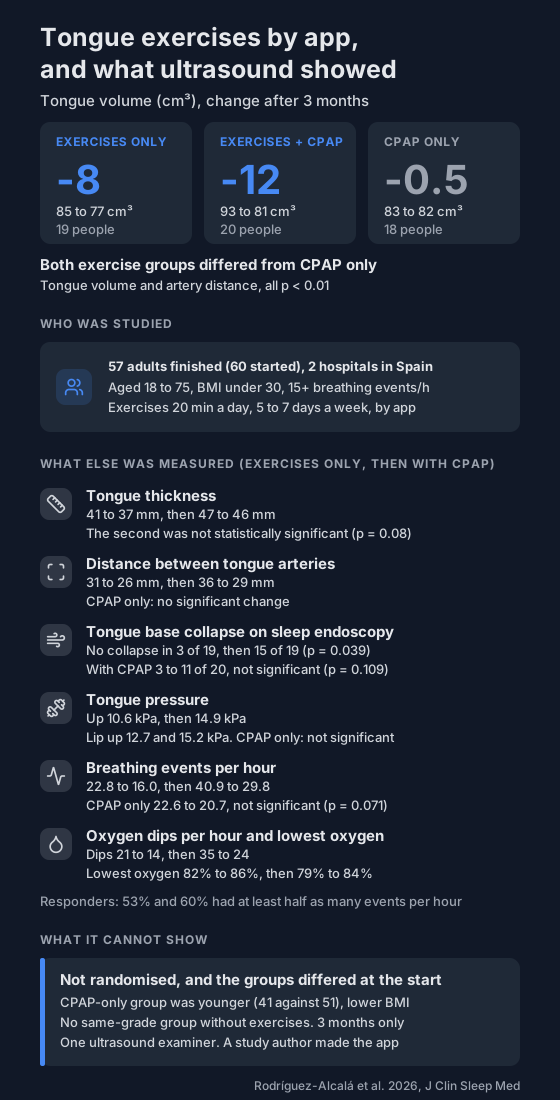
Tongue and throat exercises are often said to firm up the muscles around the airway. Whether they change anything you can actually see has been argued over. A 2026 study from Spain put an ultrasound probe under the chin before and after 3 months of exercises, and also looked at the airway with a camera under sedation. It was a controlled study, but people were not assigned to groups by chance.
Who was studied?
- 60 adults aged 18 to 75 started and 57 finished. They had sleep apnea confirmed on an overnight breathing test (polygraphy), with 15 or more breathing events per hour.
- Everyone had a BMI under 30.
- Three groups:
- 19 people with 15 to 30 events per hour did the exercises only.
- 20 people with more than 30 events per hour did the exercises and kept using CPAP.
- 18 people on CPAP only did no exercises. They were the comparison group.
- The exercises were done through a phone app: 20 minutes a day, 5 to 7 days a week, for 3 months. A therapist checked progress online each week.
- People who did less than 80% of the sessions were left out of the results. Average adherence was 92% and 97% in the two exercise groups.
What did the ultrasound show?
Tongue volume in cubic centimetres (cm³), before and after:
- Exercises only: 85 to 77, down 8 (p = 0.002).
- Exercises plus CPAP: 93 to 81, down 12 (p < 0.001).
- CPAP only: 83 to 82, no statistically significant change.
The distance between the two arteries running through the tongue also got shorter in both exercise groups, by 5 mm and 7 mm. It did not change significantly on CPAP only. Tongue thickness fell 4 mm (41 to 37) in the exercises-only group. In the exercises-plus-CPAP group it fell 1 mm, which was not statistically significant (p = 0.08). For tongue volume and artery distance, both exercise groups differed from the CPAP-only group (all p < 0.01).
What did the sleep endoscopy show?
Sleep endoscopy puts a thin camera into the throat while the person is sedated. The researchers looked at whether the base of the tongue fell back and blocked the airway.
- Exercises only: no collapse in 3 of 19 people before and 15 of 19 after (p = 0.039).
- Exercises plus CPAP: 3 of 20 before and 11 of 20 after. That was not statistically significant (p = 0.109).
- CPAP only: 4 of 18 before and 5 of 18 after (p = 0.20).
What about strength and overnight numbers?
Both exercise groups also gained strength, measured by pressing the tongue and lips against a sensor. Tongue pressure rose 10.6 kPa in the exercises-only group and 14.9 kPa in the other. Lip pressure rose 12.7 and 15.2 kPa.
On the overnight breathing test, the exercise groups had fewer events per hour and fewer oxygen dips:
| Exercises only | Exercises plus CPAP | CPAP only | |
|---|---|---|---|
| Breathing events per hour | 22.8 to 16.0 | 40.9 to 29.8 | 22.6 to 20.7 (not significant) |
| Oxygen dips per hour (ODI) | 21 to 14 | 35 to 24 | 20 to 19 (not significant) |
| Lowest oxygen | 82% to 86% | 79% to 84% | 83% to 82% (not significant) |
At least half as many breathing events per hour was reached by 53% of the exercises-only group and 60% of the exercises-plus-CPAP group. The CPAP groups were tested after at least 48 hours off CPAP. The authors also report that bigger drops in tongue volume went with bigger drops in events per hour, but that was an exploratory check.
What can't it show?
- It wasn't randomised. The authors say that leaves room for selection bias.
- The groups weren't alike. The CPAP-only group was younger (average 41 against 51) and had a lower BMI (23.1 against 27.7 and 29.8). The paper's baseline table marks those age and BMI gaps as not statistically significant (p = 0.15 and 0.78), which is hard to square with the numbers. Tongue size and strength differed significantly at the start.
- The exercise groups were chosen differently. Everyone in them breathed through their mouth by habit. The comparison group didn't have that criterion.
- There was no same-grade group without exercises. The comparison group was on CPAP, so it is only a loose comparison for the exercises-only group.
- Ultrasound is operator dependent. One examiner did every scan, blinded to group. Repeat scans on 10 people agreed closely.
- Tongue fat wasn't measured. The registered plan said "tongue fat", but the paper reports tongue volume instead. The authors say the registry wording was for the public and that ultrasound can't measure fat in the tongue directly.
- It was short and small. 3 months, no follow-up after stopping, and no one with a BMI of 30 or more.
- No correction for multiple comparisons. The authors call it exploratory and say larger randomised trials are needed.
- Possible conflict. One author created the app the exercises were done on. The study had no specific funding.
- The paper has some inconsistencies. The text gives 38.85 events per hour at the start for the exercises-plus-CPAP group, and the table gives 40.9. This article uses the table. The text gives 15% to 80% with no tongue base collapse in the exercises-only group; the table's counts are 3 to 15 of 19 (16% to 79%). This article uses the counts. The results say a CPAP-only participant left with jaw joint problems, while the discussion says a participant stopped the exercises over jaw joint discomfort. A January 2026 correction to the paper fixed a typo in one of its references and changed none of the results.
What can you take from it?
The study suggests that regular supervised tongue and throat exercises can come with a smaller tongue on ultrasound over 3 months. It doesn't show that the smaller tongue is what changed the night, or that the exercises work for everyone.
For a randomised trial of a throat and neck exercise program that found no statistically significant difference, see do throat exercises help sleep apnea?.
If you log your nights, your ODI and lowest oxygen are the numbers to watch. Share them with your doctor before you change anything. Here's how to share them.
Not a medical device. Does not diagnose, treat or prevent any condition. Discuss results and changes with a clinician.
References
- Rodríguez-Alcalá C, Rodríguez-Alcalá L, Ignacio-García JM, Plaza G, Gozal D, Baptista P, O'Connor-Reina C. Telemedicine-delivered myofunctional therapy remodels upper airway anatomy in obstructive sleep apnea: a prospective controlled study. Journal of Clinical Sleep Medicine. 2026;22(1):12. doi:10.1007/s44470-025-00008-0