Acromegaly and Sleep Apnea: A 2026 Study
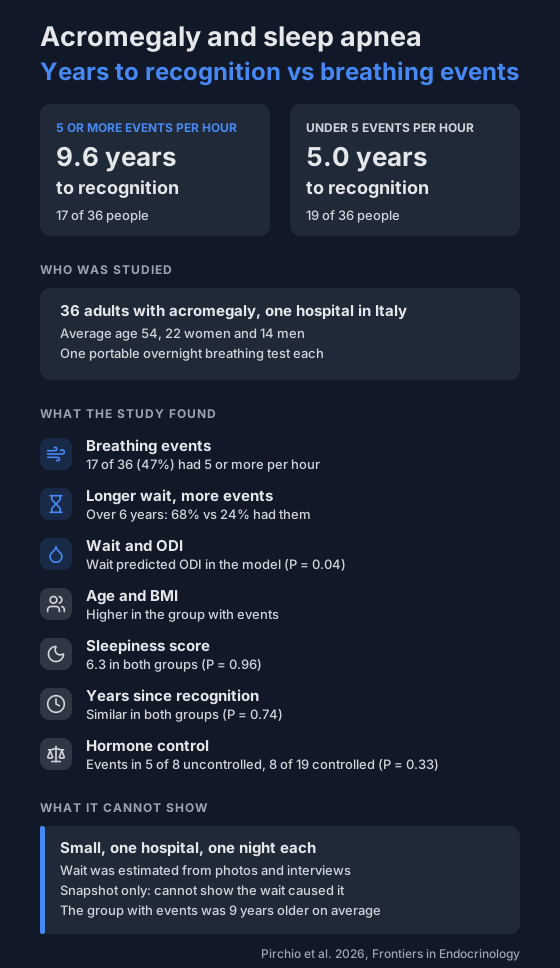
In 36 adults with acromegaly, 17 had 5 or more breathing events per hour on a portable overnight test. Those with events had waited 9.6 years for acromegaly to be recognised, against 5.0 years.
Acromegaly is a rare hormone condition in which the body makes too much growth hormone, usually from a growth on the pituitary gland. It slowly enlarges the hands, face, tongue and soft tissues, and it is often recognised years after it starts. Sleep apnea is common in people with it.
A 2026 cross-sectional study from Naples asked whether the length of that wait for acromegaly to be recognised lines up with overnight breathing events. In 36 people, it did, and in the authors' regression models the wait was the best predictor of breathing events per hour and of ODI.
Who was in the study?
- 36 adults with acromegaly at one university hospital in Italy, tested between November 2023 and May 2025.
- 22 women and 14 men, with an average age of 54.
- 5 had not had any care for acromegaly yet, 21 had had surgery and medication, and 10 had had surgery alone.
- People already known to have sleep apnea were excluded.
- Each person had one overnight test with a portable device that recorded airflow, chest and belly movement, oxygen level, heart rate and body position.
The wait for recognition averaged 7.2 years. The authors estimated it from photographs taken over 10 to 30 years and from asking each person when their hands and face began to change.
What did the overnight tests show?
- 17 of 36 people (47.2%) had 5 or more breathing events per hour, the cut-off the study used for sleep apnea.
- Below, "with events" means 5 or more per hour and "without" means fewer than 5.
- Of those 17, 11 had 5 to 14.9 events per hour, 2 had 15 to 29.9 and 4 had 30 or more.
- 11 of 36 (30.5%) had at least twice as many events per hour on their back as off it, all of them among the 17 with events.
How did the wait line up with the results?
- The 17 with events had waited 9.6 years on average, against 5.0 years for the 19 without (P = 0.003).
- 68.4% of those with a wait of more than 6 years (the median) had events, against 23.5% of those with a shorter wait (P = 0.007).
- That is a relative risk of 2.91 (95% CI 1.17 to 7.22).
- The wait correlated with breathing events per hour (r = 0.395) and with ODI, the number of 3% oxygen dips per hour (r = 0.442).
- In the regression models, the wait was the best predictor of both breathing events per hour and ODI (P = 0.04 for each), independent of BMI.
- BMI and age at the test also correlated with ODI (r = 0.404 and 0.401).
- The wait correlated with a lower overnight oxygen level (r = -0.439), but age at the test was the best predictor of that one.
The group with events was older (59.1 against 49.7 years) and had a higher BMI (30.1 against 26.9). They also had more high blood pressure (82.3% against 47.4%) and more insulin resistance (52.9% against 21%, P = 0.05). Years since recognition were similar in both groups.
What about sleepiness?
The Epworth sleepiness score averaged 6.3 in both groups (P = 0.96). The share with high scores showed no significant difference either (P = 0.44). The authors say their sleepiness checklist did not pick out the people with events. A second checklist, STOP-Bang, scored significantly higher in the group with events, according to the paper's abstract and text (P = 0.001). The paper's Table 2 prints the two averages the other way round, so we leave them out.
What about how well acromegaly was controlled?
The authors grouped people by their IGF-I hormone level. Events were found in 8 of 19 people with fully controlled levels, 4 of 9 with partly controlled and 5 of 8 with uncontrolled levels (P = 0.61).
Comparing uncontrolled with fully controlled:
- The uncontrolled group had more apneas (P = 0.02).
- Their lowest oxygen level averaged 77.5%, against 84.6% (P = 0.02).
- They spent an average of 21.9% of the recording below 90%, against 3.3% (P = 0.03).
- Breathing events per hour (18.6 against 6.7) and ODI (18.4 against 7.0) were higher but not significantly (P = 0.06 and 0.08).
Across all three groups, none of these differences was statistically significant.
The authors conclude that the wait and age, rather than disease control, appear to predict whether events occur and how many. Elsewhere in the paper they suggest control may matter more for how many events people have than for whether they have them. They also suggest that years of unrecognised hormone excess may change the shape of the airway. The study did not measure the airway directly.
What doesn't it tell you?
- Cause. It is a cross-sectional study and everyone was tested once, so it shows what went together, not that the wait caused the events.
- Age. The group with events was about 9 years older, and age is itself linked to breathing events. The paper says the wait's result was independent of BMI, but does not say it was independent of age.
- Size. 36 people at one hospital, with many comparisons and several P values of 0.04 or 0.05.
- The 47%. People already known to have sleep apnea were left out and most had already had care, so it is not a figure for everyone with acromegaly.
- The wait itself. It was estimated from photographs and interviews, which the authors say may be biased.
- No comparison group. People without acromegaly were not tested.
- One night. Each person had a single recording.
What can you do with this?
This study is about people who already have acromegaly. It says nothing about whether you do.
An overnight oximeter records some of the oxygen measures the study looked at, such as ODI and the lowest oxygen level. Home oximetry is not a sleep study, and it does not count breathing events. Read about what ODI means and how it tracks breathing events per hour. If your recordings show repeated dips, you can share them with your doctor.
The sleep apnea risk check takes about a minute. For the classic signs, see snoring vs sleep apnea.
Not a medical device. Does not diagnose, treat or prevent any condition. Discuss results and changes with a clinician.
References
- Pirchio R, Auriemma RS, Sanduzzi Zamparelli S, Bonavolontà P, Merola C, Canora A, Pivonello C, Sanduzzi Zamparelli A, Pivonello R, Colao A. Diagnostic delay length and disease severity are the main predictors of sleep apnea in acromegaly patients. Frontiers in Endocrinology. 2026;17:1928818. doi:10.3389/fendo.2026.1928818