CPAP and Eye Blood Vessels Over 7 Years
Australian researchers photographed the eye's blood vessels in people with sleep apnea for 7 years. Only 39 people came back, and no difference between CPAP users and non-users was statistically significant.
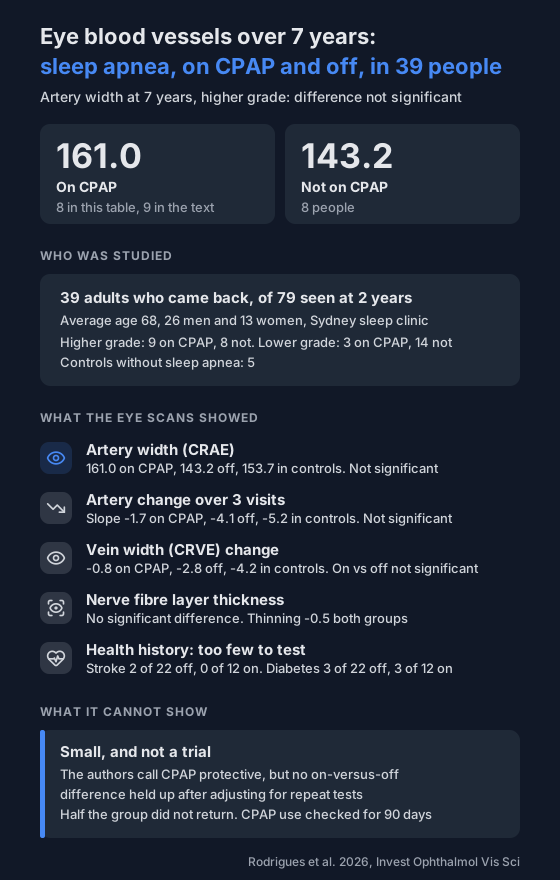
The back of the eye is a place where small blood vessels can be photographed directly. Some researchers use those photos as an indirect look at how the body's vessels are doing.
A team in Sydney has followed the same group of people with sleep apnea since 2015. Their 2026 paper reports the 7-year check, with people sorted by whether they used CPAP.
Who was studied?
- Adults sent for an overnight sleep study at one Sydney hospital in 2015 and 2016. 115 joined, 79 were seen again at 2 years, and 39 came back at 7 years.
- The 39 had an average age of 68. 26 were men and 13 were women.
- Sleep apnea was graded by breathing events per hour on the original sleep study.
- Higher grade (30 or more an hour): 9 used CPAP and 8 did not.
- Lower grade (5 to 29.9 an hour): 3 used CPAP and 14 did not.
- 5 controls had fewer than 5 events an hour.
- "On CPAP" meant at least 4 hours a night on 70% of nights, checked on the machine's memory card for the last 90 days before the visit. Anyone below that counted as not on CPAP.
- Whether CPAP was offered was up to the sleep doctor. It was not assigned by the researchers.
What was measured?
- Photos of the retina gave the width of the arteries (CRAE) and the veins (CRVE), and the ratio between them.
- A scan of the optic nerve gave the thickness of the nerve fibre layer, which thins slowly with age.
- Blood pressure and a history of conditions like stroke were collected at the 7-year visit.
What did they find?
Among people with higher-grade sleep apnea:
- Artery width at 7 years: 161.0 on CPAP and 143.2 not on CPAP.
- Vein width at 7 years: 200.9 on CPAP and 186.9 not on CPAP.
- Change over the three visits (baseline, 2 years, 7 years): the artery width slope was -1.7 on CPAP and -4.1 not on CPAP. For vein width it was -0.8 and -2.8.
Comparing on CPAP with not on CPAP, none of the vessel differences were statistically significant after the authors' adjustment for repeat tests. The artery-to-vein ratio was 0.8 in every group at 7 years. The paper doesn't state the units for these measures. Its text puts 9 people in the higher-grade CPAP group, but its two vessel tables list 8.
The 5 controls lost width too. Their slopes were -5.2 for arteries and -4.2 for veins, the steepest of any group. The Results section reports three sleep apnea groups with a smaller drop in vein width than controls after the adjustment: higher grade on CPAP, higher grade not on CPAP, and lower grade on CPAP. So a smaller drop was not limited to people on CPAP. The paper isn't consistent here. Its Discussion says vein changes in the CPAP groups weren't significantly different from controls, and it names the lower-grade group not on CPAP as declining more slowly than controls.
Overall thinning of the nerve fibre layer didn't differ significantly between the sleep apnea groups, with a slope of -0.5 in both higher-grade groups. It was -1.0 in controls. The higher-grade CPAP group had a thicker layer in the upper outer sector (142.3 against 123.0 µm) but a thinner layer in two other sectors. None of those differences were significant.
What about other health conditions?
- Blood pressure was higher on average in people not on CPAP.
- High blood pressure was reported by 7 of 12 people on CPAP and 15 of 22 not on CPAP.
- The only stroke or mini-stroke cases were in the not-on-CPAP groups: 1 in the higher-grade group and 1 in the lower-grade group.
- High cholesterol was reported by 9 of 12 on CPAP and 12 of 22 not on CPAP.
- Diabetes was reported by 3 of 12 on CPAP and 3 of 22 not on CPAP.
The authors say these numbers were too small for statistical testing.
What do the authors conclude?
They conclude that CPAP can have "long-term protective effects" on these vessels. That's their reading of the trends, not a tested result. They also call the cohort too small for robust statistics, and they describe their results as trends and as data for larger studies. With no significant on-versus-off difference, and controls declining the most, this study doesn't show that CPAP protected the eyes.
What can't this study show?
- Cause. People chose, or were prescribed, CPAP. People who keep using it may differ in other ways, and the authors name this as a possible "healthy adherer" effect. They couldn't adjust for blood pressure, diabetes or other conditions with so few people.
- Size. 39 people, split into five groups. One group had 3 people.
- Dropout. About half of the 79 seen at 2 years didn't return, partly because of the 7-year gap and the pandemic years. Some couldn't be contacted, some declined and some had died.
- CPAP use over time. It was checked for only 90 days. Some people on CPAP may have used it on and off, and some not on CPAP had used it for a few years before.
- Controls. One control reported symptoms of sleep apnea at follow-up. They stayed in the control group because they had no formal confirmation.
- Who measured. The two researchers taking the measurements knew each person's group.
- Funding. The ResMed Foundation funded the study. ResMed makes CPAP machines. The authors declared no conflicts.
What can you do with this?
It's one small set of eye measurements, with no significant difference between people on and off CPAP. If you use CPAP, you can track your overnight oxygen alongside it. For larger studies on CPAP and heart events, see CPAP and heart health. Questions about your own care are for your doctor, and you can share your recordings with them.
Not a medical device. Does not diagnose, treat or prevent any condition. Discuss results and changes with a clinician.
References
- Rodrigues D, Schulz AM, Britton A, Wong B, Tong J, Farah CS, Graham SL, Fraser CL. Impact of Continuous Positive Airway Pressure Treatment on Retinal Vasculature in Obstructive Sleep Apnea: A 7-Year Follow-Up. Investigative Ophthalmology & Visual Science. 2026;67(10):7. doi:10.1167/iovs.67.10.7