Mindfulness App and Sleep: A 10-Day Trial
In a 2026 trial of 81 healthy adults, 10 days of a mindfulness app was followed by a small rise in ring-measured sleep efficiency, a temporary rise in personal burnout scores, and no significant change in overnight heart rate variability.
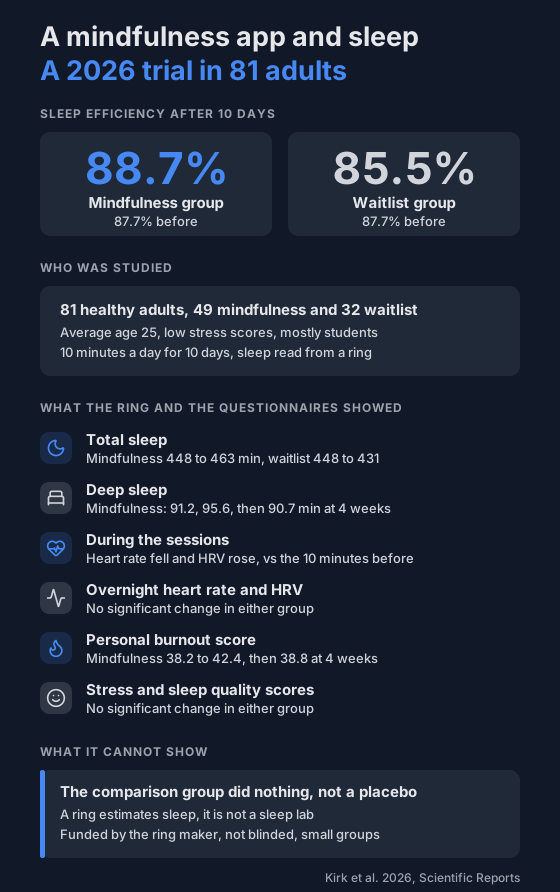
Mindfulness apps are often sold as a way to sleep better. A trial published in March 2026 gave healthy adults a 10-minute mindfulness session a day for 10 days and tracked their sleep with a smart ring.
Sleep efficiency was a little higher afterwards, but the comparison group's figure also dipped. Heart rate variability rose during the sessions only, not overnight. Personal burnout scores went up before they came back down.
Who was in the study?
- 81 healthy adults in Denmark, recruited through a university and local adverts: 49 in the mindfulness group and 32 on a waitlist.
- Average age about 25, and 62 of the 81 were students.
- Low scores on a perceived stress scale, no self-reported heart disease, anxiety, depression or medication, and no regular mindfulness practice.
- The mindfulness group did a 10-minute "destress" session from Headspace inside the Oura app, once a day for 10 days.
- The waitlist group did nothing and got access to the content afterwards.
- Both groups wore an Oura ring (Gen 3) for the whole study.
The mindfulness group completed 7.6 of the 10 sessions on average.
How was sleep measured?
With the ring, not in a sleep lab. It uses a light sensor on the finger for pulse and heart rate variability, plus body temperature and movement, and estimates when you're asleep and which stage you're in. The authors point out that stage estimates are less accurate than a sleep lab study. For more on that, see how accurate smart rings are for sleep.
Each result is an average of the 7 nights before the program, the 7 nights after it, and the last 7 nights of a 4-week follow-up. Stress, sleep quality and burnout came from questionnaires.
What did they find?
Sleep efficiency is the share of time in bed spent asleep.
- Mindfulness group: 87.7% before, 88.7% after, 89.1% at 4 weeks.
- Waitlist group: 87.7% before, 85.5% after, 87.8% at 4 weeks.
- The mindfulness group went up 1 point and the waitlist group went down 2.2 points, so most of the gap after 10 days came from the waitlist dip.
- The paper reports the mindfulness group's rise as statistically significant and the waitlist group's change as not significant.
Total sleep went from 448 to 463 minutes in the mindfulness group and from 448 to 431 in the waitlist group. At 4 weeks it was 457 and 445.
Deep sleep in the mindfulness group went from 91.2 to 95.6 minutes, then back to 90.7 at 4 weeks. Light sleep in that group rose from 252.7 to 263.8 minutes and stayed there. REM sleep and the percentage of the night in each stage showed no significant group difference.
Sleep onset time also showed a group difference, but the paper doesn't say how it is defined. Time to fall asleep (sleep latency) did not.
What about heart rate variability?
- During the 10-minute sessions, heart rate was lower and heart rate variability was higher than in the 10 minutes before each session.
- That comparison was within the mindfulness group, not against the waitlist group.
- Overnight heart rate, heart rate variability and breathing rate did not change significantly in either group.
The paper's title reports a heart rate variability gain. That rise was during the sessions only, not at night.
And the burnout scores?
On the personal burnout scale, the mindfulness group went from 38.2 to 42.4 straight after the 10 days, then 38.8 at 4 weeks, which the authors call a non-significant trend back toward the starting level. The waitlist group went from 38.3 to 32.5, then 35.9. The authors say the rise may reflect people noticing tiredness they hadn't paid attention to, or that 10 days isn't enough, and that it needs more study.
Perceived stress, overall sleep quality (PSQI) and the work burnout scale showed no significant group difference. Both groups started with a PSQI of about 9. Mindfulness scores were measured only in the mindfulness group and rose from 3.8 to 4.1.
What doesn't it tell you?
- That mindfulness caused the change. The comparison group did nothing, so the study can't separate mindfulness from the effect of doing a calming activity or expecting to sleep better. The authors list this as a main limitation.
- How big the effect is. The sleep efficiency difference is small, and the groups were small and unequal. Ten people in the waitlist group were excluded for not wearing the ring enough, and none in the mindfulness group were.
- Anything about people with sleep problems. These were healthy, low-stress adults, mostly students.
- Anything beyond 4 weeks.
- Clean numbers. The authors did not control for alcohol use and did not blind the researchers. Some figures in the table don't line up, such as time in bed and total sleep not giving the stated efficiency.
- Independence from the ring maker. The study was funded by Oura Health Oy, which supplied the rings, and participants kept the ring if they finished. The authors declared no competing interests.
What can you do with this?
Sleep efficiency and total sleep move from night to night. That's why the trial averaged 7 nights at each point, and why a single night tells you little.
If you want to see how an evening routine affects your own nights, log it and compare a week against a week. You can do that with the session viewer and your own overnight recordings. Heart rate and oxygen data from a fingertip oximeter are one view of the night, not a sleep study.
Not a medical device. Does not diagnose, treat or prevent any condition. Discuss results and changes with a clinician.
References
- Kirk U, Hovgaard CN, Persiani MTL, Romagnoli M, Staiano W. A digital mindfulness intervention improves sleep efficiency and heart rate variability in healthy adults. Scientific Reports. 2026;16(1):14348. doi:10.1038/s41598-026-44902-w