Melatonin and Children's Sleep: A Lab Study
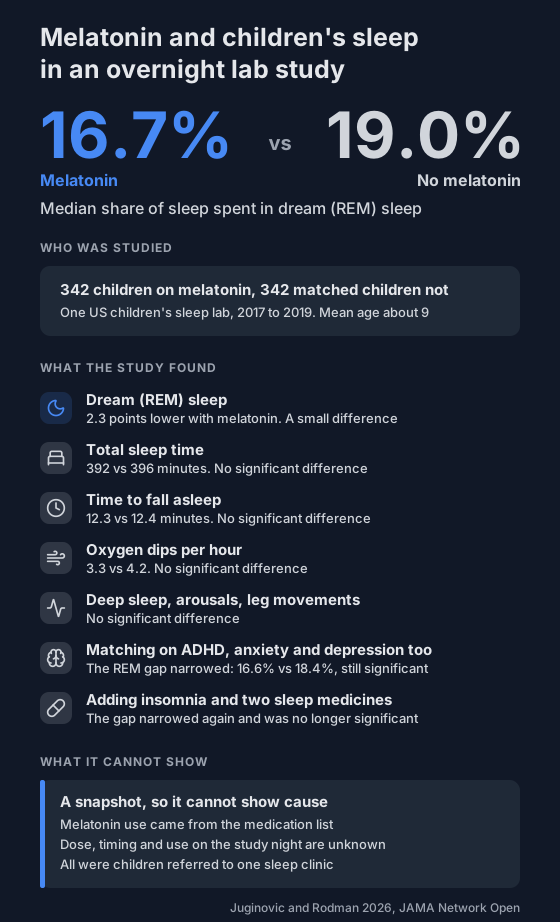
A 2026 study compared overnight sleep lab results from 342 children on melatonin and 342 matched children who weren't. REM sleep was a little lower, and oxygen dips showed no significant difference.
Melatonin is the most widely used sleep aid for children. Most earlier trials relied on movement trackers or parents' reports, which can't see sleep stages.
A study in JAMA Network Open in August 2026 used overnight sleep lab recordings instead. Children on melatonin had a little less REM sleep, and no other measure showed a statistically significant difference.
Who was studied?
- 3,392 children aged 18 or under with an overnight sleep study at Nationwide Children's Hospital, Ohio, from 2017 to 2019.
- 346 had melatonin on their outpatient medication list.
- 342 of them were each paired with a child not on melatonin, similar in age, sex, BMI percentile, number of health conditions on record, sleep apnea and epilepsy.
- That left 684 children, mean age about 9.
What did the sleep lab show?
REM (dream) sleep was the main outcome.
- With melatonin: a median of 16.7% of sleep.
- Without: 19.0%.
The authors call the 2.3 point gap a small effect, within night-to-night variation, and say its meaning is uncertain.
The other 14 measures showed no statistically significant difference after correcting for multiple comparisons:
- Total sleep time: 392 against 396 minutes.
- Time to fall asleep: 12.3 against 12.4 minutes.
- Oxygen dips per hour (ODI): 3.3 against 4.2.
- Deep sleep, breathing events, arousals and leg movements.
Did the REM gap hold up?
Partly.
- It held when each child on melatonin was matched with two or three others, and when repeat nights were averaged.
- Children on melatonin had more ADHD, anxiety and depression on record, even after pairing. Matching on those too narrowed the gap to 16.6% against 18.4%, still statistically significant.
- Adding insomnia and two types of sleep medicine narrowed it again, and it was no longer statistically significant.
What can't it tell you?
- Cause. It's a cross-sectional study. The authors say children with less REM sleep may be the ones more likely to be given melatonin.
- Whether melatonin was taken. It was on a medication list at some point. Dose, timing and use on the study night are unknown.
- Shop-bought melatonin. The comparison group may have used it without a record.
- Every child. These were children referred to one sleep clinic, and about two thirds had sleep apnea on record.
- A usual night. Each child had one night in a lab.
What can you do with this?
A home oximeter doesn't record sleep stages, so it can't show REM sleep. It logs overnight oxygen and pulse; here's what counts as a dip.
Questions about melatonin for your child are for their doctor.
Not a medical device. Does not diagnose, treat or prevent any condition. Discuss results and changes with a clinician.
References
- Juginovic A, Rodman L. Melatonin Use and Polysomnographic Sleep Architecture in Children. JAMA Network Open. 2026;9(8):e2626983. doi:10.1001/jamanetworkopen.2026.26983